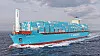
Rotor sails claimed to deliver fuel and emissions savings of 21%
Shipping giant Maersk is testing a modern rotor sail from British firm Anemoi Marine Technologies in an effort to cut fuel consumption and greenhouse gas emissions.
Anemoi says Maersk will fit one of its rotor sail systems to an 8,700 TEU Lima-class container ship. TEU, or twenty-foot equivalent unit, is the standard measure of container-carrying capacity.
That makes the Lima-class vessels relative tiddlers in the container-shipping world. Rival MSC's Irina-class ships measure 400 m (1,312 feet) long and can carry 24,346 TEU.
Under the agreement, Anemoi will design and manufacture a rotor sail measuring 5 m (16 feet) in diameter and 35 m (115 feet) high. Promotional images identify the vessel as the Maersk Labrea.
Anemoi will provide the engineering and installation support needed to integrate the sail with the ship's existing systems. Installation is scheduled for mid-2027, after which it will be tested during regular voyages across the North and South Atlantic.
Rotor sails, also known as Flettner rotors, differ radically in appearance and operation from traditional sails. They use the Magnus effect, in which a spinning body moving through an airstream generates lift.
The rotor's surface moves with the airflow on one side and against it on the other, creating a pressure difference and a force perpendicular to the apparent wind. When that force has a component in the ship's direction of travel, it provides additional thrust and reduces the load on the engines.
Anemoi claims that a ship equipped with three of its rotor sails achieved average net fuel and emissions savings of 9.1 percent during a year-long assessment, rising to 21 percent on some voyages.
"We're delighted to be working with Maersk on this pioneering project. It's a strong example of how collaboration can support the adoption of wind-assisted propulsion, and we look forward to carrying out the installation and working together as the project progresses," said CEO Clare Urmston.
Maersk head of fleet technology Ole Graa Jakobsen commented: "Wind-assisted propulsion is one of several promising maritime solutions with the potential to improve vessel efficiency and reduce emissions. It has already been tested in other parts of the shipping sector, and we see this pilot with Anemoi as a valuable opportunity to build practical experience and assess its relevance for our fleet and for container shipping more broadly."
The trial comes as the International Maritime Organization (IMO) pushes the shipping industry to reduce total annual greenhouse gas emissions by at least 20 percent from 2008 levels by 2030 and at least 70 percent by 2040, before reaching net zero by or around 2050. ®