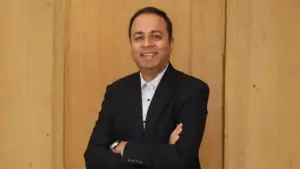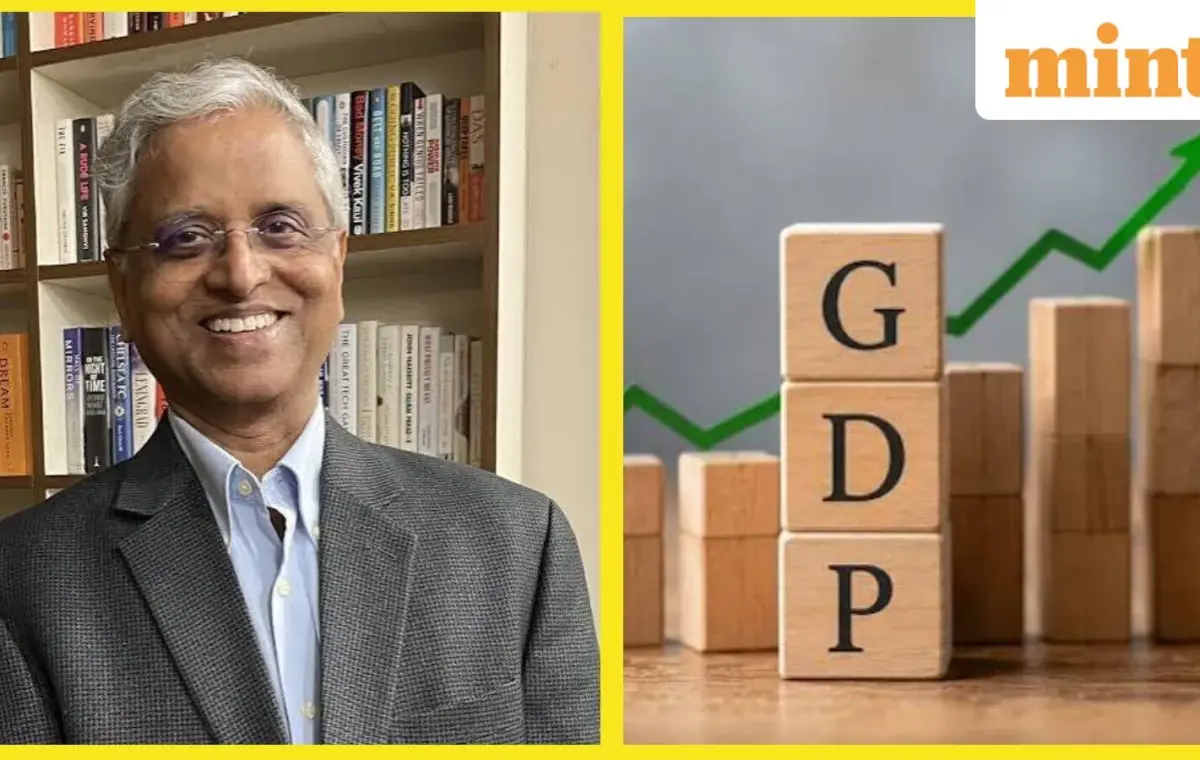
Former Finance and Economic Affairs Secretary Subhash Chandra Garg is in the spotlight for his critical remarks on latest Gross Domestic Product (GDP) numbers.
India's economy grew 7.8 per cent in real terms in the first quarter of fiscal 2026-27, according to the revised GDP series. But Garg said that the country’s 7.8 per cent growth April-June quarter needs a closer scrutiny because the base used to calculate the growth has changed.
Let's take a closer look at who is Subhash Chandra Garg.
Born in Jaipur in 1960, Subhash Chandra Garg is a 1983-batch retired Indian Administrative Service (IAS) officer from the Rajasthan cadre. Garg served as Finance Secretary in 2019 after serving as Secretary of the Department of Economic Affairs (DEA).
In July 2019, Garg took voluntary retirement from service, a day after he was moved to the Power Ministry in a broader reshuffle just three weeks after the presentation of the Union Budget. Garg's scheduled retirement was in October 2020.
Since his retirement, Garg has written and spoken extensively on India’s economy, fiscal policy and public finance. He is best known for his book The Ten Trillion Dream Dented: The State of the Indian Economy and Reforms in Modi 2.0 (2019-2024), in which he discusses India’s economic growth ambitions and policy challenges.
This book based on Garg's data-driven analysis of India’s economic path presents a comprehensive and critical analysis of the performance of the Indian economy under the Prime Minister Narendra Modi government from 2019 to 2024. It critically examines the policy measures taken by the government and identifies the reasons why India can’t become a $10 trillion economy by 2035.
Garg was Executive Director in the World Bank Group for Bangladesh, Bhutan, India and Sri Lanka from November, 2014 to July, 2017. He also served on the Board of Directors for the International Bank for Reconstruction & Development (IBRD), the International Development Association (IDA), collectively referred as the World Bank, the International Finance Corporation (IFC) and the Multilateral Investment Guarantee Agency (MIGA).
Garg has over three decads of experience in administration, management and public policy, in finance and several development sectors – agriculture, education, energy and rural development.
Garg has managed government finances both at the Centre and in the State of Rajasthan. In Government of India, he worked as Director in the Department of Economic Affairs (DEA) and Joint Secretary in the Department of Expenditure (DoE), in the Ministry of Finance and in the Rajasthan in various capacities as Secretary (Expenditure), Secretary (Budget) and Principal Secretary of Finance. He has also been Joint Secretary (Agriculture) and Additional Secretary (Cabinet).
Garg, in an interview with NDTV, suggested that GDP growth would have been just about 2.6 per cent in current prices if last year's GDP had not been revised down from roughly ₹86 lakh crore to ₹80 lakh crore.
He also said that truth cannot be hidden, and the system that records what happens every month and every quarter has been in place for years.
Garg pointed out that real GDP data for the first quarter of the previous year was released under the old series rather than the new one. He said the figure being used as the base for Q1 of 2025-26, however, comes from the new series.
“I think this is a serious question which we should really examine. The growth 7.8 per cent in this quarter on the face of it looks very good,” Garg said.
Basically, Garg tried to highlight that Ministry of Statistics and Programme Implementation (MoSPI), which released the fresh data, retrospectively lowered Q1 FY2025-26 nominal GDP from about ₹86.05 trillion to ₹80.00 trillion, a reduction of roughly ₹6.05 trillion, with much of the production-side revision concentrated in services.