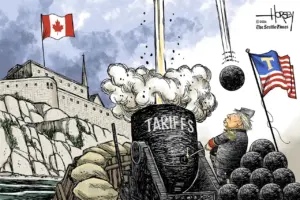
At the approach of midnight, on August 21, 2026, Canada walked out on talks with the United States to avert new tariffs due to kick in on some $20 billion (US) worth of US imports from Canada. These tariffs were nominally in retaliation for Canada’s retaliation on US retaliation against alleged unfair trade practices.
We put ‘u’ in neighbour and you in Canada’s conversation. Enjoy a roundup of Canada’s best writing. Sign up for The Walrus newsletter and get trusted Canadian journalism straight in your inbox.
However, the timing of the US tariff action says something beyond the specifics of the alleged grievances (or extortion) demands: the tariff talks with Canada were timed to conclude just before sweeping tariffs on US imports from around the world enter into force. This move has been interpreted as an attempt to pressure Canada—the most trade-exposed country to the US—to bend the knee and to set an example for others that resistance is futile.
By walking out, Canada set a different kind of example. Washington was effectively asking Canada to sign up for collective war on the global economy—to match US tariff levels on key products against all trading partners outside North America.
Canada refused. The rest of the world should follow suit.
Canada has been at trade war for some time, and we have had a lot of time to work out the optimal response. This strategy is rolled up in what might be called “The Carney Doctrine,” which may be summarized as doubling down on open trade and expanding Canada’s international partnerships, falling back on Canada’s own resources to develop domestic capabilities, and managing the US relationship from a position of strength without bending the knee.
This amounts to doing what is best for Canada. And that is, thankfully, straightforward—but none of it entails going to “trade war.” In trade, every piece of trade policy ordnance deployed against the opponent (actually, in this case, against the trade partner—think about that because the Donald Trump administration obviously hasn’t) has an equivalent damaging effect on the country deploying the measure.
That means that Canada should be prepared to sell to the US what it wants to buy from us—US tariffs on our products or no US tariffs. There is no point to imposing export taxes to harm the US economy. Canada does not do better if the US does worse (memo to the Trump administration: the US does not do better if Canada does worse, notwithstanding what certain influential thinkers in the administration seem to think—if the US agrees with them, it hasn’t done the trade math).
Canada should also continue to buy from the US what we want to buy, without penalizing ourselves with retaliatory tariffs—self-inflicted blow for self-inflicted blow. We are now beyond the point where our actions should be predicated on bringing about change in the United States—to get it to revert to the bargain that was struck before the tariff chaos. Canada lacks the leverage to bring about change in the political economy of an entity ten times our size. And it is not our responsibility to “take one for the team” by imposing punitive tariffs that would cause more pain in Canada than in the US in the now obviously vain hope that it would bring the US administration to senses that it obviously lacks.
But it also means declining to buy what Canadians don’t want to buy or what we shouldn’t buy in the interests of ensuring that vulnerable industries are not brought down by a sucker punch—in some cases, responsive trade protection is in order. So, there is a bit of burden sharing by Canadians in solidarity with our most exposed industries and the Canadians who work in them.
However, this approach should not be conceived as “retaliation.” Trade war is not actually war, and the correct response is asymmetric—it means increasing trade, not decreasing it—just with other partners who actually want to trade. Talk of “retaliation” may be essential rhetoric when a country is attacked, but any trade protection deployed should be surgically aimed at attenuating any harm inflicted by US tariffs.
Imposing Section 338 of the Tariff Act of 1930 in the current trade dispute is Smoot-Hawley redux. The Smoot-Hawley tariff is infamous as one of the contributors to turning a stock market crisis into a decade-long depression. It violates the Canada–United States–Mexico Agreement (CUSMA). Canada should go through the legal motions and challenge the measures under CUSMA mechanisms and under the World Trade Organization agreement.
Why? Because our interest is in preserving the rule of law in trade. We do this with no hope of practical outcomes in the short term but in full confidence of the correctness of our actions. It is also a direct repudiation of US trade representative Jamieson Greer’s characterization of Canada’s response to illegal US tariffs as putting us in some pariah-state category. The reverse, however, is true.
Gluttony is its own punishment, and the same is true of trade protection. The debilitating side effects of gorging on protection are on full display in the US: worsening of the affordability problem; increasing inflation, which is compromising the conduct of monetary policy; and the loss of export markets through the natural consequence of diverting US production to inefficiently satisfy its own needs in areas where other countries have comparative advantage.
The US will have to go on a trade-protection diet in due course. But markets (and states) can stay irrational longer than we can stay solvent (as the saying goes), so Canada must fall back on its own resources.