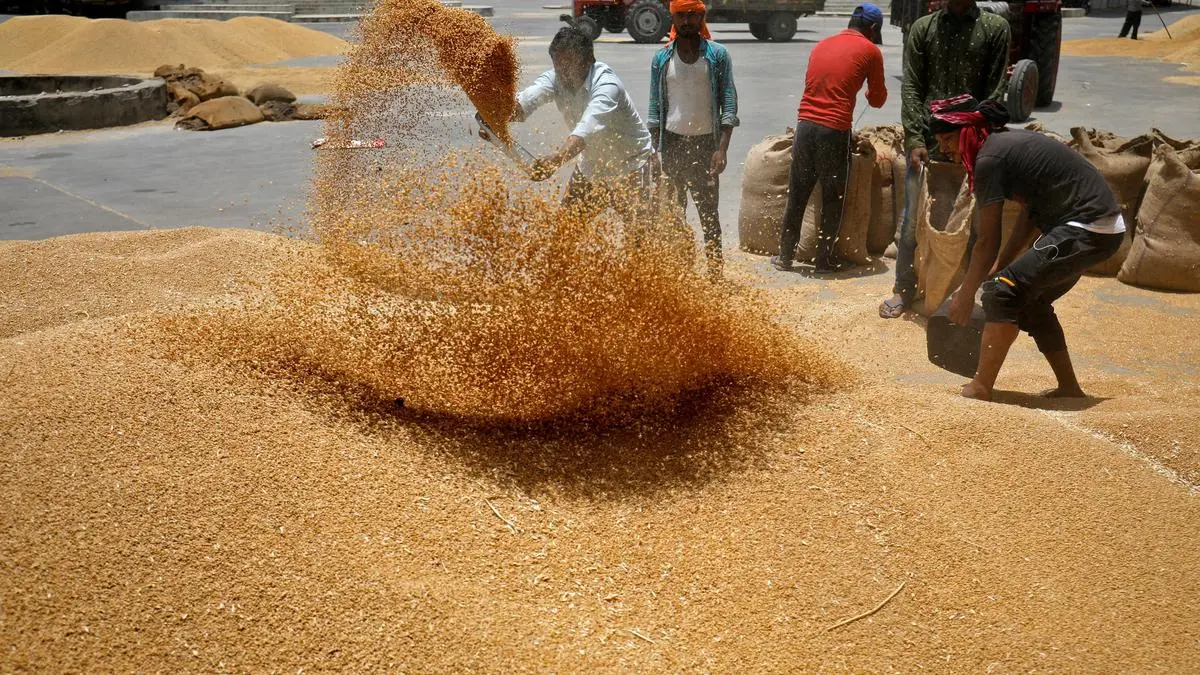
Indian wheat prices have increased by over ₹150 a quintal after the government lifted its 4-year ban on exports of wheat and its products such as flour, maida and semolina on August 24.
With global wheat prices ruling near a 3-year high, a section of the industry is concerned over the development. This is particularly in view of fears that the drought-bearing El Nino weather will likely affect the upcoming crop, which is sown during rabi. Global agencies have forecast the El Nino lasting until March 2027.
However, another section of the trade says there is nothing to worry as Indian wheat is still not competitive in the global market.
“It is at least $30 a tonne f.o.b (free-onboard) higher than wheat from other origins,” said New Delhi-based exporter Rajesh Jain Paharia.
The rise in domestic wheat prices at the agricultural terminal markets (agricultural produce marketing committee yards) has not reflected in retail outlets, but industry stakeholders say it will happen soon.
According to the Price Monitoring Division of the Department of Consumer Affairs, the all-India average retail wheat price is ₹31.58 a kg, with ₹55 being the maximum and ₹22 the minimum.
On the other hand, prices at Uttar Pradesh agri terminal markets such as Lucknow have increased from ₹2,466 to ₹2,640 a quintal since August 17. In Hardoi, a key growing centre in Uttar Pradesh, the price of the Dara variety has gone up from ₹2,408.21 a quintal (modal or the price at which most trades took place) on August 17 to ₹2,553.31 on Tuesday (September 1).
“The crop is down 7-8 per cent compared with last year. The Centre has procured 36 million tonnes. Maize prices are also rising. With El Nino hanging as a sword over the head, why did the government allow exports? This can create a problem,” said a miller, who did not wish to be identified.
According to the Ministry of Agriculture and Farmers’ Welfare, wheat production this year is estimated at a record 120.66 million tonnes (mt) compared with 117.95 mt a year ago. Wheat stocks, as of August 1, are at a 5-year high of 50.53 mt, data from the Food Corporation of India showed.
“F.o.b prices of wheat at Kandla are $325 a tonne. This is far higher than $295 or less from other countries. Prices have increased on export hopes, but chances of a good volume of shipments are remote,” said Jain.
At most, India could export to Nepal, Bhutan and northern Bangladesh via railway rakes. “Bangladesh has an agreement to buy US wheat. So, only a limited quantity will go to northern Bangladesh,” said the New Delhi-based exporter.
In the global market, wheat prices on the Chicago Board of Trade (CBOT) were quoted at $7.54 a bushel on Wednesday ($277/tonne). The cereal’s prices have surged on renewed attacks in the Black Sea region, affecting exports from Russia. In addition, concerns over lower production due to weather-related problems have also lifted prices to near the highest seen in February 2023.
The other problem is that corn prices, too, have surged to a 3-year high at $5.15 a bushel ($202/tonne) on fears that the US crop may be lower.
The International Grains Council has projected global wheat production in 2026-27 (September-August) at 817 mt against 844 mt this season. Consumption is set to rise by another 3 mt to 826 mt and carryover stocks are estimated 10 mt lower at 275 mt.
Reports from Australia said wheat production is seen sinking 17 per cent to 29.9 million tonnes in 2026–27, while analysts see Black Sea export disruption as a large supportive factor.
Source: Read the original article on www.thehindubusinessline.com