When you buy through links on our articles, Future and its syndication partners may earn a commission.
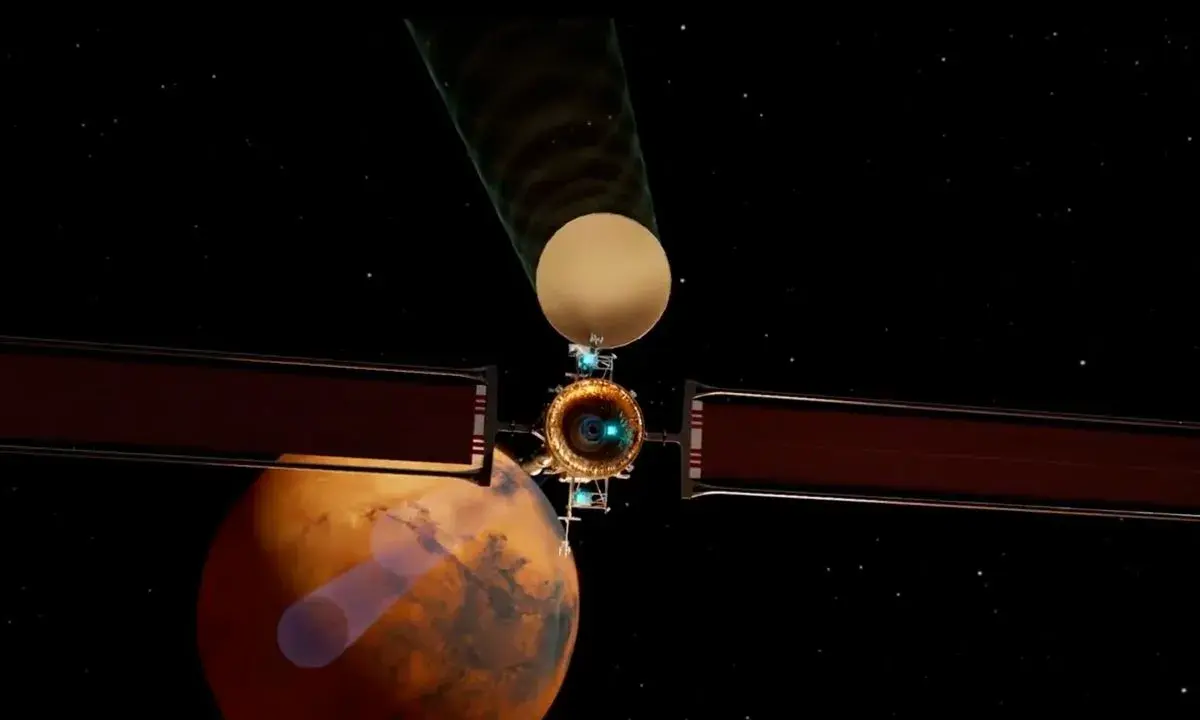
Blue Origin will build NASA's next Mars orbiter.
The agency announced on Tuesday (Sept. 1) that it has selected Jeff Bezos' spaceflight company to develop the $700 million Mars Telecommunications Network (MTN), which is expected to be up and running at the Red Planet by 2030.
"The award marks a milestone in NASA's strategy to expand communications and navigation services beyond Earth and the moon, establishing the foundation for sustained exploration of Mars in the coming decades," NASA officials said in a statement on Tuesday.
As its name suggests, the MTN — previously known as the Mars Telecommunications Orbiter — will primarily serve to aid NASA science missions rather than gather data of its own.
The MTN is "a next-generation communications system that will enable reliable, high-bandwidth communications and navigation services for current and future Mars missions," NASA officials said in the statement.
The need for such a data-relay craft is expected to become acute in the coming years as NASA's fleet of current Mars orbiters ages and the agency works to prepare the Red Planet ground for crewed missions in the late 2030s or early 2040s.
At the moment, just two NASA orbiters relay data and commands between the agency's Curiosity and Perseverance Mars rovers and their handlers on Earth — Mars Odyssey and the Mars Reconnaissance Orbiter, which launched in 2001 and 2005, respectively. The European Space Agency's Mars Express and Trace Gas Orbiter spacecraft help out as well.
All four of these orbiters are gathering science data of their own, however. The MTN will not have a split focus; it will be a dedicated communications craft.
NASA got $700 million for a Mars telecom orbiter in July 2025, when Congress passed a budget reconciliation bill. The agency laid out requirements for the spacecraft in February of this year, then issued a request for proposals in May.
Blue Origin and Rocket Lab were viewed as the front-runners for the contract, and both pushed hard for it, touting their bona fides and expertise.
Blue Origin won out in the end, however. The company will base MTN on its Blue Ring spacecraft platform, which it describes as "an all-in-one, high-powered hybrid solar electric and chemical propelled spacecraft that provides unmatched mission maneuverability, versatility, and capacity at dramatically lower profile costs."
Blue Ring has not flown a mission yet, but a prototype version of it went to space on the first-ever launch of Blue Origin's powerful New Glenn rocket in January 2025. Though Blue Ring can fly on other rockets as well, MTN will presumably launch on a New Glenn; the newly announced NASA contract calls for Blue Origin to "design, develop, integrate, launch and operate" the Mars telecom mission.
The contract calls for Blue Origin to deliver the spacecraft to NASA no later than Dec. 31, 2028.