Find this story in your account’s ‘Saved for Later’ section.
Vulture’s critics are tracking the highlights of this year in film, from blockbuster adaptations to low-budget originals and everything in between. Check back each month for the latest additions, which are noted with an arrow. Movies are organized chronologically by their U.S. theatrical-premiere date with the most recent at the top.
David Kittredge’s documentary about the making of John Boorman’s disastrous 1977 Exorcist sequel, The Heretic, is hugely entertaining, energetic, and insightful. I’m in the movie as one of the many talking heads, so I can’t really review it, but I can definitely recommend it — not the least because of the great director at its center. Boorman mastered many genres over the course of his career, but Exorcist II: The Heretic nearly destroyed him, both figuratively and literally. Not a fan of William Friedkin’s original, Boorman had taken the sequel partly as an opportunity to present a competing vision of the world — a “riposte,” in his words — one that wasn’t so bleak and exploitative and heartless. It was an attempt to make an honest genre film. That he failed so spectacularly makes the effort that much more poignant. Part of the beauty of Kittredge’s film is that it restores the dignity and nobility of Boorman’s ambition without trying to whitewash the messy results. —Bilge Ebiri
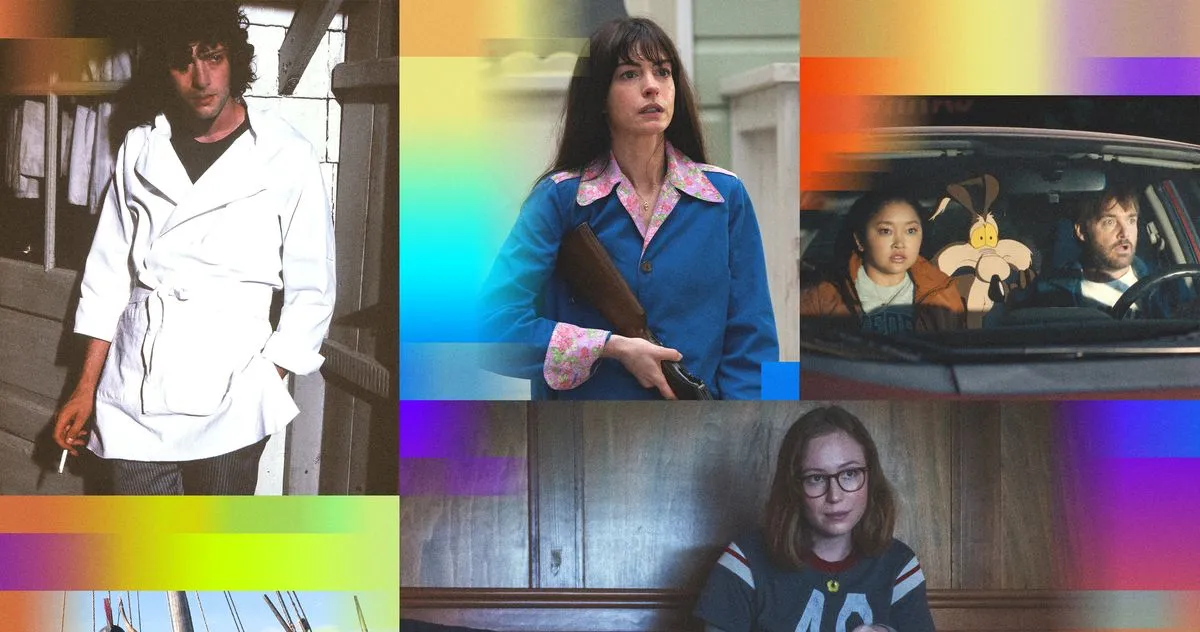
The movie Warner Bros. tried to kill lives, and it is wonderful. Coyote vs. Acme is an exuberant celebration of expressively animated Looney Tunes characters, a gag-a-second comedy, and an unexpectedly impassioned defense of the underserved at a time when those with deep pockets seem infallible and unapologetic. Coyote vs. Acme follows Wile E. Coyote as he finally decides he’s fed up with the myriad dangerous Acme products that have failed him in his quest to catch the Road Runner. (A long sequence tracking the catastrophic impact of Acme’s failed rocket skates on Wile E.’s health sets the energetically chaotic tone.) After lawyer Kevin Avery (Will Forte) begrudgingly takes Wile E.’s case, he stumbles upon a wide-scale conspiracy in which cartoons are treated as second-class citizens by the very company that claims to cater to them. Director Dave Green and writer Samy Burch skillfully blend the beautiful vulnerability of Kevin and Wile E. realizing they aren’t as lonely as they thought with the drama of a whistleblower subplot. Erin Brockovich would be proud. —Roxana Hadadi
Who says they don’t make them like they used to? Alicia MacDonald’s exuberant rom-com feels like it could easily sit beside such youthful classics of the genre as Get Over It, Ten Things I Hate About You, and maybe even Party Girl. One night in Manchester, young working-class sound engineer Owen (Spike Fearn) meets a girl at the club who tells him her name is Emily and proceeds to give him her phone number with one digit missing. The naïvely romantic Owen goes about trying to find her at the local college, but the first Emily he finds turns out to be someone else entirely, an American psychology student (Angourie Rice) looking to prove her thesis that romantic attachment leads to madness. She secretly decides to turn him into her case study, egging him on in his increasingly desperate attempts to locate his dream girl. You get one guess as to what happens next. Yes, it’s predictable, and yes, it’s hokey, but it’s also done with such colorful verve, and the leads are so charming, that it seems destined to become a comfort-watch cult classic in the years to come. —BE
Rafael Manuel’s Filipiñana asks for the viewer’s attention and patience — not because it is slow or oblique but because it’s built entirely out of details. It’s the kind of movie in which the angle of a golf club can evoke suspense, a piece of fruit on the ground can feel like a tragedy, and a casual glance can take your breath away. It takes place during one idle day at an elegant golf course outside Manila, all rolling lawns and tidily trimmed trees, far from the crowded, chaotic streets of the city, where citizens line up to fill their water jugs in the unbearable heat. Amid these deceptively lovely expanses of green, we find Isabel (Jorrybell Agoto), a 17-year-old “tee girl” at the driving range, who occasionally strays from the regimented, ruthless nature of her job. As Isabel wanders the club, she passes through different spaces, each subtly revealing another layer of exploitation and cruelty. What comes through most vividly is the sense of forced placidity, the assembly-line-like control over life and activity this country club comes to represent. The more beautiful it all is, the more terrifying it becomes. —BE
Early in American Doctor, Dr. Mark Perlmutter argues with director Poh Si Teng, who quit her job at ABC News after an Israeli drone attack killed her colleague Samer Abu Daqqa. Perlmutter is showing her a picture he took in Gaza of a table stacked with corpses of Palestinian children, and when Teng says she’s “gonna end up blurring it,” he loses it. “You’re not doing them a service by not showing them. This is what my tax dollars did,” Perlmutter says, and American Doctor strums along with the frustration of that moment, of how difficult it is to have conversations about Palestinian lives and dignity, even with people who mean well. Teng’s film follows Perlmutter (Jewish), Dr. Thaer Ahmad (Palestinian and Muslim), and Dr. Feroze Sidhwa (Zoroastrian) throughout 2025; while Perlmutter and Sidhwa volunteer at a Gaza hospital that’s increasingly under attack, Ahmad tries to enact change through conversations with American politicians. Sometimes American Doctor feels like an exercise in helplessness, but there’s a zoomed-in portrait here of what it means to be a physician and a caretaker, and what the Hippocratic oath actually looks like in practice, that’s unshakeable and even, somehow, a little hopeful. —RH
In 2003, the documentary filmmaker Robb Moss released the incredibly powerful The Same River Twice, which followed five friends who once worked as guides on the Colorado River in their golden youth but had entered middle age. Now he’s back with this follow-up, which traces these people now that they’re in their 70s. Like the earlier film, it’s filled with older footage, juxtaposing youthful bodies with the responsible (and occasionally not-so-responsible) middle-age adults they later became and with the senior citizens they’ve since become. Moss’s intentions clearly run counter to the weighty, totalizing efforts of traditional longitudinal documentaries, which often seek to find some deep truths and grand statements about the broad arcs of their subjects’ lives. His approach is lighter, almost impressionistic. Nevertheless, a melancholy sense of powerlessness runs through these films. The earth changes, the river changes, people change, and as much as these characters might have thought they had some control over the world, they now realize they didn’t. —BE
I can’t fathom how The End of Oak Street actually exists, even if it is a perfect example of what the big studios should be doing right now: making original spectacles, ideally ones in which Anne Hathaway fires a rifle at a velociraptor. David Robert Mitchell’s big-budget follow-up to Under the Silver Lake is a tribute to the Amblin era that also wryly tears it to bits by dropping an idyllic swath of ’80s suburbia into the prehistoric age. Mitchell deploys the horror chops he showed off in It Follows in surprisingly effective ways here with the best dino-attack sequences involving quiet approaches rather than jump scares. But what makes the movie so effective is that its characters all feel developed, especially Hathaway’s restless matriarch, who harbors writerly aspirations, and Ewan McGregor’s hapless patriarch, who prefers denial and keeping up appearances to actually tackling the family’s issues — which, admittedly, get wildly worse in ways no one could foresee. —Alison Willmore
Andrew Patterson’s follow-up to his brilliant Twilight Zone–esque debut The Vast of Night is even more impossible to sum up neatly. It’s the tender story of a man (an electric Matthew McConaughey) reuniting with a young woman (newcomer Angelina LookingGlass) he used to foster-parent, and a raucous tribute to a rural Oklahoma community, and a depiction of the beekeeping industry, and also a revenge drama. Oh, and there are musical interludes — ebullient sessions where McConaughey’s character, the Amziah King of the title, jams on a mandolin, banjo, guitar, or kitchen table with his friends and neighbors and whomever else he can enlist to join him in song. It’s strange and vibrant and tense and alive like little else this year. —AW
Will Poulter is one of those actors who has stood out in supporting parts for so long that it seems high time he got some meaty lead roles. In Union County, he plays Cody Parsons, a recovering addict who has just entered a rehab program in lieu of prison. Director Adam Meeks populates his film with real people — real addicts in recovery, real social workers. While Poulter doesn’t fully blend in among these nonprofessionals, one could argue he’s not really supposed to. There’s an awkwardness to his behavior that makes it feel like he’s just now learning how to function properly. With his hangdog face and perpetually watchful eyes, the actor makes for an ideal outsider: He looks like he’s always trying to figure out how the universe works. Meeks admirably keeps the story focused on Cody’s attempts to stay clean without relegating these efforts to the background of something more cinematically palatable and narratively charged. Not that much happens in Union County, but what does happen — whether it’s a slide back into addiction or a clumsy burgeoning romance — is of enormous consequence to the characters themselves, and we understand this because the film has drawn us in through its sheer attention to detail. Just about everything in the movie feels authentic. —BE
Jane Schoenbrun has been out here reclaiming nostalgia as a force for good when it has never felt more weaponized and toxic, treating it not as a retreat from the difficulties of the present day but as a way of communing with the person someone used to be and the one they’ve become. Their newest film centers on a young queer filmmaker (Hannah Einbinder) who seeks out the reclusive star (Gillian Anderson) of the slasher franchise they’ve been hired to reboot. But what starts off a meta-horror-industry satire goes places far funnier, more vulnerable, and more joyful, developing into an exploration of being open about what turns you on, both in bed and onscreen, that explodes in ecstatic geysers of blood and some sultry consumption of dipping sauce. —AW
Matt Johnson’s take on Anthony Bourdain may not be detail-accurate to the handful of pages covering the same era in Bourdain’s memoir, but it’s spiritually insightful. It’s what you might expect from a movie from Johnson, who, in addition to being the more chaotic half of the team behind Nirvanna the Band the Show, is a gifted, unpredictable filmmaker. Compared with Johnson’s previous work, Tony is downright traditional, a straightforward coming-of-age story that happens to be about a man who’ll go on to become a pop icon of cultural curiosity and fuck-your-niceties authenticity. But the film, which stars The Holdovers’s Dominic Sessa as a 19-year-old Bourdain with aspirations of being a writer and little interest in actually writing, is also a sharp portrait of someone poised on the precipice of adulthood and surveying the possibilities of the kind of man he’s going to become. —AW
As an actress, Olivia Wilde has always stood out when she’s been allowed to go big, and as controversial artist Erika Tracy, a self-described “pretentious bitch from hell,” she gets what might be her best part yet in Gregg Araki’s latest. This is a woman who instantly peppers her newest assistant, the unassuming Elliot (Cooper Hoffman), with all sorts of inappropriate questions and, within a week of hiring him, turns him into a sex toy, much to his incessant delight. Erika’s a great, outsize character, and she’s also an avatar for Araki’s many gleeful provocations. She rails against the sexless prudery of Generation Z, she has endless contempt for workplace decorum, and she says things like, “Sex is everything. It’s also nothing,” which sounds like a lot of hooey at first but might actually summarize Araki’s cinematic vision of sex quite well. This could all easily get tiresome quite quickly, but the director has a light touch thanks to his poppy, direct style. There’s a wink-wink levity to I Want Your Sex that tells us not to take any of it too seriously, even though the filmmaker himself is being quite candid. —BE
Kiyoshi Kurosawa’s first Samurai film begins with a rebellious warlord throwing a rival’s envoy in his dungeon, but then enlisting his aid in solving a series of mysteries that are unfolding at his besieged castle. The movie works okay as a mystery but it works really well as a kind of existential drama, in which the two men’s conversations go beyond the mere facts of the case and also address the demands of leadership, intricate strategies of betrayal, and the nature of mercy. Eventually, the film’s central puzzle emerges as something far more profound: the question of how to achieve freedom in a world that seems to have no place for it. —BE