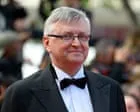
Sergei Loznitsa likens removal of €2m grant to ‘a punishment in kindergarten’ on eve of Venice film festival
One of Ukraine’s most acclaimed film-makers has criticised the European Commission’s decision to cut off funds to the Venice Biennale over the opening of Russia’s pavilion, likening it to “a punishment in kindergarten”.
The Biennale drew heavy criticism this spring when it allowed Russia to use its pavilion for the first time since 2022, despite the ongoing full-scale invasion of Ukraine.
Speaking on the eve of the Biennale’s cinematic branch, the Venice film festival, the director Sergei Loznitsa said that while he would “never ever” personally visit the Russian pavilion, the row was a distraction from the EU’s own failure to enforce more effective economic sanctions against Moscow.
“The question I ask myself is this: can the existence of this Russian pavilion stop this war or not?” said Loznitsa, who won wide acclaim for his 2014 documentary Maidan and last year’s Soviet-set drama Two Prosecutors, and is showing his new film Imperium out of competition on the Lido this year.
He added: “What I do know is that in the second quarter of this year, European companies imported gas from Russia at unprecedented levels, and all that money goes straight into bombs that fall on Ukraine.”
According to the EU’s Agency for the Cooperation of Energy Regulators, European imports of Russian liquified fossil gas increased by 17% compared with the same period in 2025, before a full EU-wide ban on Russian gas from 2027.
Loznitsa said: “This is a much more serious issue than whether there is a Russian pavilion in Venice or not. Cutting off funding to the Biennale is like a punishment in kindergarten.”
While the Russian pavilion’s exhibition The Tree is Rooted in the Sky was only accessible during the pre-opening vernissage dates and has been closed to the public since 9 May, the European Commission confirmed last month that it was terminating its €2m (£1.7m) multiyear grant to the Biennale Foundation.
The row is now also threatening to engulf the Venice film festival, which has a degree of institutional independence from the Biennale but will be directly affected by the funding cut.
The Biennale’s management said the terminated grant used to co-finance the activities of the cinema department relating to Biennale College and the Venice Production Bridge affects “activities and a department that have nothing to do with Russia’s participation in the Biennale Arte”.
In a confrontational speech before the announcement of this year’s lineup, the Biennale’s president, Pietrangelo Buttafuoco, accused the commission of “abandoning our journey”. The Biennale, he said, was not engaged in politics but “international research in the field of arts”.
For a festival that has in the past often looked more focused on attracting celebrity glitz than its competitors in Cannes and Berlin, this year’s programme is noteworthy for its political flavour and thematic focus on Russia and the countries in its sphere of influence.
As well as Loznitsa’s Imperium, there is the French director Alexandre Smia’s geopolitical “disaster movie” Jupiter, in which the Russian president has survived an assassination attempt for which he blames Ukraine and seeks retribution. Andrei Kutsila’s animated documentary Letters from the Silenced Country focuses on political repression in Belarus, while the Russian-born American film-maker Julia Loktev’s five-hour documentary My Undesirable Friends: Part II – Exile follows a group of Russian dissident journalists working for the independent television channel TV Rain after they are forced to flee their country in the wake of the full-scale invasion.
Loktev’s film circles around the question of where art and journalism stops and propaganda begins. In one scene, the journalists working for TV Rain find themselves chastised for continuing to speak of “our army” after they have registered the network in Latvia. “It’s a film about when your country does terrible things, how to take accountability,” said Loktev. “How do you speak as a citizen of your country about the awful actions and the crimes your country is committing?”