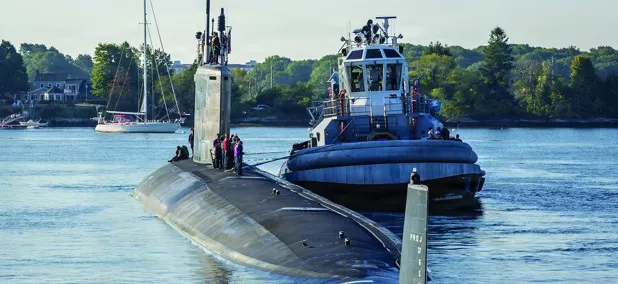
The Virginia-class attack submarine USS North Dakota was delivered back to the fleet after completing a historic first-ever Virginia-class Block III availability at Portsmouth Naval Shipyard in Maine, Aug. 20, 2026.
U.S. Navy / Neil Boorjian
Maintenance delays have cost the Navy’s attack submarine fleet more than 41 years they could have been in operation—and those waiting to be taken out of service could cost more than $3 billion over the next five years, according to a recent watchdog report.
The main problem is that shipyards are simply overloaded with work, the Government Accountability Office wrote in an Aug. 27 report.
“The USS Pasadena entered inactive idle status on January 1, 2025 and is not expected to be inducted into Norfolk Naval Shipyard for decommissioning until November 15, 2028 (1,414 days)—due to shipyard capacity constraints,” the report said. “During this time, the attack submarine is unable to be operational since its dive certification is expired, but is still fully crewed with sailors.”
In the meantime, the Navy is using the inactive submarine to train crews but its nearly-four-year delay is costing the services about $300 million in operating and support costs, according to the GAO’s analysis.
More than a dozen subs are currently at risk of heading down the same, costly path.
“Without mitigation, 15 attack submarines will enter inactive idle time from fiscal year 2026 through fiscal year 2030—during which time the Navy could incur more than 14,000 days of inactive idle time and $3.1 billion in costs to operate and support these inactive submarines,” the GAO found. “The U.S. Navy has not fully evaluated alternative options to more efficiently decommission attack submarines and develop and implement an inactivation plan that could allow them to reduce inactive idle time for crews and save billions.”
The report comes just months after the Navy decided to decommission USS Boise, a Los Angeles-class attack submarine, despite spending $1.6 billion on repairs. Last year, Chief of Naval Operations Adm. Daryl Caudle told lawmakers it was “unacceptable”.
Over the past decade, the Navy spent about $3.3 billion on idle Los Angeles-class boats, and about $835 million on idle Virginia-class boats—roughly $230,000 for every day a sub sits pierside waiting to be worked on, the report said.
The GAO submitted two recommendations: for the Navy to find “alternative options for decommissioning attack submarines,” including defueling outside of drydocks and reducing crewing for those waiting to be taken out of service; and create and execute a detailed plan that reduces inactive idle time.
The agency also sent two other recommendations, which DOD deemed sensitive. “The Navy, on behalf of DOD, verbally concurred with the recommendations in this report, but did not provide written comments,” the report said.
NEXT STORY:
Golden Dome Caucus chair says building support, funding for missile shield is a ‘tough slog’