By STACY LIBERATORE, US SCIENCE & TECHNOLOGY EDITOR
Published: 13:14 BST, 1 September 2026 | Updated: 20:55 BST, 1 September 2026
A powerful tropical storm slammed into the US Gulf Coast on Tuesday.
Tropical Storm Edouard made landfall near Johnson Bayou, Louisiana shortly after 3pm ET, just east of the Texas state line, while a 71mph gust was recorded nearby at Texas Point.
Despite its strength, Edouard had one of the smallest wind fields ever observed in an Atlantic tropical system, limiting the scale of its destruction. However, millions of people across the wider region face a dangerous day of flooded roads, travel chaos, power outages and possible tornadoes.
Storm surge could push water as high as eight feet in the hardest-hit coastal locations near Port Arthur, Texas and the Louisiana border.
Meanwhile, repeated bands of thunderstorms could dump up to 20 inches of rain in isolated areas by Wednesday, overwhelming drainage systems and potentially cutting off low-lying communities.
A tropical storm warning stretches from Port Bolivar, Texas to the Vermilion-Cameron Parish line in Louisiana, while a storm surge warning covers the coast from High Island to Cameron.
The bulk of the heaviest rain and strongest gusts is forecast to pass east of the Houston metro, although the city and its surrounding communities could still experience downpours and dangerous travel.
The National Hurricane Center (NHC) noted that Edouard should weaken as it moves farther inland, but its flooding and tornado threat could persist for hours after landfall.
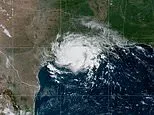
Tropical Storm Edouard is slamming into the US Gulf Coast, unleashing torrential rain as officials warn of flooding, tornadoes and a dangerous storm surge
A surge of three to six feet is forecast across much of that area, while AccuWeather warned that water could reach a Local StormMax of eight feet in isolated locations.
Farther east along the Louisiana coast, forecasters expect a lower, but still potentially dangerous, surge of one to three feet.
Storm surge occurs when powerful winds push seawater inland, raising water levels along the coast and flooding roads, homes and businesses.
The threat becomes particularly dangerous around bays, rivers and other waterways where rising water can move well beyond the immediate shoreline.