By WILIAM HUNTER, SENIOR SCIENCE & TECHNOLOGY REPORTER
Published: 00:05 BST, 2 September 2026 | Updated: 00:05 BST, 2 September 2026
Charles Darwin famously claimed that fire was the greatest of all human inventions, with the exception of spoken language.
Now, scientists claim that these two great human innovations could be two sides of the same coin.
Researchers say that human speech was born when our ancient ancestors started gossiping and trading stories around the campfire late into the night.
More strikingly, they argue that firelight itself could have been 'critical' to the evolution of sophisticated language that separates us from our primate relatives.
Humans’ ability to control fire allowed us to cook and make more sophisticated tools, but it also extended early humans' wakeful period roughly four hours past sunset.
The researchers say that the end-of-the-day campfire would have been one of the first times that the whole community could come together without pressing practical needs.
Just like many campers still do today, that would have been the perfect moment to exchange news about what had happened in the day and tell stories.
According to lead author Professor Catherine Hobaiter, a psychologist and neuroscientist from the University of St Andrews, this could have been the first step towards a more complex, abstract system of communication.
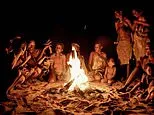
Researchers say that human speech was born when our ancient ancestors started gossiping and trading stories around the campfire late into the night. Pictured: The Ju/’Hoansi-San in Namibia telling stories by the fire
Most previous theories suggest that language gradually emerged out of calls and gestures, like those used by gorillas and chimpanzees.
However, new evidence about primates' complex social lives and impressive abilities is now casting doubt on this idea.
Professor Hobaiter says: 'Decades of research with other species has shown us that you don’t need language to learn from each other, to organise where and when to forage, to learn cultural knowledge about tools and songs, to co-ordinate.'
Chimpanzees, for example, are perfectly capable of teaching each other how to make tools, organise patrols of their territory, wage 'war' against other groups, and maintain a complex social order without anything resembling a language.