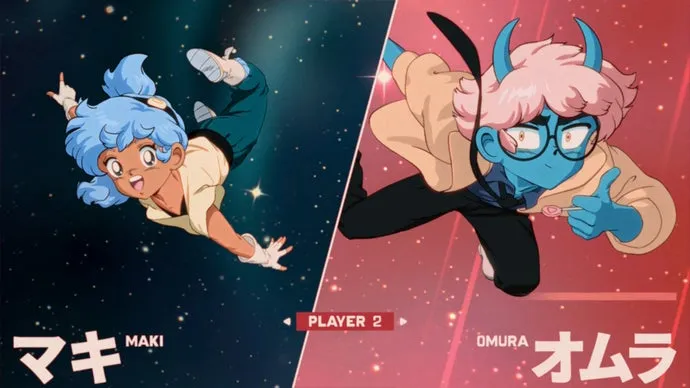
Orbitals' twin protagonists Maki and Omura have this adorable little habit. When they leave behind a tool – a ground-pound backpack or hacked microwave oven – they'll often say goodbye to it. Or sayonara, rather, if you're playing Orbitals in Japanese (as well you should; subs over dubs any day).
This habit is, first and foremost, a nice little character touch. We first meet this pair as wide-eyed tots, in a sumptuous hand-animated cinematic. Jumping forward 15 years on, not much seems to have changed. They're still running around their starship home, taunting one another as they race: "You're the slowest slowpoke ever!"
This is a little jarring, given what happened, just moments before, in that introductory cinematic. On a space-station base about to explode, the two wee babes are put into a machine that stores their consciousness then – as far as I can tell – incinerates them both then Ctrl-Vs their minds over into two freshly baked clone bodies.
In fairness, running around in these bodies is a joy. My co-op partner and I settle on who will be who – Orbitals being a two-player split-screen affair, one of the growing number of games being made in the mould of It Takes Two and Split Fiction that I assume we're all agreeing to call Hazelikes – and then spend a good few minutes just showing off our respective run animations to one another. These are absolute works of art. My partner enthuses about the way Maki patters down steps, while I'm more partial to Omu's seamless segue from a louche, hand-in-pocket idle stance into a full Naruto run.
And the fact that they don't seem to have been at all traumatised by their youthful experience of being forcefully respawned? Well, that's just Maki and Omu for you: the kind of good-natured kids who'd wave goodbye to an inanimate object, and can laugh when they fall into lava and are reconstituted from their base atoms. They keep nattering away and occasionally even breaking out into song, all the way through their adventures, even when things take a grimmer, weirder turn.
Even an inveterate grump like me can't help but be endeared by this kind of eternal optimism, and develop a genuinely fondness for these cheery idiots. After I've taken a quick trip to the language settings menu, anyway.
Voice actors Rebecca Wang and Stephen Fu do a perfectly good job with the English script, but the characters' constant twittering is much more tolerable in a language you (or at least I) don't speak. My co-op partner sticks with the default English dub for a while longer – the game is happy for you to be on different languages – and there are moments where, as I'm being charmed by Maki and Omu's antics, I'm sure I hear a quiet groan coming down the mic.
But back to those little goodbyes. It feels like the game's developers tipping you the wink, acknowledging that they know what makes a good Hazelike. They should – Orbitals game director Jakob Lundgren previously worked as a designer on It Takes Two and Split Fiction. It's all about introducing an idea (which Orbitals also does with aplomb: picking up a new gadget, you're hit with the kind of close-up shot you'd expect to find in an infomercial) and then dropping it before it gets old.
This frenetic pace of invention is necessary in Hazelight's games, because of the way it offsets their narrative shortcomings. Five-minute cutscenes in any game are a risky gambit, but doubly so in one where you have a partner constantly there on voice comms. It's like someone wandering into the pub, sitting down at your table and interrupting the conversation to tell you the plot of a TV show they were just watching. Hazelight offsets this by pulling a new cool toy out of their bag every few minutes, making the blather much more palatable. (Given my choice of analogy, I should probably caveat here: don't take toys from strangers in pubs, kids!)
Orbitals inherits many of the same tendencies. The game rambles its way through a tale that I'm not sure makes a huge amount of sense – though in fairness we were sometimes talking over it. It does fare better than its Hazelight cousins in a couple of areas, at least. For one, Maki and Omu are considerably less annoying than any characters Josef Fares has come up with since the speechless brothers from Brothers. And in cutscenes, they have the distinct advantage of being produced by Japanese animation house Studio Massket. They're a real treat for the eyes, even if your ears are otherwise engaged.
But when it comes to offsetting narrative shortcomings by dipping into the toybox? I fear that Orbitals' comes up a little bare.
Early on, the game presents you with three Proton Pack-sized gadgets, hefty enough that each player can equip just one of them at time. These are all essentially variants on the same basic aim-and-shoot interaction, just firing different payloads. There's the Liquid Launcher, a kind of weaponised hosepipe that can be used to extinguish fires or spin water wheels, in a constant stream of wet or (using the alt-fire mode) a single big splat. The Beam Cannon works very similarly, but with lasers. The Scrap Hook can grapple onto marked points then, with a pull of the other trigger, wrench open panels and doors.
Get used to these tools, because they'll be sticking around for the duration – no sayonaras here. Their abilities get repurposed, and mixed in different combinations (three tools being more than two players can carry) and occasionally merged with other temporary gadgets that do get waved off-stage after a few uses. The results, though, are rarely all that exciting, and often leave a sense of déjà vu.
One room, for example, has you grabbing seeds with the Scrap Hook, planting them in soil then watering them with the Liquid Launcher so they grow into platforms that can carry a player's weight. It makes for a perfectly decent stretch of co-op puzzle-platforming… but didn't we do all this already, with It Takes Two's nailgun?
More distinct is the aforementioned microwave – as in, a popty-ping Ginsters-warmer. In Orbitals, this device gives you access to some unlikely mashup of Metal Gear Solid's steerable Nikita missile, Sam Raimi's trademark shaky-cam bullrush, and those invisible platforms in Astro Bot that only appear when you shine light on them. But even this goes underutilised, used in puzzles that feel like the first five post-its you'd stick on the ideas wall, never getting around to the really good, weird stuff.