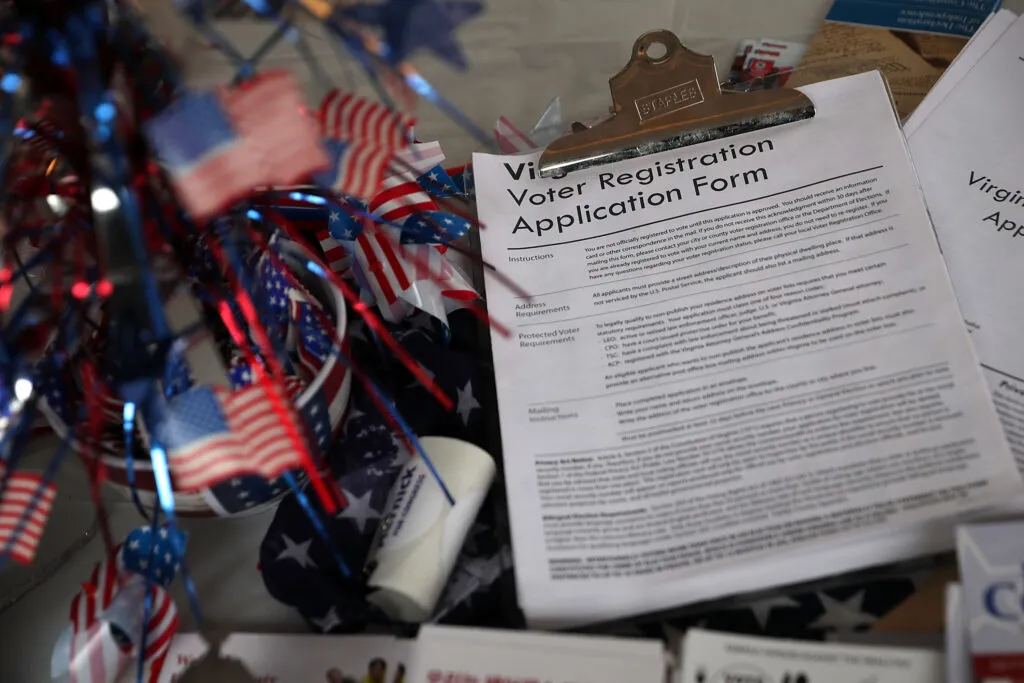
A pile of voter registration forms is seen at the booth of Fairfax County Republican Committee during the annual KORUS festival, a Korean cultural festival, in Tysons Corner, Virginia, in October 2016. (Photo by Alex Wong/Getty Images)
Federal courts have blocked a voter registration provision slipped into Ohio's latest two-year transportation budget. The change requires Ohioans registering to vote at the Bureau of Motor Vehicles to present proof of citizenship in order to register.
The organizations Red, Wine and Blue and the Ohio Alliance for Retired Americans challenged the policy in federal court. Secretary of State Frank LaRose has promised to appeal and has asked the judge to stay the ruling, which would allow the changes to remain in effect as the case goes forward.
The arguments hinge on the National Voter Registration Act of 1993 — commonly known as the Motor Voter Act because it required vehicle registration offices to help people register to vote.
That law requires a person to attest under penalty of perjury that they're a citizen, and it also bars states from requiring anything more than the "minimum information necessary" to get a person registered.
"Ohio is not free to impose an additional requirement for voter registration when that requirement conflicts with federal law," the challengers' complaint reads. "Congress made the judgment that an attestation was sufficient to demonstrate citizenship, and that nothing beyond that minimum requirement was allowed."
To the challengers, Ohio's new law represents an important albeit subtle change. Everyone who registers to vote must be a citizen. But the groups contend requiring documentary proof, rather than just a sworn statement, will harm their members who don't have documents readily available.
Seniors who have lost their birth certificates, those whose names have changed through marriage or divorce, or those whose passports have lapsed could all have trouble registering to vote. Similarly, younger Ohioans who are still in school may have left documents with their parents for safekeeping. The challengers add that collecting the necessary documents is both costly and time consuming — with processing times running from a few weeks to a few months.
Research from the University of Maryland indicates 21 million Americans don't have the documents they need to register readily available.
But to Secretary of State Frank LaRose and Ohio Motor Vehicles Registrar Charles Norman, the new requirements aren't really a change at all.
"Because Ohioans necessarily present proof of citizenship (or non-citizenship) through their applications for Ohio credentials," they said in court filings, "registrars and deputy registrars know which applicants are eligible to register to vote."
The Ohio officials argued the Ohio Alliance for Retired Americans and Red, Wine, and Blue don't have standing because they can't demonstrate how the change harms their members. The state pointed to a woman named Margaret Dutcher, referenced in the challengers' filings, who has a passport but believes she shouldn't have to show it to register to vote.
"If she refuses to produce her passport," the state said, "any injury will be self-inflicted."
In his decision, District Judge Solomon Oliver focused on the question of when a driver's license application is "submitted." That's the point at which the Bureau of Motor Vehicles must offer to register a person under the Motor Voter Act.
Ohio's officials contend an application isn't submitted until a person presents all the required identity documents. The challengers, however, argue an application is submitted when a person applies — regardless of whether they have all the required documents.