Updated
Aug 4, 2026 4:35 PM EDT
We may earn revenue from the products available on this page and participate in affiliate programs. Learn more ›
Product news, reviews, and must-have deals.
We don’t think about light bulbs until they burn out. But, tweaking the bulbs in your home can change the whole feel of the place. After tons of testing, spec comparison, reading editorial reviews, and surveying user feedback, we’ve chosen the Feit Electric Enhance A19 as the LED light bulb we’d screw into almost every socket in the house. It renders color at a 90+ CRI, a spec that used to cost real money, and sells for about $4.70 per bulb as of August 2026 (often less at big-box stores). If your lights live on dimmers, the Philips Ultra Definition A19 is the one to buy instead, rated by Philips to fade from soft white down to a 2200K candlelight glow. Plenty has changed since our last update: the EPA retired Energy Star certification for ordinary bulbs at the end of 2024, high color accuracy got cheap, and smart bulbs have grown into a category that deserves (and is getting) its own guide. This one is for people who want excellent regular light bulbs that turn on when you flip the switch.
We started with the A19 shape at 800 lumens, the 60-watt equivalent that fits most household fixtures, then added the shapes people actually need: BR30 floods for recessed cans, a brighter A21 (a slightly larger bulb shape, not a wattage class), and candelabra bulbs for fixtures with the skinny E12 base. Color accuracy was the bar that mattered most this time around. Bulbs rated at 90+ CRI now cost within a dollar or two of the 80 CRI basics, so we treated high CRI as the default rather than a luxury. To be clear about method: we did not conduct laboratory testing for this guide, but unless you have robotic eyes that measure delta E, that’s not super useful information for you.
Recommendations are based on real world experience, as well as manufacturer specification sheets, retailer listings we checked in August 2026, and recurring complaint patterns in owner reviews. Where a number is a manufacturer’s claim rather than an independent measurement, we say so, and dimming behavior in particular varies with the switch and fixture you own. One filter we dropped: Energy Star. The EPA retired its certification for ordinary replacement bulbs on December 31, 2024, so the logo on a box reflects the old program, not a current endorsement. If you want a deeper primer before you shop, we have a whole guide to buying the right lightbulb.
Most conventional incandescent bulbs left store shelves under the federal efficiency rule in force since July 2023 (specialty categories like oven and appliance bulbs are exempt), and the Department of Energy has finalized stricter standards for 2028. LEDs won. The upside is that the winners keep getting better: the replacements below generally offer better color rendering, smoother dimming, or lower per-bulb prices than the bulbs they pushed out of this guide. If you’re after app-controlled, color-changing bulbs instead, hold tight for our dedicated smart bulb guide, or browse our current favorite smart home devices.
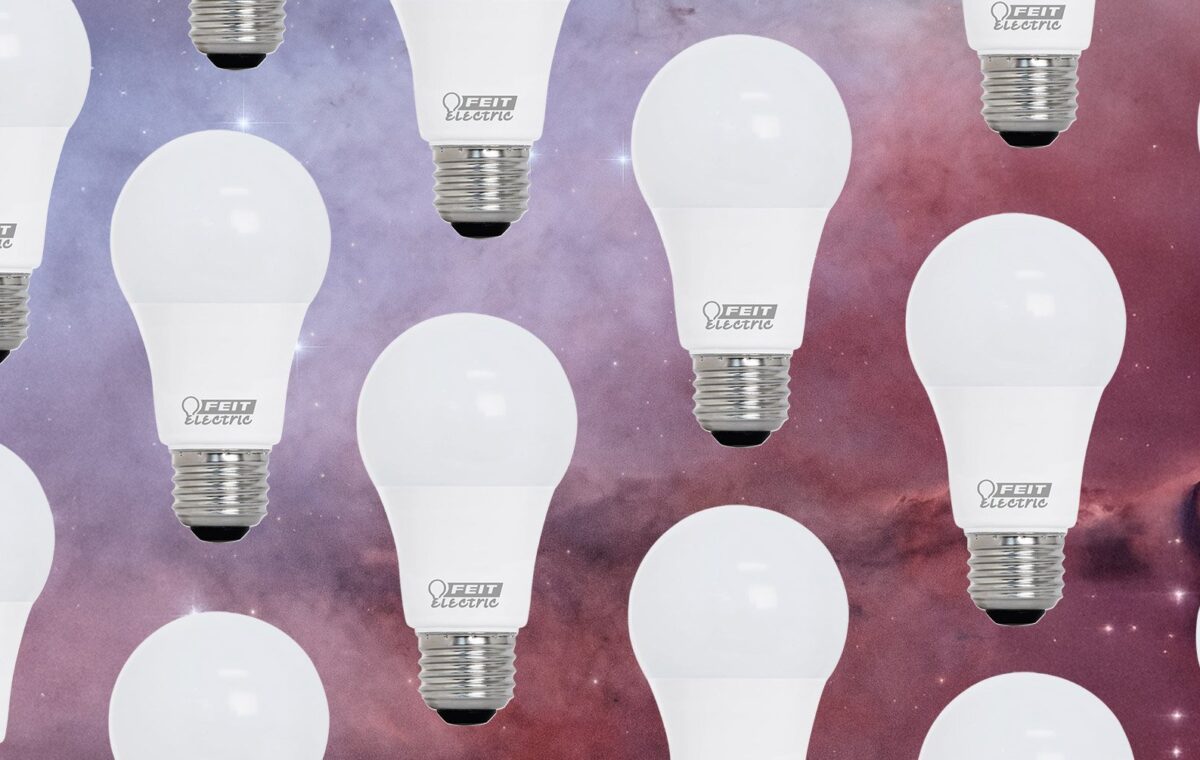
The Feit Electric Enhance A19 hits the sweet spot of the entire category: 90+ CRI color accuracy for about $4.70 per bulb as of August 2026, and often less at big-box hardware stores. If color matters to you, that CRI number is the first thing to check on the box. Basic LED bulbs render color at around 80 CRI, which can leave a freshly painted wall looking slightly wrong and skin tones washed out; the Enhance line generally renders those colors more faithfully, for a small premium over the bargain bin. I have been using this model in my home for the past year and they have performed very well.
The rest of the spec sheet holds up. This exact four-pack is the fixed 2700K soft white version with a standard E26 base (the 3000K and 5000K daylight versions are separate listings), and each bulb draws 8.8 watts to produce 800 lumens. Feit rates it for damp locations like a bathroom ceiling (damp-rated means moisture, not direct water contact), for enclosed fixtures, and for 25,000 hours of use, which works out to more than two decades at three hours a day.
A handful of owners report flicker when these bulbs sit on dimmers. An incompatible dimmer is a frequent suspect, though bulb drivers and wiring can contribute, so check Feit’s compatibility notes if yours misbehaves (more in the dimming section below). Beyond that, shop around: Amazon’s price on this four-pack moves around, and big-box stores frequently beat it, so check a local shelf before you order eight. If you’re replacing a houseful of bulbs and want all of them to just look right, start with the Feit Enhance.
Dimming is where cheap LED bulbs go to embarrass themselves, and it’s where the Philips Ultra Definition A19 earns its slot. Most LEDs hold the same color while they fade, which is why a dimmed living room can feel like a dentist’s office at midnight. Philips rates this bulb to slide from 2700K down to 2200K as you pull the dimmer, mimicking the warmer-colored light an incandescent gives off as its filament cools while dimming.
The listing backs the rest with numbers printed on the spec sheet: 800 lumens from 8 watts, a stated CRI of 95 (second only to the GE Sun Filled’s claimed number in this guide), a frosted envelope that diffuses the individual LED filaments and cuts glare in exposed fixtures, and Philips’s EyeComfort flicker-free designation. (Amazon’s title calls the glass clear; Philips’s own spec sheet for this model, the 576116, says frosted.) Sold and shipped by Amazon at $11 to $14 for a four-pack in our August 2026 checks, it also undercuts many of the basic dimmables it outclasses on paper.
One honest caveat: this listing carries a 3.7-star average across more than 2,000 ratings as of August 2026, worse than its specs deserve at face value, and worth a skim before you buy for a whole room. Dim-to-warm behavior also depends on your dimmer, so check Philips’s compatibility list rather than trusting the word “dimmable” on an old switch. On a compatible LED dimmer, the Philips Ultra Definition A19 gives your living room back the sunset fade that incandescents took with them when they left.
The GE Sun Filled A21 is one of the most color-accurate bulbs you can buy at retail. GE rates it at 97 CRI, about as close to the scale’s ceiling of 100 as consumer LEDs get, with a full-spectrum design the company says fills in the gaps standard LEDs leave in their output rather than leaning on a strong blue peak.
That makes it the bulb for the places you actually look at things: the lamp you read under, the mirror where you do your makeup, the wall where the art hangs. GE also markets the reduced blue spike as friendlier before bed; treat that as the company’s claim, since how light affects alertness depends on brightness, timing, and duration as much as spectrum. The Sun Filled draws 10.5 watts to produce 840 lumens, dims, and comes in soft white or daylight, sold in one- and two-packs.