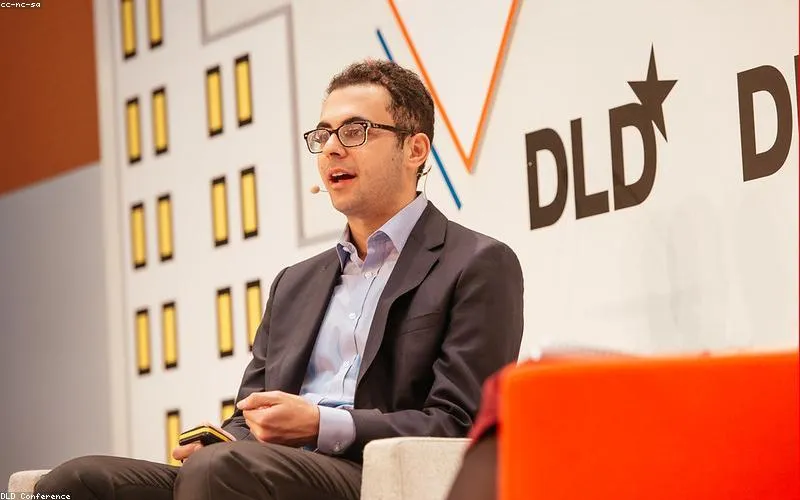
Hospitality workers wait in line to apply for unemployment benefits at the outset of the COVID-19 pandemic in March 2020.
Marcio Jose Sanchez/AP
hide caption
How much of your life do you spend waiting, either in line, on the phone or while filling out government forms? Annie Lowrey, a journalist with The Atlantic, says all that waiting amounts to what she calls a "time tax," paid most often by those applying for government benefits like unemployment, disability and food assistance.
"I really saw this as a tax, because there's this understanding that, with the government, we should be getting what's ours," Lowrey explains. "How much time, how much effort, how much emotional strain, how much do you have to give up to receive something that you're trying to either purchase or obtain or a right that you are supposed to have?"
In her new book, The Time Tax: How the Government Wastes Our Time — and How to Fix It, Lowrey argues that excessive red tape in many, but not all, government agencies often acts as a barrier to people receiving benefits. She notes that new paperwork and work requirements have already cut millions of Americans from food assistance, and the numbers are still growing. She points to our current unemployment insurance system as an example of how administrative hurdles prevent people from collecting benefits they are owed.
"Unemployment insurance is a contributory benefit. You have to be paying into a trust fund in order to get it," she says. But, she adds, some people don't collect unemployment, either because they can't figure out how to complete the paperwork or "the state, frankly, can't figure out how to deal with all of the paperwork that it's receiving."
In addition to lost benefits, Lowrey says living with such a time tax contributes to what she calls a "low-trust society."
"When the government treats us like this, we don't trust it. And if we don't trust it, we're not going to trust it to do more and better things for our life. And I think that it leads us not to trust each other, too," she says.
On the administrative burdens faced by the Americans with the greatest need
If you are looking at the programs that are targeted at the most at-risk Americans — Supplemental Security Income [SSI], which is used by very low-income seniors with disabilities; TANF [Temporary Assistance to Needy Families] or cash welfare, which is used by very low-income, primarily mothers of small children; WIC [Women, Infants & Children], which is a nutrition support program that is also used by quite low-income mothers and their kids. They tend to come with really significant time burdens. …
SSI, for instance, it makes these folks comply with an asset test, right? So how much exact money is in your bank account? Or do you have any little pockets saved away somewhere? … And I think that everything that we know about being very sick, very at risk, very poor, homeless, vulnerable in some fashion, those programs should be easier, not harder.
On the hurdles people seeking food assistance face
Food assistance should not be a program for low-income, at-risk Americans who might not be able to eat enough, who are also good at paperwork. That's not what that program should be, right?
I see it in moral terms. Food assistance should not be a program for low-income, at-risk Americans who might not be able to eat enough, who are also good at paperwork. That's not what that program should be, right? … Do we want all of these programs to [say] this is assistance for lower income Americans, provided that they have a smartphone and a wifi connection? That's not what these programs are about.
We vote on Tuesday, because back when we were an agrarian society, the days were limited … by the need for people to go to church on Sunday. And often, [voters] would have to travel for, like, a day to get to their polling place, because they might be going on foot or they might be by horse. And you had to avoid market days also. And so it ended up being that Congress, in I believe the 1840s, decided that Tuesday was the day. And this is not a holiday. …
[As a result] We do not have high voter participation rates. And so that means that the voting public is not representative of the actual American public. That's not good for (small d) democratic reasons. And I would say that vote by mail has started to change this. But there's now real attacks on vote by mail, and I think precisely for that purpose. What you are doing when you hold elections in a really complicated fashion is you allow politicians to pick their voters instead of allowing the American public — as big as we can make it — to pick their politicians.