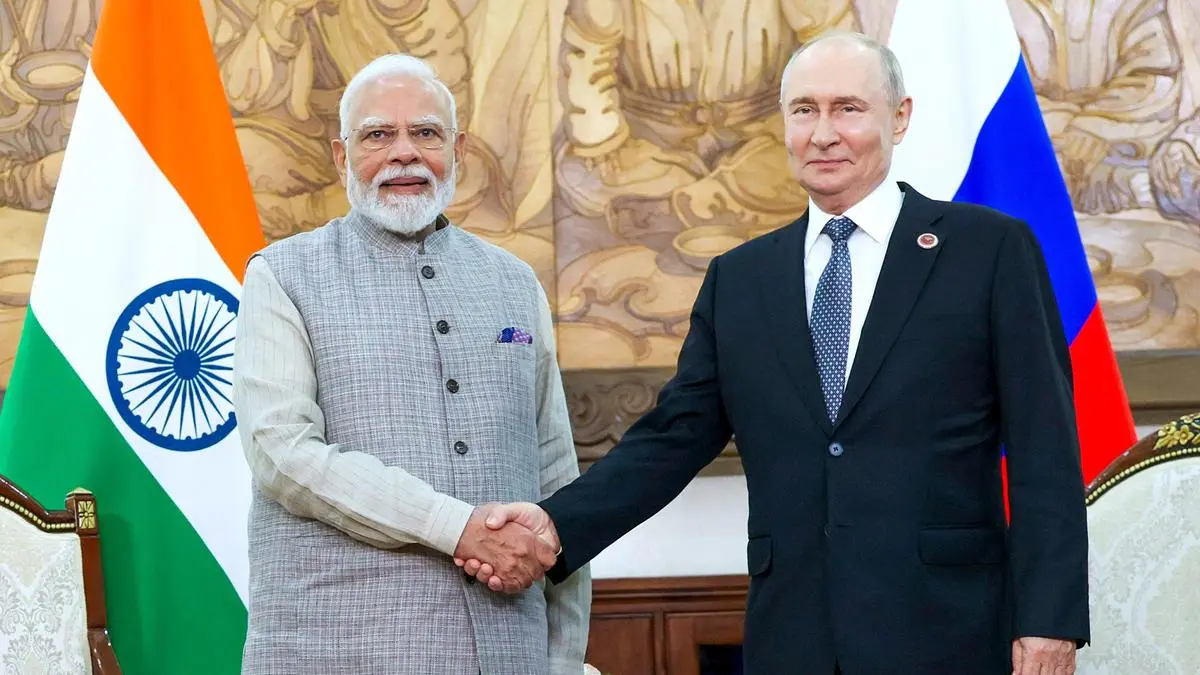
Prime Minister Narendra Modi meets Russian President Vladimir Putin, in Bishkek on Monday, August 31, 2026.
| Photo Credit:
Via ANI
Indian Prime Minister Narendra Modi called on President Vladimir Putin to end Russia’s war in Ukraine during a meeting on the sidelines of the Shanghai Cooperation Organization summit in Kyrgyzstan.
India supports all and every effort for peace and will continue to do so, Modi said, calling Putin “my friend” in televised comments at the start of their talks in the Kyrgyz capital, Bishkek. There’s a need to move from “endless war to end of war” he said, switching from Hindi into English.
Putin responded that “we’re moving in this direction,” without elaborating. Russia and India continue to strengthen their strategic partnership, facilitated by Modi’s “very kind, personal, friendly relations, for which I thank you,” he said.
Earlier Monday, Modi and Iranian President Masoud Pezeshkian held their first meeting since the start of the US-Israeli war against the Islamic Republic.
Modi said he “reiterated our commitment to strengthening India’s long standing friendship with Iran across diverse sectors” in a post on the X platform. “We want to expand and diversify our trade basket in the times to come.”
Putin and Chinese President Xi Jinping also met on the sidelines of the summit. They focused mainly on bilateral relations including trade and economic cooperation as well as key international issues, though the war in Ukraine was discussed only briefly, according to Kremlin spokesman Dmitry Peskov.
Founded in 2001 by China and Russia together with the Central Asian states of Kazakhstan, Uzbekistan, Tajikistan and Kyrgyzstan, the SCO has expanded to include India, Pakistan, Iran and Belarus as members, while Afghanistan and Mongolia have observer status and another 15 countries including Saudi Arabia, Turkey, Egypt and the United Arab Emirates are so-called “dialogue partners.”
The organization’s members account for more than 40% of the world’s population, and about a quarter of global gross domestic product, according to World Bank data.
While the bloc has grown substantially in recent years, rivalry among member states means it’s largely failed to translate that geopolitical ambition into concrete mechanisms for action on the global stage as it marks 25 years since its formation.
Tehran’s showdown with the US risks exposing the SCO’s inability to act coherently, leaving leaders likely to offer only symbolic solidarity. Neither Xi nor Putin has shown any readiness to back Iran militarily and economic support has been limited.
India is seeking to balance ties with longstanding partners including Russia and Iran while maintaining relations with US President Donald Trump, whose administration it is negotiating with on a trade deal.
India has historically maintained cordial ties with Iran and is expected to host Pezeshkian again next month at the BRICS summit. New Delhi holds the rotating chairmanship of the group this year.
Economic ties between the two nations have narrowed over the years as a result of US sanctions. India hasn’t imported any crude from Iran since 2019, except for a small window that opened up this year due to US waivers. Before the sanctions, Iran was among India’s biggest oil suppliers.
Trade in some key sectors, including rice exports to Tehran, has remained resilient, with shipments holding up despite higher prices and months of wartime disruption.
Source: Read the original article on www.thehindubusinessline.com