Two icons share cake and take us on a touching trip down memory lane. Dench is mesmerising, and McKellen is such a devilish guest that he’ll make you weep and giggle too
I am writing this in the wake of Dolly Parton’s death, so I am very much in the mood for the gentle celebration of ageing icons while we still have them. An hour of 91-year-old Judi Dench having tea with 87-year-old Ian McKellen? Sign me right up and I will not so much as breathe heavily in their direction lest anything go wrong.
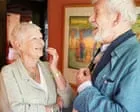
McKellen – Sir Ian, “Serena” to his friends – navigates the “treacherous” pavement leading to Dame Judi’s fairytale 15th-century home in Surrey, which is as cosy and sparkling as its owner (if anyone is listening, I will take an hour of just Dench, taking us around the house and garden, like the world’s most mesmerising estate agent), and unwraps two lumps of parkin cake to go with their tea. One from Yorkshire, where Dench is from, and one from Lancashire because McKellen was – is – a Burnley (then Wigan, then Bolton) boy.
They go through his childhood as they wire into the cake. Seeing Peter Pan at three, falling in love with panto, being aware of the local professional actors as he reached school age and hoping to become one of them one day. Then a scholarship to Cambridge University in 1958, “where I met all these boys and girls who were as crazy about the theatre as I was”, and he started to dream bigger. I suppose you do when the boys and girls include Trevor Nunn, Corin Redgrave, Derek Jacobi, Miriam Margolyes and Clive Swift. “Well,” says McKellen, “I thought – if Derek Jacobi can do it …” The devilish twist of his lips and Dench’s throaty giggle should be put on Unesco’s intangible cultural heritage list instantly.
Some of his pals went on to drama school but the Burnley boy felt he had better start earning a living as soon as possible and was soon treading the boards in regional theatre. He and Dench began their friendship at Oxford Playhouse, appearing with Ian McShane in a 1967 production of The Promise. They remember actorly moments – the time she saved him from stage fright in a George Bernard Shaw play (“It’s nice that you don’t remember it,” he says. “Just an actor helping another actor out, which is what we do, isn’t it, at best?”), whether it’s nice to know that friends are in the audience or not, entire performances that become slightly reorientated towards a Peter Brook or an Olivier in the stalls – and they sigh a bit over the youth of today who can’t manage on stage without microphones.
Intimations of mortality are briefly dealt with, because while McKellen thinks about death “every day” Dench banishes it firmly from her thoughts. She does look back, though, “with a little bit of everything – but mainly thinking about how lucky I’ve been”.
There are, of course, lots of clips of them acting – McKellen especially, as he’s the guest – and they are something to behold. You hope that those who only know him as Gandalf or Magneto (“Lovely jobs”) will one day see footage of him as Edward II or Coriolanus or as Max in Bent, or of the two of them as the Macbeths in Nunn’s minimalist 1976 RSC production (filmed by Philip Casson for Thames Television in 1978). There are only fleeting glimpses here and you long to see more. The set and costumes cost £250, McKellen notes. And a man of the cloth came to multiple performances to sit in the front row holding up a crucifix. McKellen always thought it was to protect them. Dench thinks it was to protect himself. “Ooh,” says McKellen, who you suddenly see is a sweet optimist at heart, deflating.
His work as a gay rights activist is limned. The grace and eloquence of his turn on Wogan in 1988, explaining the ramifications of section 28, evoke a vanished past. So too, in sadder ways still, does his memory of the letter his loving and beloved father wrote to him on his 21st birthday, possibly asking between the lines if there was anything Ian wanted to tell him and assuring him that he could. Both of McKellen’s parents died long before he felt able to come out. So he wonders. He wonders and he reads Armistead Maupin’s Letter to Mama and makes us all cry thunderous tears.
There are moments in Tea With … that you find yourself wishing that it was A Drink With … (though McKellen himself doesn’t drink any more – Dench looks suitably aghast). Because put any two actors together, let alone this pair, and the anecdotes are always much, much better than the ones that pass muster here. But perhaps it’s enough to hear about lives well lived, and contentment gained, and pay homage to a few of the tears shed along the way.
Tea With Judi Dench Featuring Sir Ian McKellen aired on Sky Arts and is on Now