Epson made some quality-of-life improvements from the LS650 this model supersedes, but it’s not keeping pace with the competition and really only has high brightness to offer.
Color gamut doesn’t stack up against RGB laser
Large depth and throw ratio make it stick out
Why you can trust TechRadar
We spend hours testing every product or service we review, so you can be sure you're buying the best. Find out more about how we test.
The new Epson LifeStudio Grand UST projector may not ring any bells. But its rebranding hides the fact that it’s little more than a minor update to the Epson EpiqVision Ultra LS650. That was a decent projector when it came out, but not an amazing one.
With the LifeStudio Grand, Epson has made some improvements. The Google TV operating system works well, and there’s an extra HDMI port where its predecessor offered just two. It also doesn’t have whiny fans. But the image is still a little soft and not as dazzlingly colorful as RGB laser projection. The projector’s motion interpolation also needs a lot of work. And Epson’s switch from Yamaha to Bose for sound tuning hasn’t made the audio better.
With competitors improving considerably over the past year, the LifeStudio Grand is in troubled waters. If you can’t see the DLP rainbow effect and don’t mind drawing the curtains from time to time, you can get a much better projector for your money by shopping elsewhere.
The LifeStudio Grand launched in late 2025 with global rollout in Spring 2026. The project has a retail price of $2,699 / £1,749.99 / AU$4,399.
Given its newness and the fact that it’s coming from a big player like Epson, I wouldn’t expect any major discounts on the projector too soon, though Black Friday could roll around and see at least a minor deal.
3x USB-A, 1x 3.5mm audio out, 1x Optical audio out, 3x HDMI 2.0 (1x eARC, 1x USB-B (Service port)
As soon as I took out the LifeStudio Grand, I thought it looked familiar. Sure enough, down to the inch and pound, it’s just the Epson EpiqVision Ultra LS650 back again. There are just a few changes.
Epson added a third HDMI port on the back: nice. Epson swapped to Google TV and it actually runs quickly: nice. Epson included Wi-Fi 6E: nice. And Epson added some gaming features, like ALLM and a 1080p/120Hz mode: nice. But these are more making up for fumbles from that earlier model, rather than actually keeping pace with competitors like the Hisense PX3 Pro and its 1080p240Hz mode.
Sign up for breaking news, reviews, opinion, top tech deals, and more.
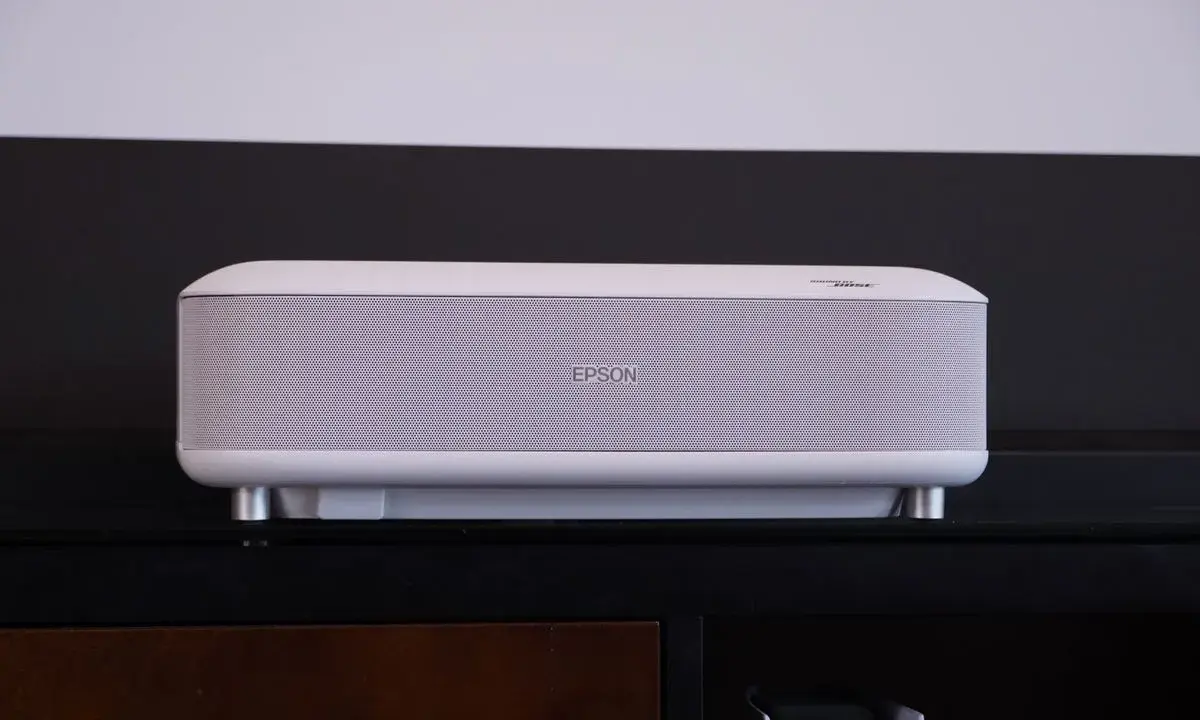
The LifeStudio Grand is a little plain to look at with its white plastic construction and gray-ish front grille — the result of a white grille dotted with black holes. Even the Epson branding looks unfortunate, like it was pasted on after having been forgotten in an earlier prototype (except we know it wasn’t because it was there on the predecessor).
One thing giving the LifeStudio Grand a bit of style is its little silver legs. These also play a crucial role in the projection, as they can adjust the tilt of the projector to ensure it lines up square with a wall or projection screen. The projector supports digital keystone adjustments, but those are best avoided when possible. The right side of the projector hides a hardware focus dial behind a small panel, which allows for quick focus adjustments while also protecting the setting once you’ve got it in place. Auto-focus would have been nice though.