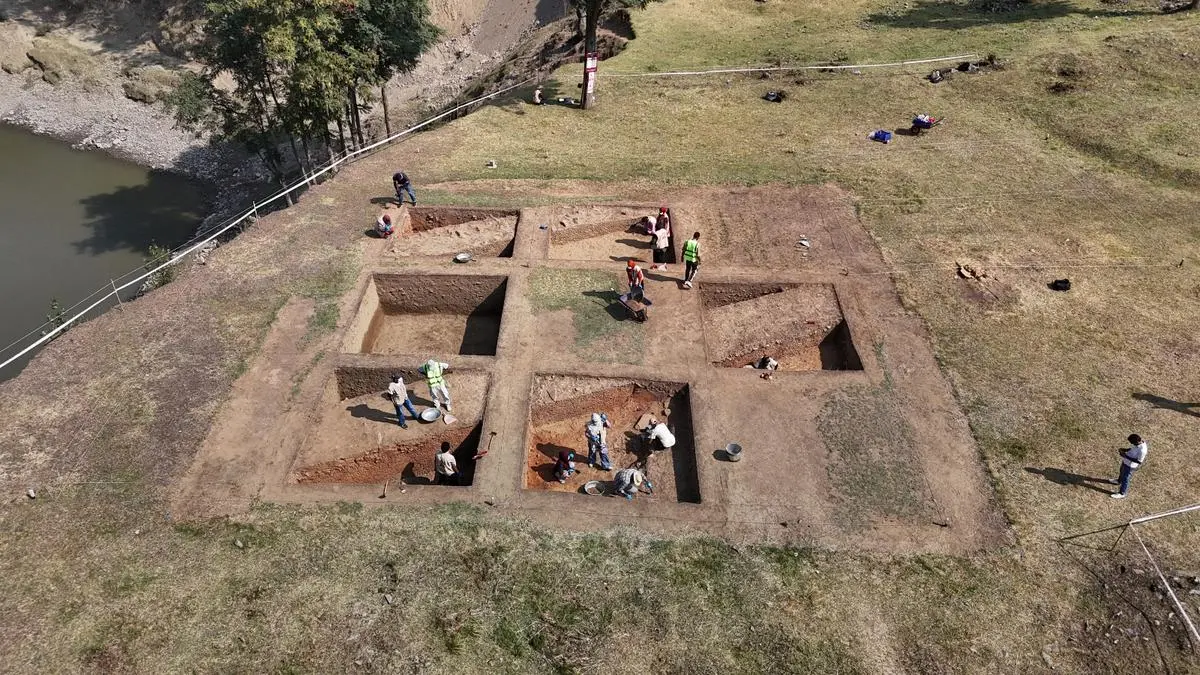
The excavation, which began on August 29, will move into unexplored portions of the nearly 2,000-year-old complex, with archaeologists seeking to establish its full extent, layout and nature of occupation.
The second phase of excavation at the Zehanpora archaeological site in north Kashmir’s Baramulla district will examine whether the ancient settlement formed part of a wider Buddhist cultural and communication network linking Kashmir with Gandhara, north-western India and potentially Central Asia.
The excavation, which began on August 29, will move into unexplored portions of the nearly 2,000-year-old complex, with archaeologists seeking to establish its full extent, layout and nature of occupation. The three-month exercise will use additional trenches, drone imagery, mapping and scientific investigation to identify structures and cultural deposits beneath the surface.
“Phase-II will expand excavation into the unexplored portions of the archaeological complex, with additional trenches and scientific investigation aimed at establishing the full extent and layout of the settlement,” said K.K. Sidha, Director, Archives, Archaeology and Museums, J&K.
He said archaeologists would pay particular attention to possible stupas, apsidal or chaitya-type structures, monastic or habitation remains, structural walls and associated cultural deposits.
The first phase had uncovered structural remains, pottery, iron objects and a human skeleton, providing clues about the settlement, its material culture and the people who inhabited the area.
The new phase is expected to determine whether the structures exposed earlier were part of a larger religious complex or a settlement that also supported habitation and other activities.
The archaeological evidence could also help researchers examine how Zehanpora fitted into the wider movement of people, ideas and goods in ancient times.
Sidha said evidence so far strongly indicated that Zehanpora formed part of a wider Buddhist cultural and communication network.
“Its location along the Jhelum-Baramulla corridor, historically an important north-western gateway into Kashmir, together with Kushan-period remains and architectural features showing Gandharan affinities, points towards cultural interaction with Gandhara and north-western India, and potentially wider connections extending towards Central Asia and the Silk Route,” he said.
Baramulla has historically served as a north-western gateway into the Kashmir Valley. Ancient travellers entering Kashmir through the corridor recorded Buddhist establishments in the region, while the area’s location along the Jhelum provided an important route for movement into the Valley.
The new excavation could therefore help researchers determine whether Zehanpora was part of this wider network and whether material recovered from the site reflects contacts beyond Kashmir.
“The evidence is particularly significant for understanding Kashmir not as an isolated region, but as a bridge for the movement of people, ideas, art, religion and trade between the Indian subcontinent and Central Asia,” Sidha said.
However, archaeologists have cautioned that the precise extent of Zehanpora’s trade connections cannot yet be established.
“Archaeological excavation is still underway; therefore, the precise extent of Zehanpora’s trade connections will be established through further artefactual, scientific and comparative analysis,” Sidha said.
Source: Read the original article on www.thehindubusinessline.com