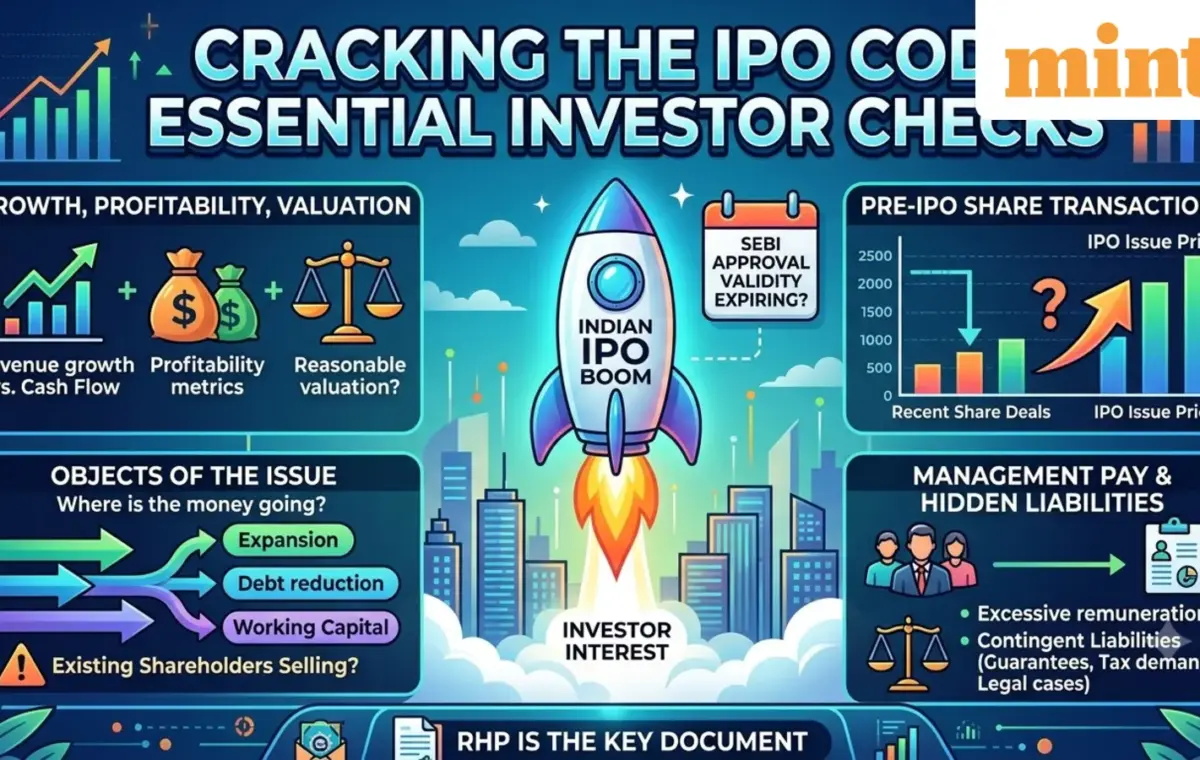
Initial public offering (IPO) activity in India is gathering pace, with companies raising around ₹22,400 crore through 26 August. More issues could hit the market before 30 September, when the one-year validity of Sebi approvals for several companies is set to expire.
Since IPO-bound companies do not have a listed-market track record or exchange trading history, investors largely have to depend on information provided before the listing. The red herring prospectus (RHP) is among the most important documents. Examining a few key sections can help investors identify warning signs, assess the company's financial health and decide whether the valuation being demanded is reasonable.
The proportion of IPOs that closed below their issue price on listing day has climbed to 37% so far in 2026, as of 26 August, compared with 33% in 2025. Nearly two-fifths of companies that have listed since 2022 were trading below their IPO issue prices as of 26 August 2026.
Investors should begin by assessing three key parameters—growth, profitability and valuation. A company showing rapid growth may still be an unattractive investment if its profitability is weak or its IPO valuation is excessive.
The financial statements can provide important clues. Experts caution that companies reporting accounting profits while consistently generating negative cash flow should be examined carefully. Persistent negative cash flows could indicate that reported profits are not translating into actual cash generation.
The "objects of the issue" section explains how the money raised through the IPO is intended to be used.
Investors should determine whether the proceeds will fund productive activities such as expansion, debt reduction or working-capital requirements. If existing shareholders are primarily using the IPO as an opportunity to sell their holdings, investors should examine the rationale closely. The concern is that limited fresh capital may be reaching the business itself.
Another important area is the company's recent share transactions before the IPO. Investors should examine the prices at which shares were issued or transferred in the months leading up to the offering.
For example, if an investor acquired shares six months before the IPO at a certain price and the public issue is now valued at twice that level, investors should ask whether the company's fundamentals have changed sufficiently to justify the sharp increase.
Any fundraising completed shortly before the IPO should also be studied, including the valuation, investors involved and circumstances surrounding the transaction.
Promoter and senior-management compensation should be compared with industry benchmarks. Excessively high remuneration may warrant closer scrutiny, particularly if it appears disproportionate to the company's size or financial performance.
Investors should also look beyond the headline debt figures and examine contingent liabilities. These potential obligations may not appear as conventional debt on the balance sheet but could result in significant financial outflows later.
The RHP's risk factors section can provide details on such exposures, including guarantees issued for other parties, disputed tax demands, ongoing legal cases and bills discounted.
Finally, investors should watch for repeated equity issuances and signs of working-capital stress. Frequent dilution or persistent pressure on working capital can point to underlying financial weaknesses that may not be immediately obvious from headline revenue and profit numbers.
Catch all the Instant Personal Loan, Business Loan, Business News, Money news, Breaking News Events and Latest News Updates on Live Mint. Download The Mint News App to get Daily Market Updates.