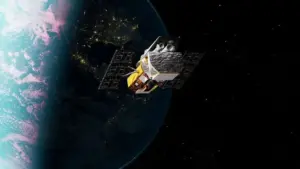
NASA’s Roman Telescope lifts off, starting a mission to explore the universe’s biggest mysteries
The Nancy Grace Roman Telescope will probe dark matter and dark energy, discover exoplanets and study stars
NASA’s newest telescope is officially on its way to deep space after more than a decade of development and high anticipation. The Nancy Grace Roman Space Telescope lifted off from Launch Complex 39A at the Kennedy Space Center in Florida at 7:26 A.M. EDT on Sunday, August 30 aboard a SpaceX Falcon Heavy rocket.
The telescope is set to transform our understanding of the cosmos—from the furthest reaches and most mysterious forces, to the planets and stars that make up our own galaxy and even objects in our solar system.
It will conduct these science observations from a perch at the second sun-Earth Lagrange point, or L2, some million miles behind our planet, where the sun and Earth’s gravitational pulls balance one another out. The effect essentially gives Roman a parking spot in space, enabling engineers on Earth to remain in constant contact with the telescope, while making sure Earth never blocks its view of the cosmos.
If you're enjoying this article, consider supporting our award-winning journalism by subscribing. By purchasing a subscription you are helping to ensure the future of impactful stories about the discoveries and ideas shaping our world today.
“Roman is poised to conduct extraordinary surveys that will impact every area of astronomy,” said Julie McEnery, Roman’s senior project scientist, at a press conference ahead of the launch on Saturday.
“We’ll perform a revolutionary census of planets around other stars, and may confirm that our standard model of the universe is incorrect and put us on the path to figuring out what is right,”
With an initial science mission lasting five years, the Roman will join NASA’s Hubble Space Telescope and James Webb Space Telescope in revealing the universe in ways we have never seen before. Among the secrets Roman will probe is the nature of dark energy and dark matter. Astronomers believe dark energy fuels the universe’s expansion, but its fundamental nature—is it constant, or is it changing?—is a mystery. Dark matter, meanwhile, is thought to be the glue that holds galaxies and other massive structures in the universe together, but again, its nature is an enigma and its existence remains unproven.
The telescope’s main survey will take at least a year, McEnery said at the Saturday press event—and its scale is incomparable. “We would need over half a million 4K TVs to fully display the single Roman image from our largest survey,” she said.
McEnery said that she expects Roman’s most exciting observations will be entirely unpredictable. “We’ll find new things that go bump in the night,” she said.
Roman is also outfitted with a special instrument called a coronagraph, which will enable the telescope to observe exoplanets with unprecedented sensitivity. “We think that we will be capable of detecting exoplanets that are about 100 million times fainter than their stars,” says Vanessa Bailey, Roman coronograph instrument scientist at NASA’s Jet Propulsion Laboratory.
We will need to wait some time before we get the first observations from Roman, however. After the telescope reaches L2, it will need go through a series of commissioning operations to fully come online. NASA expects its first images will be released in early 2027.
Editor's note: This is a developing story and may be updated.
Claire Cameron is breaking news chief at Scientific American. Originally from Scotland, she moved to New York City in 2012. Her work has appeared in National Geographic, Slate, Inc. Magazine, Nautilus, Semafor, and elsewhere.
Source: Read the original article on www.scientificamerican.com