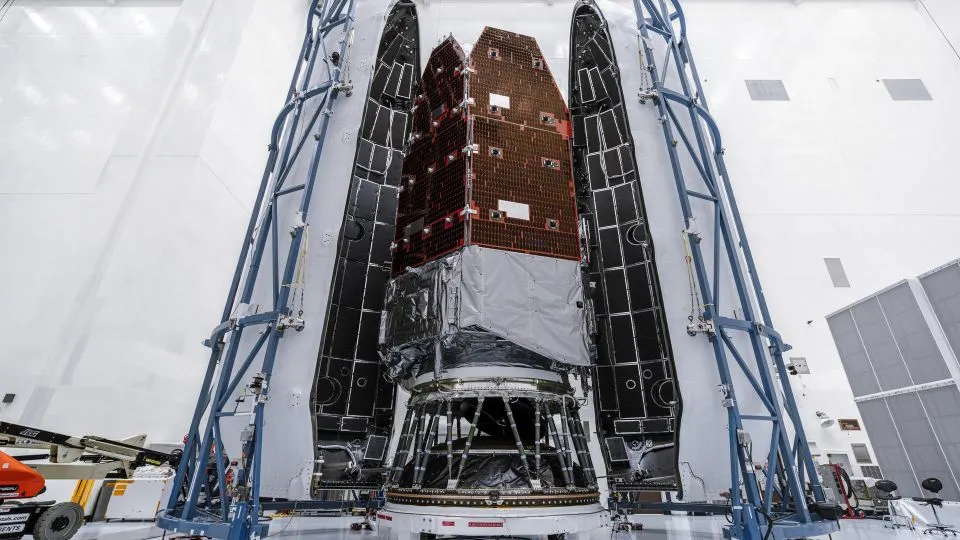
A massive observatory that scientists have called a "discovery machine" is set to launch toward the cosmos, beginning a journey that could mark a significant shift in our understanding of the universe.
Designed to seek out otherwise invisible and faint space objects, NASA's Nancy Grace Roman Space Telescope is expected to lift off aboard a SpaceX Falcon Heavy rocket as soon as 7:26 a.m. ET Sunday from Kennedy Space Center in Florida.
Over the next five years, the bus-size telescope's observations could reveal answers to enduring mysteries such as dark energy, which fuels the inexplicable accelerating expansion of the universe, and dark matter, which provides the cosmos with structure but remains unseen. It could allow astronomers to spot previously unseen galaxies and exoplanets, worlds around stars beyond our solar system, as well rogue planets that don't orbit stars at all.
"Roman will give the Earth a new atlas of the universe," NASA Administrator Jared Isaacman said as the space agency unveiled the completed telescope on April 21 at the Goddard Space Flight Center in Maryland.
With surveying capabilities more than 1,000 times faster than the Hubble Space Telescope, Roman will capture fundamentally different scientific observations that can't be done with either Hubble or the James Webb Space Telescope.
"Together, the three missions will complement each other, giving us a more complete picture of the cosmos and advancing our understanding of the universe," said Dr. Nicky Fox, associate administrator for NASA's Science Mission Directorate.
After the launch, Roman will take around three months to reach its orbital position of about 1 million miles (1.6 million kilometers) away from Earth.
In the meantime, the observatory will go through commissioning — testing out its instruments in space and deploying the antenna that will relay Roman's massive imagery back to Earth.
The telescope is expected to transmit one terabyte of data per day — like streaming 1 million songs from 1 million miles away down to Earth, said Jeremy Perkins, Roman telescope integration and test scientist at Goddard.
The estimated $4.3 billion telescope has been in development for about a decade and became a priority for the scientific community about 16 years ago. Scientists around the world are anticipating the unprecedented insights Roman could deliver.
"When you develop a tool that is radically different from anything you've had before, you will discover things that you didn't know were out there," said Dominic Benford, Roman program scientist at NASA who has been involved with projects related to the concept for more than 20 years.
"Part of what Roman is for as a discovery machine is to give people a way to ask the universe questions that we have yet to conceive."
Dr. Nancy Grace Roman, NASA's first chief of astronomy, laid the foundation for space-based observatories. – NASA
NASA's space telescopes have long explored life-altering questions, and in many ways, those capabilities are thanks to the observatory's namesake, the "brilliant astronomer" Dr. Nancy Grace Roman, said Dr. Shawn Domagal-Goldman, director of the Astrophysics Division at NASA.
Roman was NASA's first chief of astronomy in the 1960s and pioneered the idea of space-based astronomy observations, recognizing the power of lofting telescopes above Earth's obscuring atmosphere. She became known as the "mother of the Hubble Space Telescope."