During a visit to NASA's Jet Propulsion Laboratory three years ago, I stepped into a blinding white room. There, I came face-to-face with a space instrument that could one day be used to search for evidence of life beyond Earth.
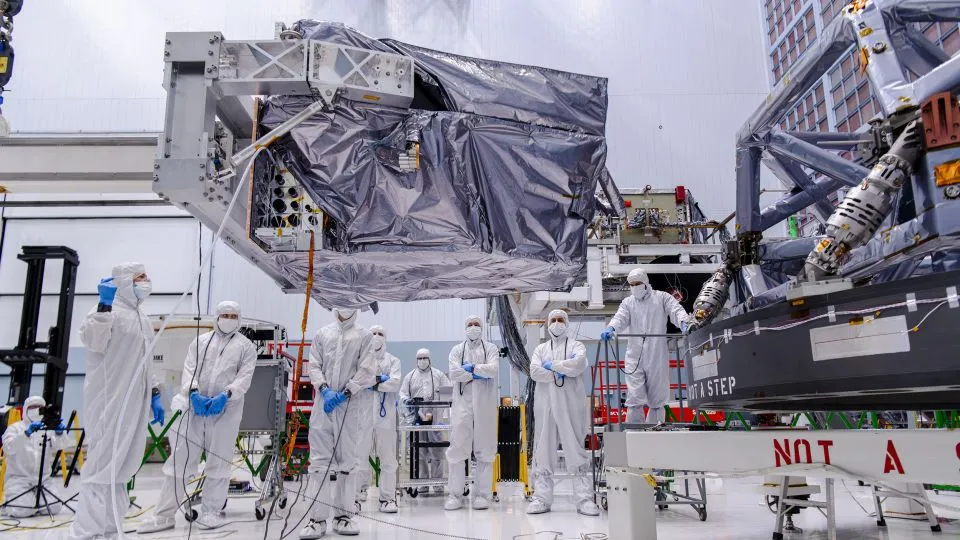
Each person who enters the clean room at the Pasadena, California, facility must wear a white "bunny suit" that covers virtually everything but their eyes.
The instrument, called a coronagraph, is so sensitive to contamination that I was given a list of things forbidden from entering the hallowed space — no makeup, lotion or scented products of any kind could be on my skin.
The instrument team invited me to step inside the coronagraph virtually by equipping me with a pair of VR glasses to see all its components and how they ultimately fit together. This crucial sci-fi-like process is employed early on when assembling such a complex feat of engineering.
Meeting people who had spent years developing the device — and hearing their hopes for what it could reveal to us — opened my eyes to the extreme dedication it takes to build a single space mission.
Now, the coronagraph is ready to study the cosmos aboard the Nancy Grace Roman Space Telescope, which could launch as soon as this weekend.
"Roman will investigate dark matter, dark energy and the structure of the universe itself, and accelerate the future of discovery of potentially habitable planets outside our solar system," said NASA Administrator Jared Isaacman when the completed telescope was unveiled in April.
Roman, named for NASA's pioneering chief of astronomy who realized the importance of space-based observatories, will complement the incredible cosmic discoveries made by the Hubble and James Webb Space telescopes. But much like its namesake, Roman will also forge a new path to uncover the unknown across the universe.
As NASA's newest flagship observatory, Roman will seek out previously hidden aspects of the universe to solve some of its biggest lingering mysteries, such as dark energy and dark matter.
The experimental coronagraph, nicknamed "starglasses," has the capability to block powerful starlight. The instrument's flexible mirrors can even react in real time to maintain incredible precision while capturing dazzling cosmic images.
This groundbreaking technology will enable Roman to search for faint, Jupiter-size planets — and maybe even spot clouds on those worlds.
If the instrument works as expected, it could one day be used to seek out distant Earth-like planets that may be able to support life.
Researchers studying modern DNA have discovered two "ghost" ancestors in the murky history of human evolution.
Neanderthals and Denisovans left behind fossils — from which scientists could extract DNA — as well as identifiable traces in human genes. But there has been no direct ancient DNA identified from the two newfound lineages to connect with the marks they left behind in our genomes.
Now, scientists have developed a new method to rebuild these lost branches of the human family tree.