How can a collapsing glacier generate such a powerful flood?
I would like to be emailed about offers, events and updates from The Independent. Read our Privacy notice
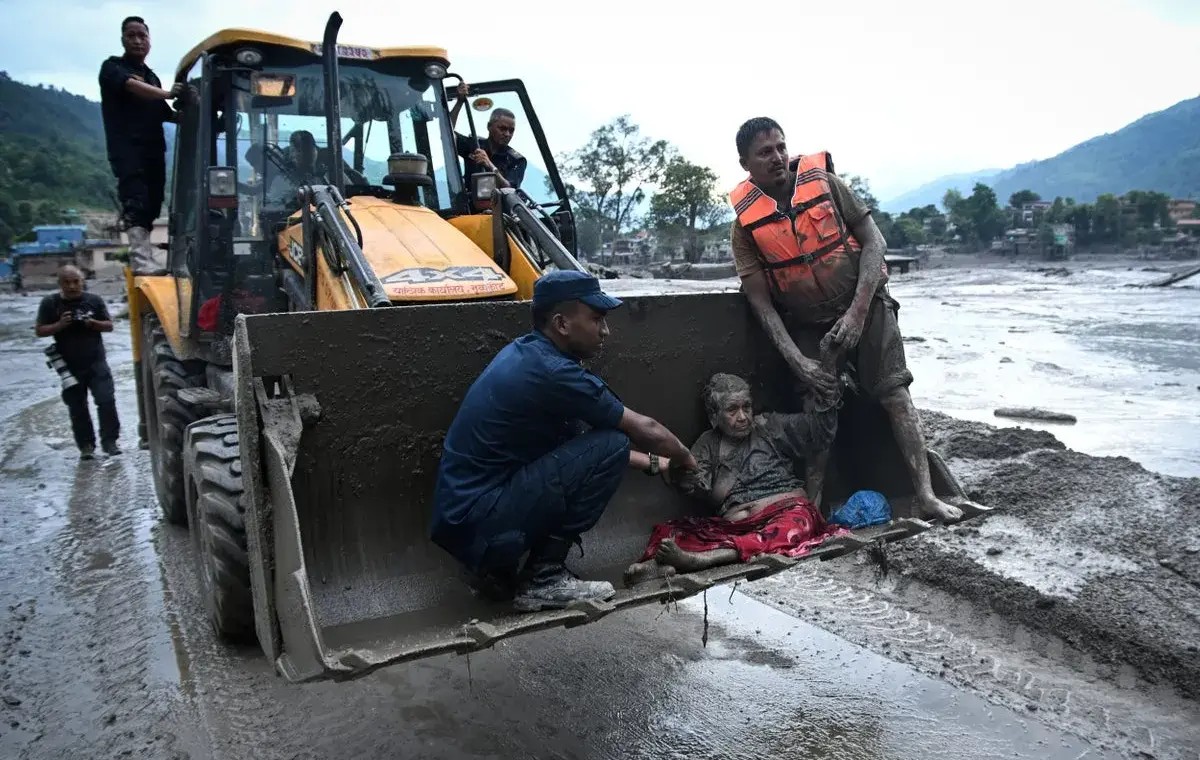
A collapsing glacier in Tibet led to a devastating wall of water and debris roaring through a valley in Nepal, leaving hundreds dead and many hundreds still missing.
Stuart Dunning is a professor of applied geomorphology who researches disaster risk reduction in high mountain areas and has closely studied the 2021 Chamoli disaster, a similar event. He’s part of a loose group of 50 or more international experts who come together to pool expertise and provide rapid analysis of events like these.
The exact sequence of events that sent so much debris and water downstream is something we are still trying to unravel. There are a number of possibilities. One is that a large bedrock landslide took the glacier with it. Another is that a bedrock landslide destabilised the glacier and it fell very shortly after. Another is that the glacier failed first and then the bedrock above failed.
I think the best description is that a rock-ice avalanche began at around 4,800 metres and fell over 1,200 metres. There was enough ice in the initial collapse – and perhaps subsequently picked up – that it could generate the water to turn it into a devastating long-runout debris flow. This is far more damaging than a dry rock avalanche.
The flow travelled along the river, gaining water. It would have been eroding the valley floor and sides as it went. Further downstream, that material will have been deposited across the landscape.
I’m part of a group of 50 or more hazard experts debating what to term this. It is easy to see why the first reports assumed it was a glacial lake outlet flood, or Glof, since that is perhaps the best known source of such cascades. However, in this case, there was no lake.
For now, I’m calling the whole “event” a hazard cascade or process chain. It started as a landslide of uncertain volumes of rock and ice. Most of that ice melted as a result of fragmentation and friction-generated heat. In other events we have found rounded bits of ice in the deposits that were transported along and then melted out much later.
Satellites are invaluable for a wide area picture of where the flood began – which is often in doubt at the start given the remote nature of the terrain – and where it travelled. With satellite data often updating daily, we can look for secondary hazards, such as water building up behind the debris, risking further sudden floods, or large sections of material that looks unstable.
It is the combination of ground data (photos, videos) and seismic data that lets us measure how fast it moved, how deep it was, how “watery” it was, which is then combined with the wide area satellite data.
In general, ice is thinning and retreating. What that leaves throughout the Himalayas are glacial lakes (not an issue for this event) and slopes that are often unstable. This is combined with thawing permafrost, sometimes described as the “glue” holding bedrock together.
So, climate change plays a role – perhaps an increasing one – alongside other preconditioning factors such as earthquake damage to rock, rapidly uplifting mountains that gravity wants to bring down. And these events are more devastating because there are more people living in these landscapes than at any time in history.
There are more “reported” hazard cascades like this, but, extreme events are just that, extreme and rare, our knowledge back in time is not always strong enough to say with absolute certainty that we have crossed a threshold and there will be more disasters of this kind or even bigger.
Events become disasters when they exceed our ability to cope. Little could withstand a wall of mud, rock and water moving at that speed. Anything on the valley floor, or up on the lower valley sides as the flow washed around corners was at risk.