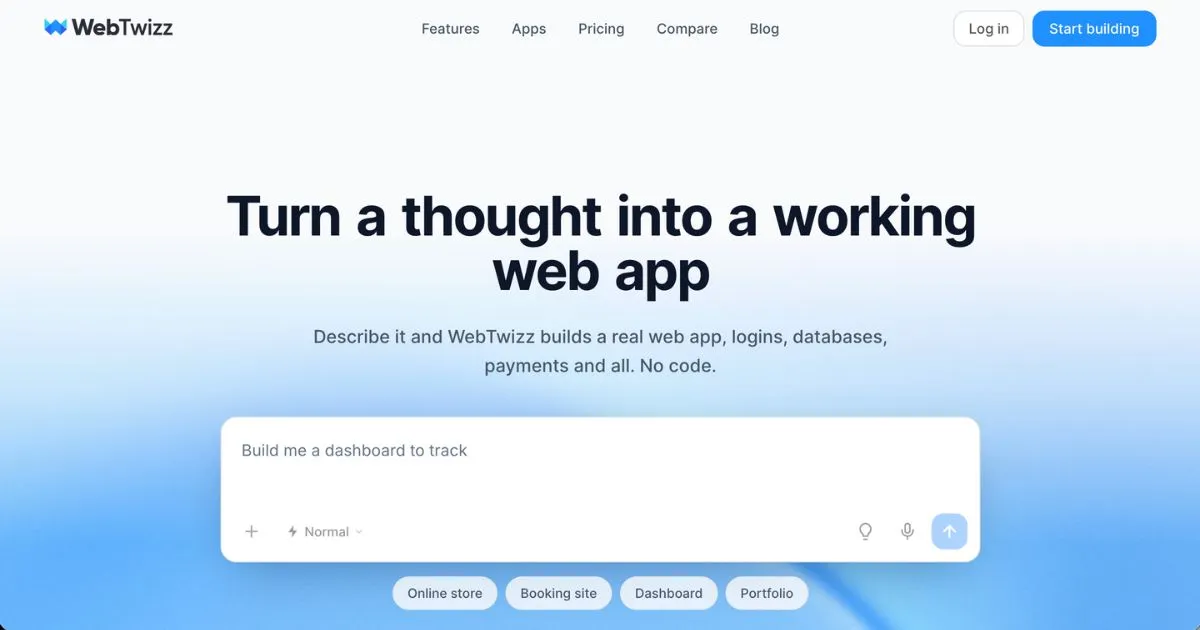
Webtwizz: AI-powered app builder turns plain ideas into full web applications, supporting user-friendly design and backend features.
Webtwizz is an AI-powered app builder designed to take ideas expressed in plain language and turn them into live, fully functional web applications. It supports the full stack of features needed for production apps—including user authentication, databases, payment processing, and styling—without requiring setup of backend infrastructure. Users can both build visually and fine-tune the UI or code if desired. Webtwizz’s engine generates responsive apps that work across desktop, tablet, and mobile.
Custom app generation: Users describe their intended app in simple terms, and Webtwizz produces a full web app scaffolded with features like authentication, database integration, and payments. No backend setup is needed. A visual builder enables real-time edits. There’s also a built-in code editor using Next.js and Tailwind CSS for deeper customization.
Flexible design and control: Every element in the app—typography, color, spacing, layout—is adjustable through clicks. Users can reuse sections (“blocks”), drop images from built-in sources, and restyle content inline. Changes are reflected live in the builder.
Data, integrations, and hosting: Webtwizz integrates with third-party tools like Supabase (for database/CMS), Stripe (for payments), OpenAI and Anthropic (for AI), Resend and PostHog (for email/analytics), etc. Users can deploy to production with one-click publishing, assign SSL certificates, and connect custom domains (on paid plans).
Ownership and portability: The output is a standard codebase that users own. It supports GitHub sync, and source can be exported. This ensures the app isn’t locked into Webtwizz’s hosted runtime.
Non-technical founders and small business owners who want to launch SaaS, marketplace, internal tools, dashboards, portfolios, or booking sites—without hiring developers—will find Webtwizz appealing.
Teams with developers: Because Webtwizz gives access to the underlying source code and supports full frontend/backend stack with Next.js and Tailwind, it’s also suitable for dev teams or technical product leads who want to speed up prototyping or reduce boilerplate.
Agencies, designers, and professionals looking to build client projects or internal systems quickly with control over design and infrastructure will benefit—especially those who need custom branding or wish to own their app’s code and deploy it on their own infrastructure.
Starter: Free plan with 30 daily free credits (up to 150 per month), plus a one-time 120-credit signup bonus. Publish one site.
Standard: Priced around $25/month (discount to $21/month if billed annually). Includes custom domain support, removal of Webtwizz badge, up to five sites, and higher credit allowances (e.g. 1,500 recurring monthly credits) on top of the daily credits.
Pro: Approx. $50/month (annual billing gives two free months). Supports more credits (e.g., 4,500 to 9,000 monthly), up to fifteen published sites, priority support, everything in Standard plus elevated usage.
Custom: Intended for teams or agencies with high-volume or bespoke requirements. Offers dedicated support, SLA guarantee, and flexible, custom credit limits.
Webtwizz offers a compelling balance between simplicity and control. It saves time for non-technical users by handling backend setup, infrastructure, and integrations while still providing design fidelity and code access. For businesses that need to launch real, user-facing applications—SaaS, marketplaces, dashboards—with payments, authentication, and ownership of code, it can be a strong option.
Potential users should assess credit usage based on their app’s complexity (features like billing, search, or user data increase usage). Also consider support expectations—priority support is reserved for higher tiers—and verify compliance and security needs, particularly if handling sensitive user data. For many small businesses, startups, or internal tool needs, Webtwizz offers enough flexibility and control without the cost and overhead of traditional app development.