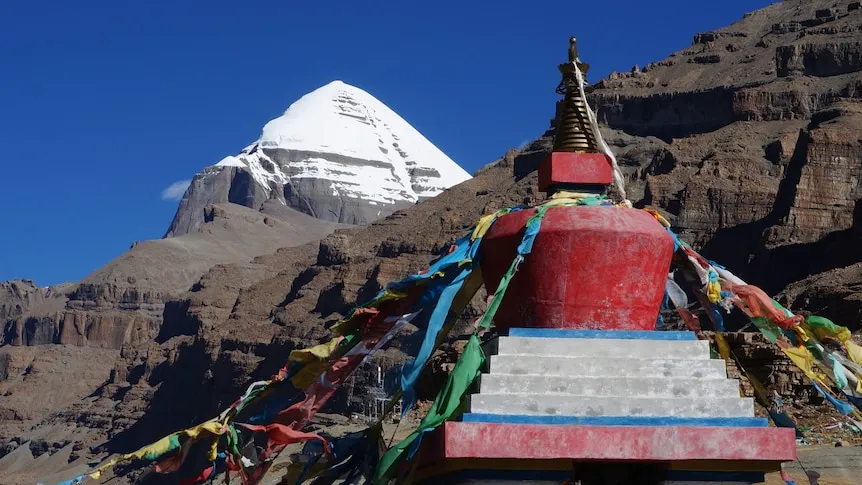
Thousands of foreigners make pilgrimages to Mount Kailash each year. (AFP: Wang Yunjia/Xinhua)
Most of the Australians missing after the flash flood that struck the Himalayas on the border of Nepal and Tibet were pilgrims to a spiritually important mountain known as Kailash.
While the identity of many of the 38 missing Australians has yet to be formally confirmed, three tour companies have reported that at least 32 were on trips to visit the remote peak.
Thousands of people from all over the world visit the mountain in south-western Tibet each year, with many travelling via the major highway destroyed on Wednesday by the catastrophic wave of water, mud and rocks.
Nepal flash floods updates: Follow this story as it unfolds with our live blog.
Mount Kailash holds significance for Hinduism, Buddhism, Jainism and the Tibetan Bon tradition. Each associates the mountain with different beliefs and sacred histories.
Geographer Emily Yeh, a professor at the University of Colorado Boulder, who has conducted research in Tibet, wrote in 2017 that Kailash is associated with the mythical Mount Meru, considered the centre of the world in Hindu and Buddhist cosmology.
Some survivors say they have lost everything after the Nepal-Tibet floods that killed at least 469 people and left thousands missing.
According to the International Centre for Integrated Mountain Development, the mountain is considered the home of Shiva, the Hindu god of destruction, and Parvati, a Hindu goddess associated with marriage, fertility and motherhood.
Followers of the Tibetan Bon tradition regard it as a seat of spiritual power and associate the region with Tonpa Shenrab, the tradition's founder.
Mount Kailash is a significant site for Hinduism, Buddhism, Jainism and the Tibetan Bon tradition. (AFP: Michael Runkel/Robert Harding Premium)
India's government operates an official Kailash Manasarovar pilgrimage from June until August or September each year, with routes through the states of Uttarakhand and Sikkim.
Private operators — including several Australian tour companies — also organise pilgrimages via Nepal.
The peak rises more than 6,400 metres above sea level and close to Lake Manasarovar, which is also a significant spiritual site. Pilgrims traditionally walk around the mountain rather than climb it, completing a roughly 53-kilometre circuit.
The circuit is believed to cleanse pilgrims of their sins and can take about three days to complete. Hindus and Buddhists traditionally circle the mountain clockwise, while followers of Bon travel counterclockwise.