Text by
Jennie Rothenberg Gritz
A seashell is the story of a creature’s life, written line by line. Soft-bodied mollusks protect themselves with crystals of calcium carbonate, adding new layers as they grow. The bands and ridges may reveal changing seasons, diets and life cycles. The shells’ many shapes also reflect how different species have evolved over the 500 million years since mollusks first appeared. Back then, their shells were simple caps and coils. Today’s mollusks include fanlike scallops, spiny conchs and spiraled nautiluses.
Yet most people who pick up shells on the beach don’t give much thought to the animals that made them. “The average citizen will say, ‘Well, I thought they were just there,’” says José Leal, the science director and curator at the Bailey-Matthews National Shell Museum, on Sanibel Island, Florida. Leal reminds museumgoers that shells aren’t simply formed by the elements the way rocks are. A mollusk absorbs calcium and carbon from the water and fuses the molecules together, generating a rocklike material out of a body part called a mantle. Bivalves—such as clams, oysters, mussels and scallops—encase themselves between two hinged shells. Sea snails build a single swirling shell that resembles the top of a soft-serve ice cream cone.
How do these creatures produce such a range of colors and patterns? “That’s the $64,000 question,” Leal says. The colors are part of a protein matrix that binds the crystals together. Leal’s colleague Suzanne Williams, at the Natural History Museum in London, has studied the pigments—pink and yellow porphyrins, brown and black melanins, orangy carotenoids—and found that certain genes switch the production of certain colors on and off, making dots or stripes. Patterns may help an animal camouflage. But many sand-dwelling mollusks have spotted shells that make them stand out, not blend in. Distinct patterns may help creatures of the same species recognize one another, but mollusks have poor color vision. “We have no idea about many, many things,” Leal says.
By the time people find seashells on the beach, they’re usually empty. The mollusks once inside them have shriveled up and died, or have been plucked out by seabirds. The shells are still intricate and beautiful, but the colors often dull when the life inside them is gone. Once the creature dies, the shell becomes like any other object left in the sun and salt water. The crystals begin degrading, and the shell weathers and fades. Some tiny mollusks have clear shells that turn opaque when their inhabitants depart.
Fun facts: More about shells and the animals inside them
Shells are more than 95 percent calcium carbonate. The remainder is protein and chitin that control the shell’s strength and shape.
Mollusks have the widest variations in eye structure of any animal phylum.
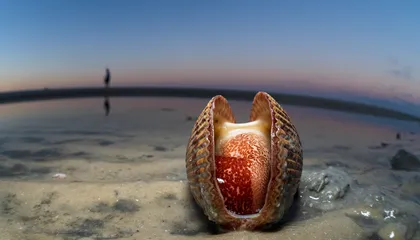
Now and then, especially at low tide, a beachgoer might spot a mollusk’s living foot emerging from a shell. This long, flexible muscle allows the creature to crawl, dig, swim or grasp prey, depending on the species. Clams use their feet to anchor themselves in the sand. Conchs use theirs to leap across the ocean floor.
“Kids pay way more attention to that stuff,” says wildlife photographer Devon Matthews, who traveled to Sanibel Island from his native Minnesota to shoot this story. “But sometimes it’s easy to just walk by things and not really look at them too closely.” Matthews is an experienced macrophotographer—capturing up-close images of tiny insects—and he found innovative ways to photograph mollusks peeking out of their shells, using special camera attachments and natural light. “I think seeing photos of them up close may help evoke some of that wonder again in adults,” he says.
Leal remembers his own sense of wonder, growing up in Rio de Janeiro. “Back in the late ’50s, early ’60s, that place was paradise,” he says. “There was so much in the way of living things that you cannot see anymore because of human encroachment and water pollution and all that. It was magical, going places on rocky coasts and seeing live crabs and live worms, and the mollusks. I mean, just mind-boggling.”
Leal spent two years as a postdoctoral fellow at the Smithsonian’s National Museum of Natural History in the mid-1990s, studying deep-sea mollusks. Since then, he’s been at the museum on Sanibel Island, where much of his work is about educating the public. Sanibel’s seashells are a huge tourism draw. The island is unusually broad, running perpendicular to the Florida coast, and currents deposit more than 400 shell species on its 15 miles of beaches.
When visitors arrive, enthralled by the island’s beauty and variety, Leal tells them how important it is to protect the creatures that live there. That means thinking about larger environmental systems. The water is becoming more acidic as carbon from the air sinks into it. That changing chemistry makes it harder for mollusks to form and maintain their thick shells.
Leal also teaches people to avoid taking home living mollusks, which is illegal on Sanibel Island. Tourists are most tempted by iconic larger shells, like tulip snails, horse conchs and lightning whelks. But when they see a foot sticking out—or when the shell feels especially heavy—it’s important to leave the creature in peace. “If you think the shell is cool,” Leal says, “now you know that there is a cool animal that made it.”
This article is a selection from the September/October 2026 issue of Smithsonian magazine