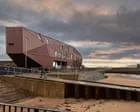
In the shadow of the crowded Lake District, this quiet coast path offers great views, breathtaking nature and a striking new hotel on the historic waterfront
What’s the edgiest region in the UK? I don’t mean in the sense of sketchy or fashionable, but where on the map of these four nations feels most at the margins of everywhere else? For my money, the north Cumbrian coast is a strong contender. Hemmed in by the Lake District fells on one side and the Solway Firth and Irish Sea on the other, this strip of towns and villages, farms and nature reserves, clinging to the low-lying littoral, has been battling nature, weather, geology and geography throughout its history.
Coastal erosion is part of the challenge. Like the railway navvies before them, the planners and builders of the England Coast Path (ECP) have done sterling work at plotting a viable footpath and shoring it up. But there are and always will be sections that are compromised and even impassable. I chose a section that would take three days, walking southwards, and my final destination, St Bees, was only reachable via a diversion. It’s all part of the adventure, and we’re lucky to have the ECP as a national trail, as it means issues and obstacles on the English coast will usually be promptly addressed.
I began my walk at Maryport, a natural choice as it’s where the Cumbrian Coast Line, travelling south from Carlisle, meets the seashore. I resisted the urge to jump off the train and set off walking, instead taking time to look around. I’m glad I did. It’s a lovely place, in a ramshackle way, and quite fascinating. The Romans, who called it Alauna, built a fort here; the Senhouse museum boasts Britain’s largest collection of Roman altars and inscriptions found at a single site.
An LS Lowry trail takes in places he painted. I followed it from the church beside the quay, up the steep town steps, and along some of the streets he worked into his compositions. Information panels celebrated less well-known, similarly gifted local painters: Sheila Fell, from nearby Aspatria, and Percy Kelly, born in Workington, known for his thick lines and dark landscapes, who played for Workington AFC under Bill Shanklyand, in later life, became Roberta Penelope.
Out on the coast path, I took in my first views of Dumfriesshire to the north. There were few walkers on the empty strand. At Flimby, the “path” was just a line of kelp on a pebble beach, bordered by flowering sea kale. Clouds of cabbage white and small blue butterflies sprang up as I walked. West Cumbria is the only area where the latter can be found in northern England. An unfamiliar call and a flutter of white wings sent me to my birder app. It was a pair of sandwich terns – an “amber” status bird on the RSPB website.
There were patches of heather and rosehip, occasional dunes and a few birds. Swallows picked off flies. Herring gulls shouted. Black-headed gulls planed. Carrot-beaked oyster catchers fluted their alarm calls. On my left, above the marram grass, I could see industrial plants and old workers’ terraces. The Cumbria coast is more Morrissey lyric than Countryfile fantasy. Boulders have been arrayed to protect against storms. Two teenage girls bronzed (or pinked) themselves on rocks in the midday sun.
Workington welcomed me, after seven miles. I’d been here before, for a “Where tourists seldom tread” feature for this newspaper, but it felt new arriving on foot and from the shore. Workington looks as its name sounds. Decades of industry have made the people steely and friendly. I spent the night above town at the Hunday Manor hotel, which has superb views over the coast and back to the fells.
The next day’s walk to Whitehaven was the longest at about 12 miles. The opening stretch, back down into Workington, was a pleasant surprise. From above town, I’d noted fuel silos, warehouses and industrial estates, but around the harbour the land was all grassy knolls. I could see Scafell Pike rising up to the south-east, and Scotland shimmering to the north. In the distance were cliffs and a wide inlet – my destination, Whitehaven.
I undertook this walk during the the UK’s fifth heatwave, one of the driest, warmest periods in living memory in these parts. As the mercury rose, I climbed up on to the clifftops, pausing at the Howe, a hill originally created from industrial slag, to gulp down water and look up at a 3-metre steel and wood crucifix put up by a local man in memory of his wife. From here, there was a messy section with scant waymarking, but I eventually came to Harrington, a bonny little suburban village, with kite flyers on the bluff and smart little terraces marching up the side streets. I ate lunch and watched trains come and go; they’re regular enough that you can always cut short a walk and hop on one.
Up on the cliffs again, I passed a large windfarm, and approached the village of Parton on a bridleway that sliced through sheep fields. The air was filled with the hairy seeds of thorns, bursting in the heat.
A path beneath dramatic sandstone cliffs guided me into Whitehaven. One of northern England’s loveliest towns, it has all the amenities a tired walker needs. But while it caters to visitors, it hasn’t sold its entire soul to tourism – which is the case with some Lakeland towns.
Get travel inspiration, featured trips and local tips for your next break, as well as the latest deals from Guardian Holidays
Whitehaven used to be an industrial powerhouse, shipping tobacco, coal, ceramics, iron ore, limestone and textiles, and it was the fifth most active British port involved in the transatlantic slave trade. The older streets are lined with crumbling mansions. Victorian-era lighthouses and a chimney known as the Candlestick are unmissable landmarks; between these are ghostly traces of tenements, coastal batteries and long-silenced engine houses. Silting and larger ships led to the town being eclipsed by the deepwater ports of Liverpool and Glasgow. Shipbuilding moved to Belfast. Nostalgia, grit, grandeur and decay all mingle in Whitehaven’s collective maritime memory.
I swotted up on Whitehaven’s layered history at The Beacon, one of the UK’s finest and most rejuvenating town museums. Underneath the museum, the Howling Wolf Bakery and cafe serves delicious cakes, toasties and coffee. There are great restaurants all over town – I can recommend The Peddler, in the former bus station, and Zest on the waterside – and every kind of pub, chippy and cafe.