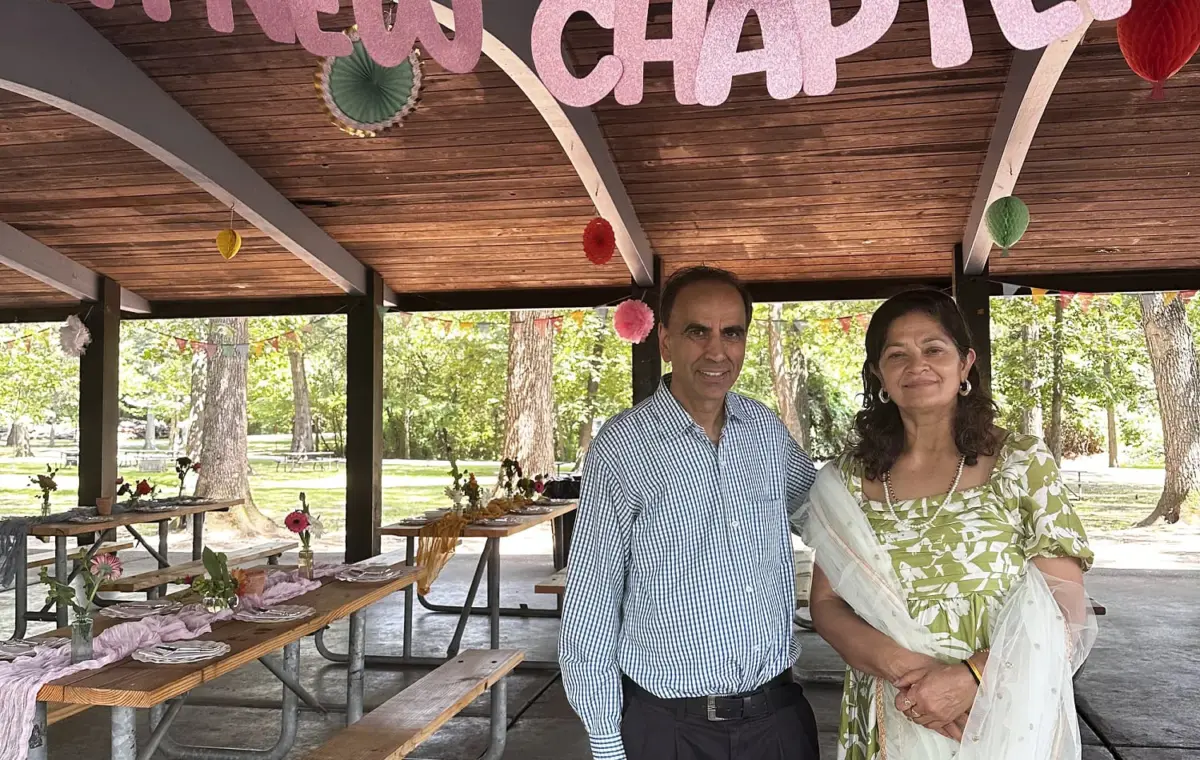
The last time Radhika Sharma heard from her parents, they had just crossed from Nepal into Tibet.
Ramesh Sharma, 65, and Neelam Sharma, 64, who live in New York and are U.S. citizens, were making a religious pilgrimage to Mount Kailash, a peak in Tibet considered sacred by Hindus, Buddhists and other faiths. Shortly after their border crossing Wednesday, a towering torrent of water, rock and mud tore through the same Himalayan corridor.
Videos from the hardest-hit border regions showed people running as the debris flow swallowed buildings and vehicles, devastated towns and settlements, and severed roads, power and communications. The suspected collapse of a melting glacier shook the ground so violently that seismic monitors initially registered it as a magnitude-4.4 earthquake.
In one video from Mailung, in Nepal’s Rasuwa region, a group of construction workers was seen walking down a mountain path before noticing giant plumes of brown debris in the distance, rapidly cascading toward them. The men reversed course to flee uphill, one briefly stopping to film before realizing the scale of the danger.
He shouts in Nepali: “Oh, my God, the flood is getting so big! Let’s run — run fast, guys! Oh, my God, get back quickly!”
As of Friday morning local time, authorities had recovered 469 bodies in Nepal and confirmed three deaths in Tibet. Hundreds more remained unaccounted for. Nepal’s Tourism Board said 644 travelers, including 65 Americans, were missing.
Sharma’s parents were among a group of seven people making the journey to Mount Kailash, visited by tens of thousands of pilgrims each year.
“It has probably been the worst 24 hours of my life,” Sharma, 32, a doctor based in North Carolina, said in an interview as she continued an anxious wait for news.
The hardest part, she said, was the not knowing. She has contacted the U.S. embassies in Nepal and China, as well as American officials domestically. “I haven’t heard anything back”, she said.
After posting pleas on social media, she has been put in contact with people in Nepal “who are trying to help track down my parents,” she said. “I’ve given them my parents’ information, their photos. I’m on the phone now, just waiting to hear someone say that they’ve even seen them.”
Sharma is far from alone in desperately seeking information about loved ones.
The State Department said in a statement Wednesday that it was “working closely with local authorities to locate and assist U.S. citizens in the affected areas,” telling concerned relatives to contact its emergency line.
Even before the disaster, this was a remote, mountainous area where travel and communication were difficult. The flood then destroyed roads and knocked out power and phone networks, leaving families unable to establish even the most basic facts.
In Baidur, Nepal, Shova Shrestha, 33, has spent more than a day waiting for news of her missing husband, Rajan Shrestha, as rescue efforts continue.
“I keep looking at each helicopter, hoping he will step out of it,” she told The Associated Press.