Woolston Eyes in Warrington, a dumping ground for canal dredgings, has become best place in UK for black-necked grebe
A dumping ground for dredgings from the Manchester Ship Canal has become the best place in Britain for the rare and beautiful black-necked grebe, hosting 64% of Britain’s breeding population.
Since 2021, Woolston Eyes in Cheshire has been restored, extended and turned into a mosaic of freshwater pools, reedbeds, willow scrub and rough grassland, managed by the RSPB and Woolston Eyes Conservation Group.
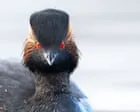
Wetland areas on a dried-out and overgrown settlement lagoon were revived and nesting islands created, with the aim of attracting black-headed gulls, which black-necked grebes nest beside for protection from predators. The wetlands also provided a new wealth of invertebrate food for the glossy black and chestnut-coloured birds, which sport tufts of gold feathers behind ruby-red eyes.
In 2023, four pairs of black-necked grebes bred on the newly restored area, successfully raising 15 young. By 2025, 35 pairs of black-necked grebes were recorded, 29 of which nested on the newly restored wetland area. The total represents 64% of the average number of breeding pairs recorded annually across the UK.
“It is fantastic to see black-necked grebe numbers increasing at Woolston Eyes thanks to the hard work of staff, volunteers and partners to create prime habitat for this rare and attractive species,” said Gavin Thomas, an RSPB ecologist. “The rapid growth in numbers shows how effective targeted conservation action can be and is a great example of nature thriving when it is given a chance.”
The site of special scientific interest (SSSI) in Warrington is also a stronghold for other rare and unusual species including willow tit, pochard and grasshopper warbler.
While Woolston Eyes relies entirely on rainfall to remain wet, water can be moved between areas so they can be dried out, refreshed and reflooded – a crucial rotation for the black-necked grebe, which will abandon wetlands that become too “mature”.
Thomas added: “Black-necked grebes are just a handful of the millions of breeding, wintering and migratory birds that rely on the UK’s internationally important wetlands. Seeing the number of black-necked grebes continuing to increase at Woolston Eyes makes all the hard work worthwhile.
“It demonstrates that restoring and managing wetlands is vital for species recovery, but we absolutely need to scale this up and deliver far more sites like Woolston throughout the UK.”