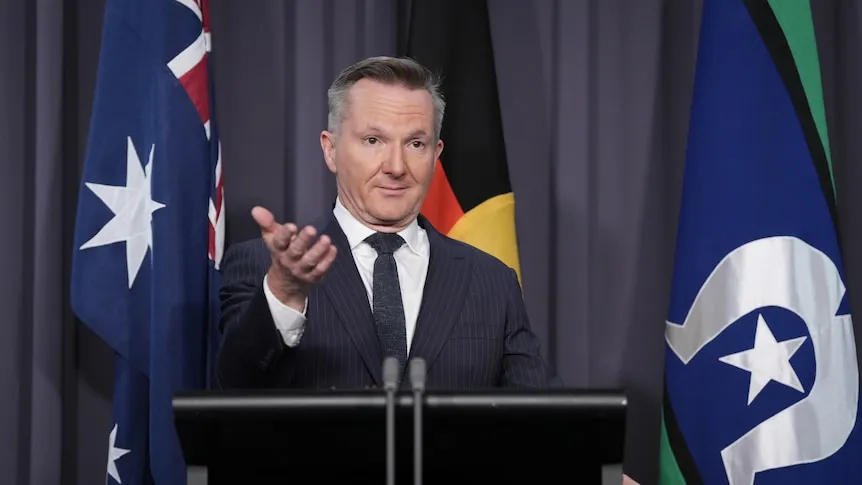
Chris Bowen has slapped down Queensland and the Northern Territory, insisting they have not been given a carve-out from new data centre rules. (ABC News: Matt Roberts)
Energy Minister Chris Bowen has rejected claims Queensland and the Northern Territory secured a carve-out from new rules requiring data centres to use 100 per cent renewables.
States will be able to seek approval to use alternatives like coal or gas, but Mr Bowen says the Commonwealth will have the final say and the threshold will be "very high".
The federal government will release draft national data centre standards before seeking to pass the legislation early next year.
Queensland and the Northern Territory will not have control over how data centres are powered, the federal government insists, declaring there will be "no exceptions and no carve-outs" under its renewables plan.
Energy and Climate Change Minister Chris Bowen told the ABC the national standards governing the development of data centres in Australia would still require them to bring their own "100 per cent" renewable energy plus firming through battery storage or gas.
Mr Bowen has rejected claims this element of the Commonwealth's plan was watered down after a meeting of national cabinet on Wednesday where Queensland Premier David Crisafulli claimed a "win" that would allow his state to decide how data centres were powered.
"So, as we said we would, we are legislating nationally consistent standards across the board with no exceptions and no carve-outs," Mr Bowen said.
Australia’s appeal as a destination for data centres has given it bargaining power in the AI boom.
"The only change is that where a state owned government electricity company asserts that they can do it cheaper than renewables, they can apply to the Commonwealth to do that."
Premiers and chief ministers signed off on new data centre standards requiring data centre operators to invest in new renewable energy to offset their power usage, but also gave flexibility for state-owned electricity assets.
This was widely interpreted as a capitulation to Queensland and the Northern Territory, which had both insisted they would not be dictated to by Canberra.
Mr Bowen said it would be up to the Commonwealth to "decide" whether to let states use coal or gas as a main power source, and they would have to prove it was "cheaper and better for the grid than renewables would be".
"[That] is a very high bar and very difficult to do, but some states may choose to do that," he said.
Mr Bowen said the Australian Energy Regulator (AER), on behalf of the Commonwealth, would consider states' applications and "make a decision".