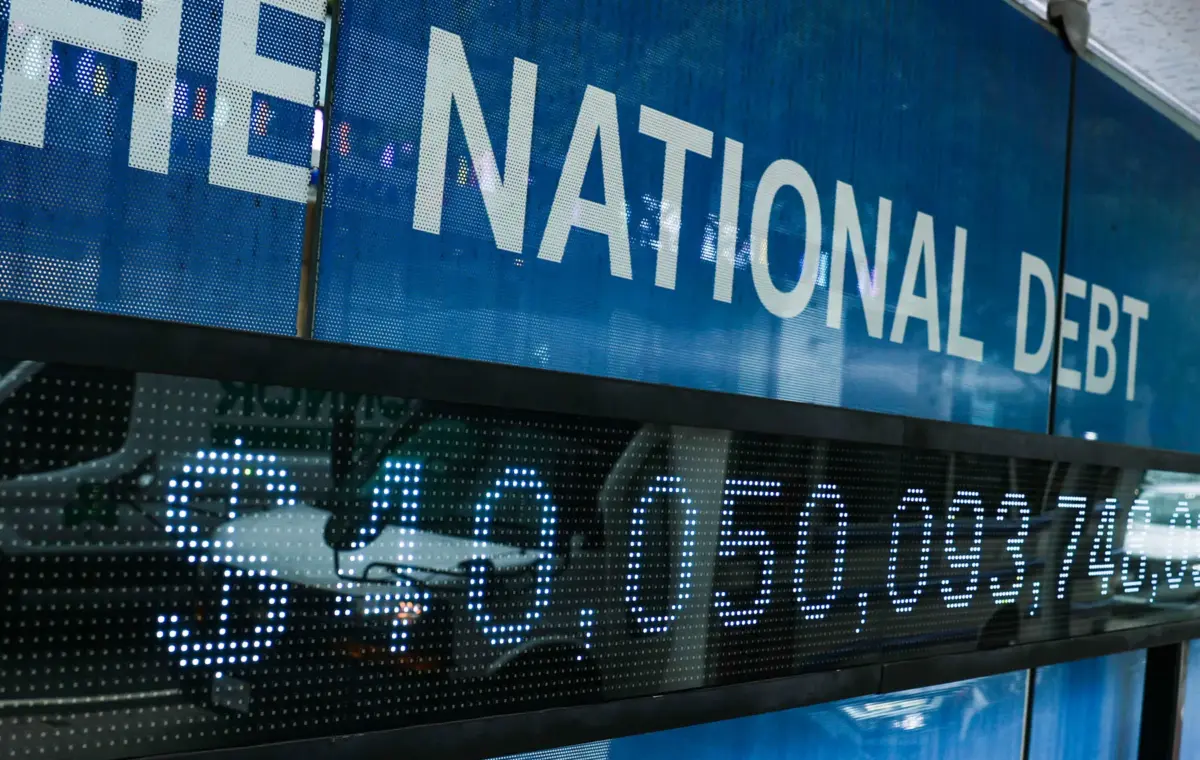
The relative indifference to the news that the U.S. government now owes $40 trillion demonstrates how drastically the politics of deficit spending has changed.
Peter Baker is the chief White House correspondent and has covered presidents struggling with deficits for most of the past 30 years.
It used to be that a new report of budgetary red ink would touch off a political crisis in Washington. There would be speeches and news conferences and blue-ribbon commissions and legislation and brinkmanship over how to get the nation’s fiscal house in order.
But when the national debt topped $40 trillion last week — that’s trillion with a T — the collective body politic all but shrugged. Never mind that the U.S. government now owes twice as much money as a share of the economy than two decades ago. Republicans and Democrats issued perfunctory, my-we’re-concerned statements and promptly moved on.
The bond markets were not so sanguine, as a sell-off indicated, but the relative indifference in the nation’s capital demonstrated how drastically the politics of deficit spending has changed in recent years. For generations, the nation’s fiscal imbalance was a constant preoccupation of presidents and members of Congress, a defining issue that shaped the rest of their agendas. Now it seems to be barely an afterthought as Washington borrows heavily to finance tax cuts and spending programs.
Both parties are engaged in a kind of conspiracy of silence about the eye-watering numbers, preferring to concentrate on other issues, whether it be the Iran war or the cost of living. President Trump is busy trying to restrict mail-in voting in the midterm elections and build his ballroom. Democrats are busy tying Republican opponents to an unpopular president in hopes of taking back one or both houses of Congress.
It has been 15 years since the last time Washington engaged in a serious bipartisan effort to curb the deficit, and both political polarization and government indebtedness have only grown exponentially since then. Few think that today’s leaders would or could come together anytime soon to make the hard choices, compromises and sacrifices that analysts say are necessary.
“The fiscal situation has never been worse and yet the political situation has never been worse and so we are absolutely unable to meet the moment,” said Maya MacGuineas, the president of the bipartisan Committee for a Responsible Federal Budget, one of the few institutions in Washington that still consistently focuses attention on deficit spending.
We are having trouble retrieving the article content.
Please enable JavaScript in your browser settings.
Thank you for your patience while we verify access.