Kurt Knutsson, 'The CyberGuy', joins 'Fox & Friends' to showcase the World Humanoid Games in Beijing, China. Over 2,000 robots and 600 teams from 16 countries compete in athletic competitions including sprinting, boxing, and soccer. Knutsson discusses how the U.S.-China tech race is expanding into humanoid robotics as developers push the boundaries of artificial intelligence.
If your mental image of a humanoid robot still involves stiff knees and awkward demos, you may want to update it. A Chinese humanoid robot has now covered 100 meters faster than Usain Bolt's 9.58-second human world record. At the opening of Beijing's World Humanoid Robot Games, an X-Humanoid robot completed the 100-meter sprint in 9.39 seconds. Then the number dropped again.
X-Humanoid announced on Aug. 25 that TianGong Ultra ultimately posted a 9.32-second time during the competition. The company says its robots reset the mark several times during roughly two hours of racing. Before anybody starts rewriting the Olympic record books, keep some perspective. Bolt still holds the official men's 100-meter world record recognized by World Athletics. These robots compete under their own rules in a separate event.
CHINESE ROBOT BREAKS HUMAN WORLD RECORD IN BEIJING HALF-MARATHON
Still, look at how quickly this technology is moving. For me, the bigger story goes far beyond a robot beating Bolt's time. We are watching humanoid machines go from clumsy demonstrations to increasingly capable physical systems at remarkable speed.
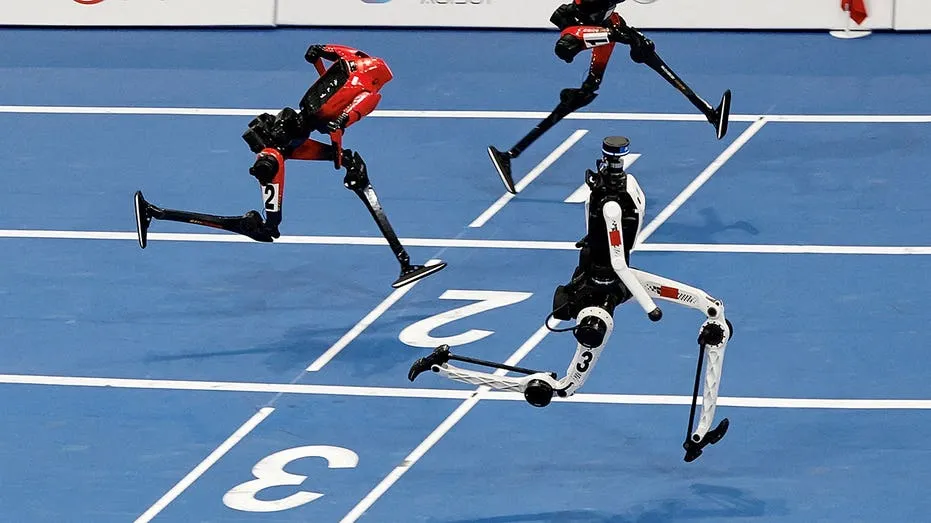
Robots from Team Tiangong Ultra compete in the 4×100-meter relay final on day 4 of the 2nd World Humanoid Robot Games at National Speed Skating Oval in Beijing, China, on Aug. 25, 2026. (VCG via Getty Images)
THIS SATURDAY! Free live CyberGuy class: Protect Your Money From Today’s Biggest Threats
Join us Saturday, Aug. 29, at 10 a.m. ET for a free CyberGuy LIVE class covering five simple steps to help defend yourself against AI scams, fraud, identity theft and financial hacks. Kurt "CyberGuy" Knutsson will explain how to set up bank alerts, strengthen your account logins, protect your phone number, freeze your credit and help secure your retirement savings against unauthorized transfers. No technical experience is needed. You’ll also receive our financial protection checklist, and every registrant will get a link to the class recording afterward.
Reserve your free spot today at CyberGuyLive.com.
The second World Humanoid Robot Games opened Aug. 22 at Beijing's National Speed Skating Oval, known as the Ice Ribbon, and ran through Aug. 26. Organizers registered 666 teams and 2,056 robots for this year's event. The competition included 51 events and 1,301 competition sessions.
The robots compete in track and field events along with challenges designed around real-world jobs. Organizers have also added tests involving physical skills such as weightlifting and tug of war.
That mix tells you something about what China wants these machines to become. The Games give developers a place to push speed and strength. They also expose weaknesses that can be harder to see in a carefully edited demonstration video.
The first number that grabbed worldwide attention was 9.39 seconds. That was already quicker than Bolt's 9.58-second human record from 2009. The comparison spread fast because almost everyone understands what a 100-meter sprint represents. Then X-Humanoid released its updated results.
The company says TianGong Ultra eventually reached 9.32 seconds, while other X-Humanoid teams recorded times of 9.34, 9.38 and 9.39 seconds. The exact comparison with Bolt needs context. These robots do not start, run or stop under the same conditions as human Olympic athletes.
A Tiangong Ultra humanoid robot crosses the finish line in 8.86 seconds next to Honor humanoid robots during a 100-meter large-size group semifinal race at the 2026 World Humanoid Robot Games at the National Speed Skating Oval in Beijing, China, on Aug. 25, 2026. (REUTERS)