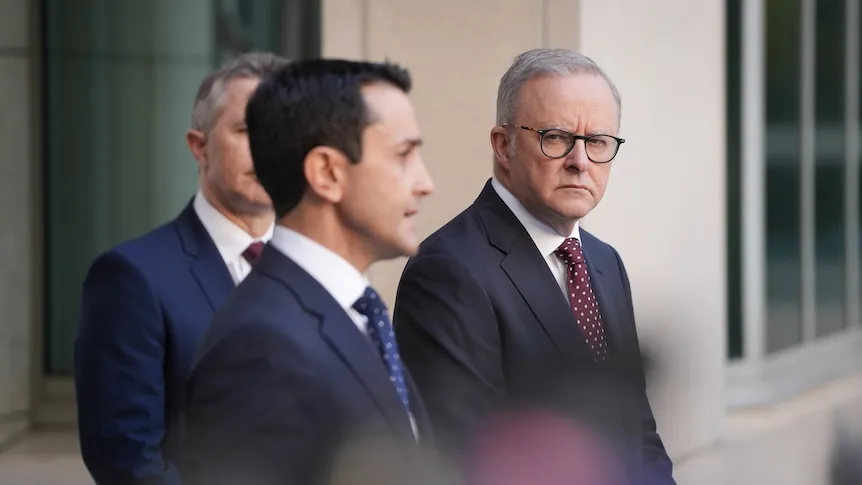
The Albanese government had a turbulent week with tussles over data centres and division within the Labor party over its humanitarian intake. (ABC News: Matt Roberts)
Welcome back to your weekly federal politics update, where this week Jake Evans will get you up to speed on the happenings from Parliament House.
Former prime minister Scott Morrison must have been surprised when he was asked by a reporter in 2022, a few months before the federal election, whether he had "neglected" Western Australia.
Morrison, as treasurer, had stitched up a deal in 2018 to guarantee WA a larger slice of the pie from the Goods and Services Tax (GST), which he said would cost the federal budget about an extra $5 billion over about six years.
The Coalition had been facing a political backlash in WA, where the mining state's share of revenue from the GST had slipped to 30 cents for every dollar collected because its high iron ore royalties changed the calculation for what the state was owed.
Morrison promised the federal government would top-up WA so that it always received a "floor" of at least 75 cents for every dollar it raised, which he expected would cost the federal budget an extra $5.4 billion.
Politically, it didn't matter in the end.
Scott Morrison promised the federal government would top-up WA so that it always received a "floor" of at least 75 cents for every dollar it raised, which he expected would cost the federal budget an extra $5.4 billion. (ABC News: Nick Haggarty)
The Coalition's gift to the west in 2018, dubbed the worst deal in policy history by economists like Saul Eslake, didn't save the Liberal Party from losing five seats in WA at the 2022 election — four of those to Labor, which had made a vow written in sharpie to keep the GST deal.
Eight years on, the $5 billion gift to WA has instead cost $23 billion, and is expected to cost $60 billion by 2030.
The Productivity Commission finds the WA GST deal is a "costly mistake" that has led to "perverse" outcomes, and recommends it be scrapped.
Undertaking a review at the government's request, the Productivity Commission advised the deal should be scrapped, calling it a "costly mistake" that was worsening inequality between the states.
It was a rare moment since Morrison's deal that gave cause for critics to hope there could be a slim chance of change.
But that was quickly extinguished, as the prime minister looked the $60 billion blow-out in the eye and vowed once again to keep it.
Standing next to him was West Australian Premier Roger Cook, who had earlier in the month insulted Productivity Commission public servants as "clowns", "dodgy, deceitful" and "dumb".