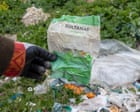
Britain exported 139,000 tonnes of rubbish to Turkey last year, leaving smallholders and poor districts of Adana to cope with the debris, microplastics and toxic smoke
UK plastic ‘waste colonialism’ found to be polluting Turkey’s farming heartland
Plastic debris clings to the reeds in a waterway metres from where Ayhan*, a farmer in Adana, southern Turkey, is harvesting aubergines. “We get pollution from all sides here,” he says, referring to the plastic recycling zone upstream, as well as a nearby textile plant that he suspects is making the water acidic. “The plastics are all there, by the bank, and the fumes come this way.”
Between May 2021 and July 2024, 13 British companies sent 545 shipments of household and supermarket plastic waste, totalling 52,000 tonnes, to the Kemal Deniz recycling zone, under a mile from Ayhan’s aubergine fields, according to data analysed for the Guardian by the Environmental Investigation Agency (EIA), an international NGO.
New research has also been shared with the Guardian that shows high levels of microplastics, as well as plastic debris, in Adana’s waterways, including one next to Kemal Deniz.
Fires from abandoned piles of unrecyclable plastic in the region create toxic smoke over neighbourhoods and fields, locals said.
“Every year we install the greenhouse tarps, and when we bring them down we have to clean the surface because we find a black coating, coming from the fumes of these places,” says Ayhan.
In January, canal water flooded on to his land after heavy rain, destroying seven hectares (17 acres) of crops, he claims. “We had to plant new ones. But what can we do? Nothing. Nowhere to file a complaint – nobody cares.”
Adana sits in Turkey’s Çukurova plain, one of the country’s most fertile regions, rich in cotton, soya beans and citrus fruits.
But since China’s 2018 ban on plastic waste imports, Turkey has become the primary destination for plastic waste from the EU and UK. Adana receives 60% of Turkey’s plastic waste imports – an influx that has overwhelmed local treatment infrastructure and sparked widespread illegal activities, including dumping and burning, according to investigations by environmental groups and journalists.
Sedat Gündoğdu, a Turkish marine biologist at Sabancı University’s Istanbul Policy Center, who has been monitoring pollution in the region, says many of the recycling facilities discharge wastewater directly into canals and channels used for irrigation.
Samples of water he took from a canal downstream from Kemal Deniz, adjacent to Ayhan’s fields, show a 10-fold increase in concentrations of microplastics compared with sites upstream, according to research he published in Environmental Monitoring and Assessment.
Ayhan does not use the canal for irrigation, but the waterway next to his fields feeds into other canals that are used by farmers to water their crops, according to Gündoğdu.
“[The recycling facilities] are discharging this polluted water into the canals,” Gündoğdu says. “Farmers then use that water as an irrigation source.” He also found pellets, films and fragments “highly characteristic of recycling processing” waste.
He found that other canals downstream of recycling facilities in Adana separate from those in Kemal Deniz had even greater concentrations: at 132-fold that of upstream. The canal network traverses agricultural fields, leading to the Seyhan River and ultimately the Mediterranean Sea.