When you purchase through links on our site, we may earn an affiliate commission. Here’s how it works.
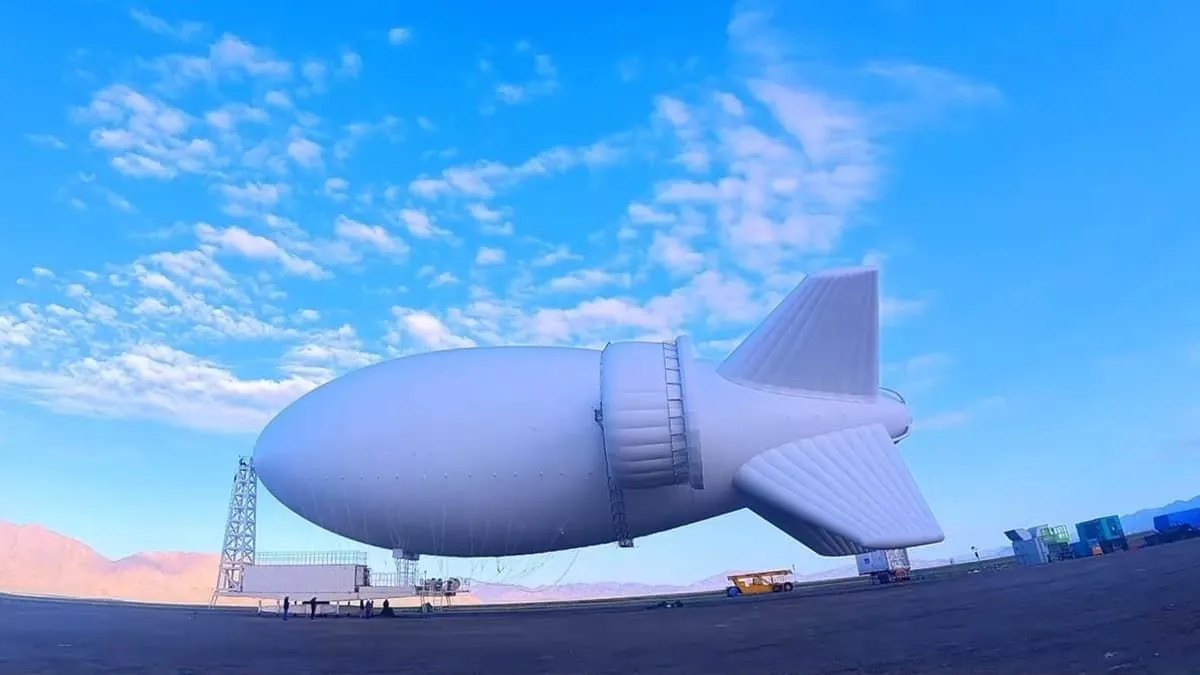
If you thought the age of blimps was over, think again. China has just launched a successful test of a helium-filled airship that is used to generate electricity from the sky, and it could mean a return to the air of the skyfaring vehicles that went out of fashion almost 100 years ago.
According to Chinese state broadcaster CCTV (via South China Morning Post), the apparent world-first feat involved the airship ascending to 4,000 meters, generating power and returning to the ground. Measuring roughly the length of a Boeing 747 airplane, the craft is reportedly not far from being deployed on a wider scale.
The goal of the vehicle — named the S4000 after the height it climbs to — is to harness the strong winds that can be found high above the earth, which it does using turbines strapped to each side of its body. The winds at altitude are stronger and steadier than those closer to ground level, and any electricity generated is sent back to base using a long tether.
By operating in the sky, the S4000 has a few advantages over traditional static wind turbines. For one thing, it can move to windier areas as required, allowing it to adapt to changing conditions or transfer to where it is needed most. For another, it means less real estate is taken up on the ground, freeing up space for other uses and potentially reducing the complaints that are often directed at wind farms.
The S4000 was developed by Chinese firm Sawes Energy Technology alongside Tsinghua University and the Aerospace Information Research Institute of the Chinese Academy of Sciences. Previous models included the S1500 and the S2000, which drew a combined total of 500 million yuan (US$74.3 million) in orders, according to the SCMP.
The S4000 is far from the only recent effort to harness wind power. As we reported earlier this week, the Ventyra R1 portable wind turbine can be folded up into a backpack yet provides 50W of power output, taking around 35 minutes to fully charge a connected smartphone.
Combined with the S4000 — and the many other developments in the wind power industry — it’s clear that a lot is being done in the world of renewable energy. So don’t be surprised to one day see blimps make a return to the skies, this time in the service of generating electricity.
Sign up for breaking news, reviews, opinion, top tech deals, and more.
Follow TechRadar on Google News and add us as a preferred source to get our expert news, reviews, and opinion in your feeds.
➡️ Read our full guide to the best laptops1. Best overall: Apple MacBook Air 13-inch M52. Best budget: Apple MacBook Neo3. Best Windows 11 laptopMicrosoft Surface Laptop 13-inch4. Best thin and light:Lenovo Yoga Slim 9i5. Best UltrabookAsus Zenbook S 16
Alex Blake has been fooling around with computers since the early 1990s, and since that time he's learned a thing or two about tech. No more than two things, though. That's all his brain can hold. As well as TechRadar, Alex writes for iMore, Digital Trends and Creative Bloq, among others. He was previously commissioning editor at MacFormat magazine. That means he mostly covers the world of Apple and its latest products, but also Windows, computer peripherals, mobile apps, and much more beyond. When not writing, you can find him hiking the English countryside and gaming on his PC.
You must confirm your public display name before commenting
Please logout and then login again, you will then be prompted to enter your display name.