Published
Aug 4, 2026 8:53 AM EDT
Get the Popular Science daily newsletter💡
Breakthroughs, discoveries, and DIY tips sent six days a week.
A mere six days into the 1960s, American moviegoers queued up for a cinematic leap. They’d watched as silent films transformed into talkies. And today, another cinematic breakthrough was surely due to delight the senses—or at least deliver novelty in compelling doses.
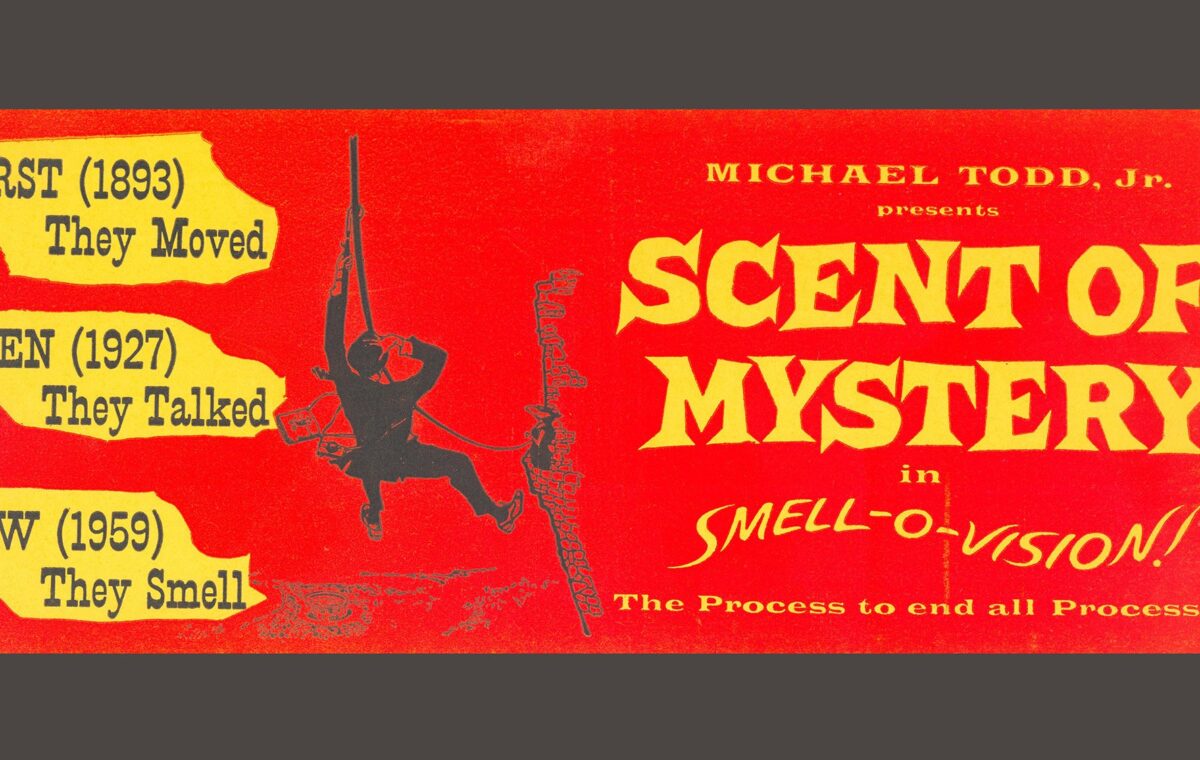
Yet when Smell-O-Vision debuted on January 6, 1960, there was something exceedingly phony about it. Teased ad nauseam in the press, this space-age tech wound up gassing moviegoers with brandy and gunpowder odors before flopping so hard its lone user called it “a complete disaster.”
Such was the verdict of famed cinematographer Jack Cardiff after his first and only smellie debuted in 1960 Smell-O-Vision. He’d made his mark with Hitchcock’s Under Capricorn (1949) and The African Queen (1951). Settling into the director’s chair, Cardiff boldly synced his third feature film with a Swiss inventor’s “scent brain.” It sequentially spewed 15 smells into auditoriums in Chicago, New York, and Los Angeles to tease plot points and amplify scenes.
Cardiff hoped viewers of his 1960 dramedy, Scent of Mystery, would associate its villain with the aroma of pipe tobacco, and a busted wine barrel with sweet grapes. Yet, inconsistent odor delivery and cost-cutting doomed Smell-O-Vision to mediocrity and a brief theatrical run.
Talkies filled seats; smellies cleared rooms. But the ideas underpinning Smell-O-Vision, which piped scents to seats—and rival format AromaRama, which pumped perfumes through air-conditioning ports—just won’t die. They’ve materialized as scratch-and-sniff gags and 4D films that feel like theme park sideshows, rattling viewers’ seats and blasting them with gusts of wind, mist, and yes, scents.
If you could go back to 1960 and experience Smell-O-Vision in all its unrealized glory, would you turn up your nose? Or would you take a whiff?
Theaters have long used odors to immerse audiences, exploiting the express route smells take to the emotional and memory centers of our brains.
Seventeenth century performances of the Shakespearean tragedy called for stagehands to detonate mini explosives, or squibs, to evoke thunder. Such effects also “would have filled the theater with the smell of gunpowder,” Oxford experimental psychology professor Charles Spence wrote in 2021, in the journal i-Perception.
This created “an olfactory reference for the ‘three witches’ bizarre incantation: ‘Hover through the fog and filthy air.’”
The olfactory system, to which Spence refers, powers the sense of smell in humans, witches(?), and other vertebrates. It includes the nostrils, odor-sensing neurons, and the olfactory bulb, which beams smell info around the brain.
This wasn’t just a Shakespeare or stage-play thing. For example, London’s Alhambra Theatre sprayed its auditorium “with scent by Rimmel’s Vaporizers” during an 1868 performance of a ballet called “The Fairy Acorn Tree.” And that’s far from the only scent-invoking performances: There are numerous accounts of theaters employing scent design, all the way through the dawn of cinema.
To contextualize Smell-O-Vision and Scent Of Mystery’s debut, Variety rustled up early cinematic experiments in many-sensory media. In one issue, the trade magazine featured a letter to the editor from a former manager of Boston’s Fenway Theater.