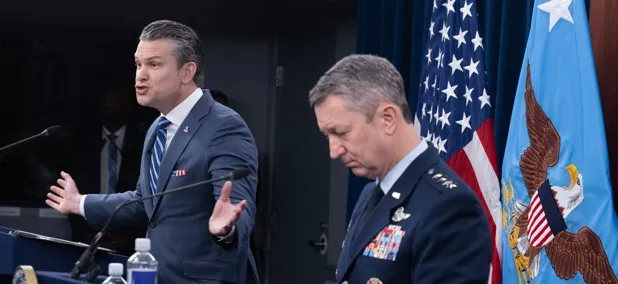
Defense Secretary Pete Hegseth speaks alongside Chairman of the Joint Chiefs of Staff Gen. Dan Caine during a press briefing at the Pentagon on April 16, 2026.
SAUL LOEB / AFP via Getty Images
Shortly after taking office last year, Defense Secretary Pete Hegseth polled the nation’s top commanders about cutting a program designed to protect civilians during U.S. military operations.
Hegseth had bet senior officers would endorse his view that focusing on civilian security was “woke” and out of step with “maximum lethality,” current and former defense officials told ProPublica.
Instead, every commander rebuffed the idea.
The poll from early 2025, which has not been previously reported, cemented top-level military support for Civilian Harm Mitigation and Response, a relatively new program adopted after years of heavy civilian tolls in Iraq, Afghanistan and elsewhere. As part of its mission, CHMR (pronounced “chimmer”) stationed personnel within major regional commands. Officials tried to develop a picture of life on the ground in combat zones to aid decision-making on military strikes and avoid or minimize civilian harm.
In the poll, Hegseth gave commanders three options: cut 65% of staff but keep the effort operational, continue with only a small centralized office in Washington, or eliminate the program.
Nine commanders chose the first option to preserve the enterprise as much as possible, according to a memo reviewed by ProPublica. Leaders of two commands, one overseeing the nuclear arsenal and the other focused on cyber threats, declined all three options, asking to maintain the full program.
Leaders at U.S. Central Command, the Tampa, Florida-based center that oversees military action in the Middle East, pressed to keep its full CHMR staff of 16. Eliminating or scaling back the effort would “result in decreased efficiency of U.S. lethal operations due to an increased risk of target misidentification and reduced battlespace awareness,” a memo reviewed by ProPublica said.
Erik Kurilla, the Army general who was then in charge of Central Command, and several other senior officers directly involved in combat operations had appealed to Hegseth to keep the program. They explained that it was a valuable tool, another retired general said — but “that intent was overridden.”
Hegseth gutted the effort, leaving only a handful of people to carry out the mission. It was stripped of almost all of its funding, even as the U.S. launched new campaigns in Somalia, Yemen and Iran. One official summed up the Hegseth approach as: “Bombs away!”
Hegseth’s early exchanges with the generals made clear that the civilian harm program had no future in his reimagined “Department of War.”
“No more politically correct and overbearing rules of engagement,” Hegseth would later tell a gathering of hundreds of generals and admirals.
But now, after U.S. missile strikes have killed hundreds of civilians in Iran and Yemen, episodes that drew global criticism and questions from Congress, the program could soon be partially revived.
The about-face would mark a rare reversal in a department that hasn’t tolerated dissent under Hegseth and President Donald Trump. Last year’s military memos detail a delicate pushback that may preserve at least the framework of the civilian security campaign.
Current and former defense officials described the evolution of the civilian security program on condition of anonymity for fear of retaliation from the Trump administration.