Archaeologists have discovered a prehistoric ritual structure oriented to the sun and moon in the Czech Republic.
When you purchase through links on our site, we may earn an affiliate commission. Here’s how it works.
Archaeologists in the Czech Republic have discovered a prehistoric structure they believe was a ritual center linked to the movements of the sun and moon. The center is around 6,500 years old — about 1,000 years older than Stonehenge.
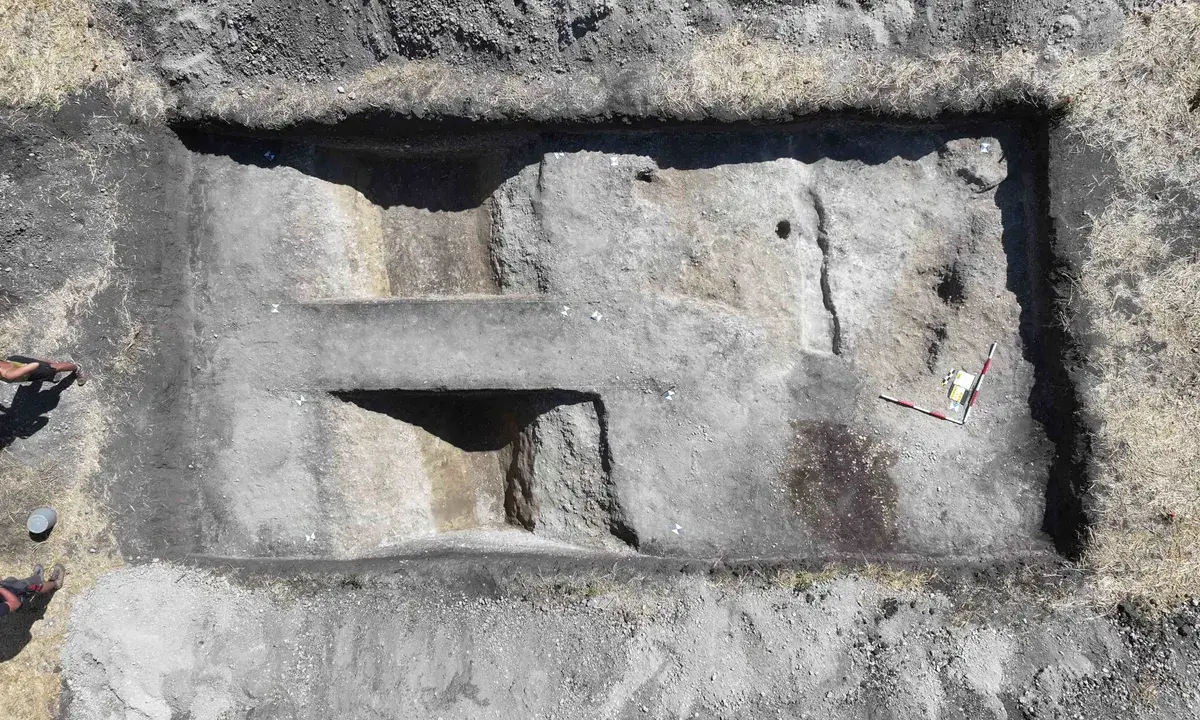
The structure was discovered at Chleby in the Central Bohemian Region. Archaeologists found a circular enclosure consisting of a ditch that was about 750 feet (230 meters) in diameter and 8 feet (2.5 m) deep. Twelve entrances that led to the center of the enclosure were located in different spots around the ditch, the team said in an Aug. 18 statement.
Archaeologists suspect that wooden posts likely created the walls of the enclosure. Based on animal bones found in the ditch, experts think that the entryways were decorated with bull skulls and horns.
"The cult of the bull was an important religious symbol among the first farming communities and is known from many parts of prehistoric Europe," Jan Turek, an archaeologist at Charles University in Prague who is involved in the research, said in the statement. Bulls in these Neolithic cultures were likely symbols of strength and fertility.
A remote sensing image of a Neolithic period enclosure found in the Czech Republic.
The shape and orientation of the mysterious structure are unusual for a Stone Age site, the archaeologists noted.
"Circular enclosures are completely unknown in our region for this period, which already makes the site exceptional," Petr Krištuf, an archaeology professor at the University of West Bohemia in the Czech Republic who is leading the research team, said in the statement. "But when we began to analyze the positioning of the entrances in detail, it became clear that their arrangement was not random. Their geometry creates a system that made it possible to observe the most significant moments of the solar and lunar cycles."
Specifically, the 12 entrances were oriented so that people inside the enclosure could observe important astronomical events, such as the moon's most extreme position on the horizon during its 18.6-year cycle. People could also observe sunrise on the summer solstice, the longest day of the year, and sunset on the winter solstice, the shortest day of the year, through the structure's entrances.
Get the world’s most fascinating discoveries delivered straight to your inbox.
"For prehistoric farming communities, the connection between sunrise and the summer solstice symbolized a beginning, while sunset and the winter solstice represented an ending," Krištuf said. "The same principle can be seen along Stonehenge's main axis. We can now see that [this site] was designed similarly."
In later times, the ritual purpose of the Chleby structure seems to have changed or been lost entirely. Previous excavations at the site found burials of 18 people from the Bronze Age Únětice culture (circa 2300 to 1600 B.C.), a culture which had unique burials and artifacts, including the Nebra Sky Disc. The site may have still maintained a ritual purpose at this time. But in the Iron Age (circa 800 B.C. to 1 B.C.), a settlement was built over the Chleby site.
"By the Iron Age, the monument appears to have definitively lost its original significance. The ditch was gradually filled in, and an ordinary settlement was established on the site of the former sanctuary," Krištuf said.
Research is ongoing, and archaeologists plan to analyze the site's soil to learn more about the people who once lived there.