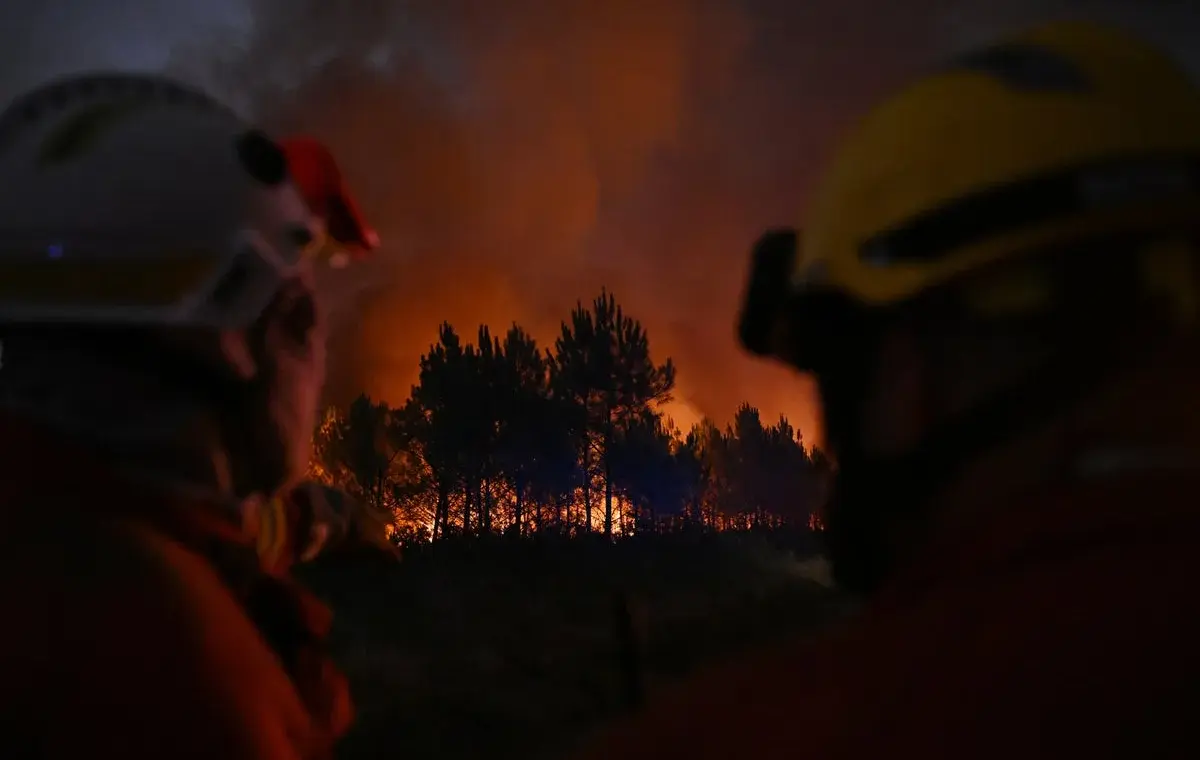
Science tells us catastrophe is not a question of if, but when
I would like to be emailed about offers, events and updates from The Independent. Read our Privacy notice
In the opening scene of American writer Kim Stanley Robinson’s “The Ministry for the Future,” a heat wave combined with a breakdown of the electrical grid in India kills 20 million people. The devastation causes the world's nations unite to combat climate change.
Scientists have long warned that the world will experience more intense extreme weather events like heat waves, storms, floods and droughts. But what once seemed like the realm of fiction is now discussed as a possibility, even an inevitability.
Warning about an “extreme of extremes” or the “Other Big One,” a play off the California reference of a big future earthquake, can be fraught. After all, nobody can say for sure when a weather catastrophe may happen. But in the last few years, the planetary ingredients needed for a massive disturbance have been building. And alarm is growing.
“The risk is that people just think you are exaggerating,” said Daniel Swain, a climate scientist with the California Institute for Water Resources. “It's the ‘Boy Who Cried Wolf’ problem. Sometimes wolves are real. If it’s outside the door, wouldn’t you want to know?”
In the 1850s, while living in Seneca Falls, New York, amateur scientist Eunice Newton Foote did a series of experiments that put different substances, including carbon dioxide and moist air, inside glass cylinders and left them in the sun. What she found was extraordinary: cylinders with carbon dioxide, a greenhouse gas that is released when coal, gas or oil is burned, heated up faster and took longer to cool after the sun went down.
Fast-forward: Today, Earth is being heated by massive amounts of greenhouse gases being pumped into the atmosphere, leading to a gradual rise in average global temperature. That increase, 1.44 degrees Celsius (2.59 degrees Fahrenheit) warmer in 2025 compared to the early 1800s, leads to more frequent, and more intense, extreme weather events.
The country that has released the most greenhouse gas, and thus contributed most to climate change, is the United States. But don't expect recognition of that, much less major government-led efforts to combat it, as the country marks its 250th birthday. President Trump has called climate change “the greatest con job ever," referred to climate policies as a “Green New Scam” and U.N. climate predictions were made by “stupid people.”
At any given time there are numerous extreme weather events happening around the globe. Indeed, some have already been so big that we have arguably entered an age of extremes.
Consider Australia's “Black Summer” of wildfires in 2019 and 2020, when 19 million hectares (over 46 million acres) were scorched. Or Pakistan in 2022, when flooding left a third of the country under water. Or Hurricanes Milton and Helene in 2024, which ravaged parts of the southern United States. That is to say nothing of periodic smaller disasters, such as last year's Texas floods that engulfed young campers; the Los Angeles wildfires that chewed through entire neighborhoods; and Typhoon Kalmaegi, which walloped Vietnam and the Philippines.
Sarah Perkins-Kirkpatrick, a climate scientist at Australian National University, says she had a “come to Jesus moment" when she realized that constant extreme weather events wouldn't stop even if the world could immediately reach net zero, the point when as much greenhouse gas is taken out of the atmosphere as released into it. Many countries and major companies have net-zero targets for 2050 or beyond.
Because carbon dioxide can last hundreds of years, and so much has already built up, the damage could take centuries to reverse. And we keep adding more.
“It's the issue of the frog in the boiling water," said Perkins-Kirkpatrick. "If we get used to bracing ourselves, are we going to notice?”
What's clear is that no country is truly prepared for a major climate disaster, and the risks are changing.