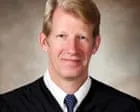
Then Advocate editor-in-chief and writer testified editorial was not part of agenda against Jefferson Davis Hughes III
A jury on Monday awarded $300,000 to a Louisiana supreme court justice over a 2019 editorial by the state’s largest newspaper in a rare defamation trial involving an elected public official.
Jurors in Iberville parish, Louisiana, found that the editorial whose headline included “Jeff Hughes … made a mockery of justice” and was published by the Advocate had defamed state supreme court justice Jefferson Davis Hughes III. The $300,000 in damages that the jury awarded Hughes were nonetheless significantly less than the $10m he sought for what he described as injury to his reputation and emotional distress.
In a complex case that involved days of testimony and arguments in its trial phase, Hughes as a US public figure had to prove “actual malice” in connection with the editorial, which centered on how he handled a child custody case earlier in his career as a district court judge in 1998 and 1999.
The case pitting the Advocate against Hughes was the second in the US on consecutive business days to show a jury’s willingness to award damages against a publication.
An Alabama jury on Friday awarded $9.25m in damages against the New York Times for wrongly reporting that a college basketball player was at the scene of a fatal shooting.
In the case against the Advocate, lawyers for the justice claimed he was libeled by the editorial, which ran two days after an investigative news story into the custody case.
The investigative news story – produced by the Advocate and television news station WWL Louisiana – quoted a woman who described helping her son fight for the custody of his five-year-old boy, Austin, in 1998 when she asked Hughes to recuse himself. The woman said she understood Hughes was dating a lawyer on the opposite side of the custody battle, Berkley Durbin – but that Hughes refused to step away.
The investigative news story reported that Durbin withdrew from the case in August 1998, days before Hughes expanded custody for Austin’s mother. But the ensuing newspaper editorial later said “in 1999 …” Hughes and Durbin were “romantically involved” and then said, “Durbin represented Austin’s mother,” WWL Louisiana – which covered the trial – reported.
The Advocate’s editor-in-chief at the time of the editorial and the piece’s editor testified at the trial that they did everything they could to ensure accuracy, WWL Louisiana reported.
The paper then took years to clarify the timeline in an editor’s note online despite pressure from Hughes for the outlet to act more quickly, WWL Louisiana reported. Testimony at the trial established that Hughes wanted to keep everything off the record, preventing the newspaper from reporting what he said, according to WWL Louisiana, a Guardian newsgathering partner.
Hughes then stormed out of an on-the-record interview – and then never responded to an offer for another on-the-record interview, said testimony from the Advocate’s editor-in-chief at the time, Peter Kovacs, who is now retired.
Testimony also showed that the newspaper waited to clarify things while perceiving Hughes to have serious credibility issues, WWL Louisiana reported. The news station said Kovacs while testifying accused Hughes and his attorneys of telling “Russian lies”.
Kovacs and the writer of the editorial also testified that the editorial was not part of an anti-Hughes agenda, as the state supreme court judge claimed.
Hughes, meanwhile, said in court that the newspaper “can’t bring themselves to admit they made a mistake”. He also questioned witnesses himself at times and participated in sidebar discussions with Kimball at the bench, according to reporting from WWL Louisiana and The Advocate.