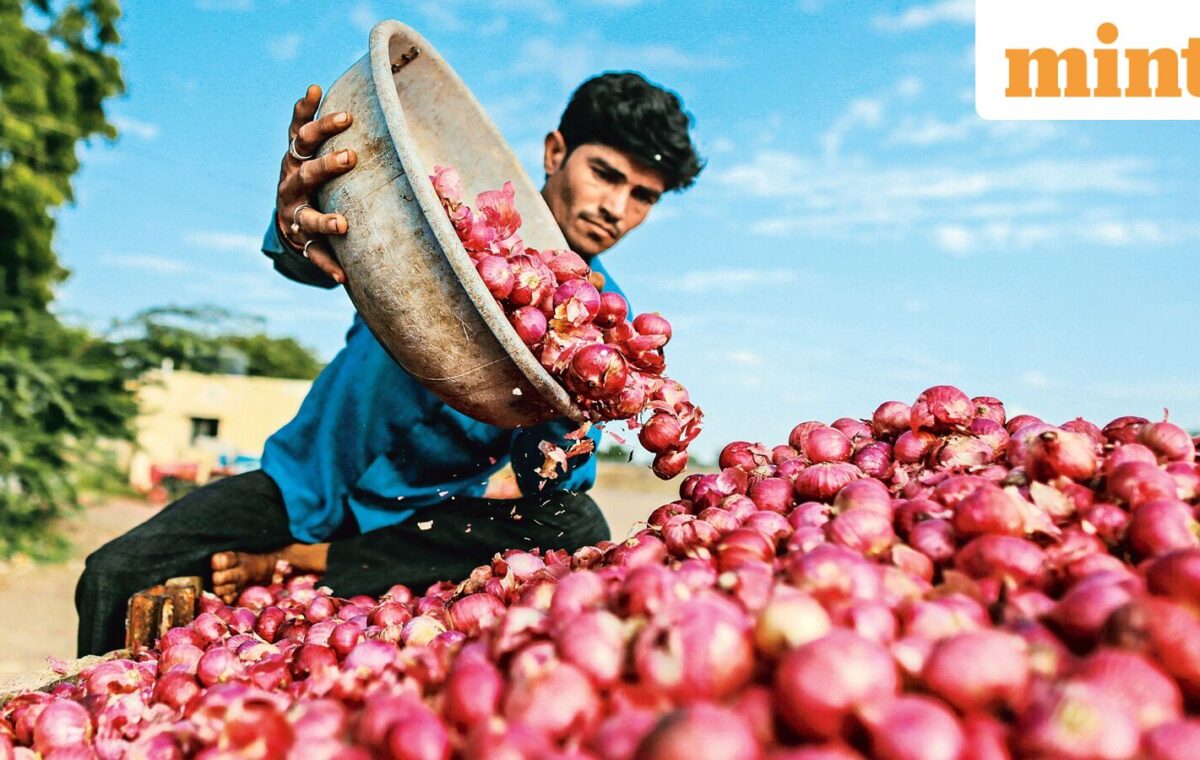
The government will sell onions at a subsidized price of ₹35 per kilogram in Delhi, as it moves around 800 metric tonnes of buffer stock to the national capital through its Kanda Express initiative, consumer affairs secretary Nidhi Khare said on Tuesday.
The onions will be sold through government agencies, including the National Cooperative Consumers’ Federation of India (NCCF) and National Agricultural Cooperative Marketing Federation of India (Nafed), as the Centre seeks to contain rising prices. The all-India average retail price rose 59% year-on-year to ₹43.53 per kg on 24 August, from ₹27.37 a year ago, and was up 24.3% from ₹35.01 a month ago.
“Coming Soon: Kanda Express is bringing about 800 metric tons of onions to Delhi to be sold at Rs. 35/kg at NAFED, NCCF and Kendriye Bhandar stores,” Khare tweeted.
“Kanda Express will initially reach Chennai, Ernakulam, Madurai and Guwahati,” said Khare.
Mint reported on 20 July that the Centre had planned to start a calibrated release of onions from its buffer stock to bridge the seasonal supply gap before substantial fresh kharif arrivals reach markets.
The Kanda Express is a dedicated 42-wagon goods train capable of carrying up to 1,700 tonnes of onions, compared with about 25 tonnes per truck. Rail transport is cheaper and enables the government to move larger quantities from producing centres to major markets.
Introduced in 2024, it transports buffer-stock onions from Nashik to major consuming centres. Mint first reported on 27 September 2024 that the government planned to shift onion transportation from road to rail to cut costs and speed up deliveries.
Mint also reported on 30 October 2024 that the government planned to make railways the standard mode of transporting onions to help moderate retail prices.
With the move, the government seeks to prevent higher onion prices from adding to food inflation. Onions have historically been among the most volatile food commodities and have frequently prompted policy measures such as buffer stock releases, export restrictions, and changes in import policy whenever prices have risen sharply.
Fresh kharif onions typically begin arriving in markets from November, with arrivals gathering pace in December, depending on monsoon progress and harvesting. Until then, markets remain largely dependent on stored rabi onions.
The government has set a target to procure 200,000 tonnes of onions, and procurement is currently underway. On 4 July, the government increased the procurement price of onions for the buffer stock by 13%, from ₹1,875 per quintal to ₹2,125 per quintal.
The all-India average retail price of onions stood at ₹43.53 per kg on 24 August, up 59% from ₹27.37 per kg a year ago and 24.3% from ₹35.01 per kg a month ago, according to the department of consumer affairs.
Wholesale prices have risen even faster. The all-India average wholesale price stood at ₹3,558.79 per quintal, up 67.6% from ₹2,123.05 per quintal a year ago and 29.5% from ₹2,747.98 per quintal a month ago.
Among major cities, the average retail price in Delhi stood at ₹55 per kg, up 57.1% from ₹35 per kg a year ago. Mumbai recorded ₹47 per kg, compared with ₹32 per kg a year ago, while Chennai reported ₹60 per kg, up from ₹33 per kg. In Ranchi, prices rose to ₹38 per kg from ₹25 per kg a year ago.
The rise in onion prices is also feeding into household food budgets. According to Crisil Intelligence's latest Roti Rice Rate report, the cost of a home-cooked vegetarian thali rose 4% year-on-year in July, while that of a non-vegetarian thali rose 9%. Onion prices rose 8% year-on-year in July and 10% from the previous month, adding to the cost of home-cooked meals.