Topic:Forestry, Logging and Timber Industry
The WA government is ecologically thinning native forests to address problems left behind after the banning of native logging.
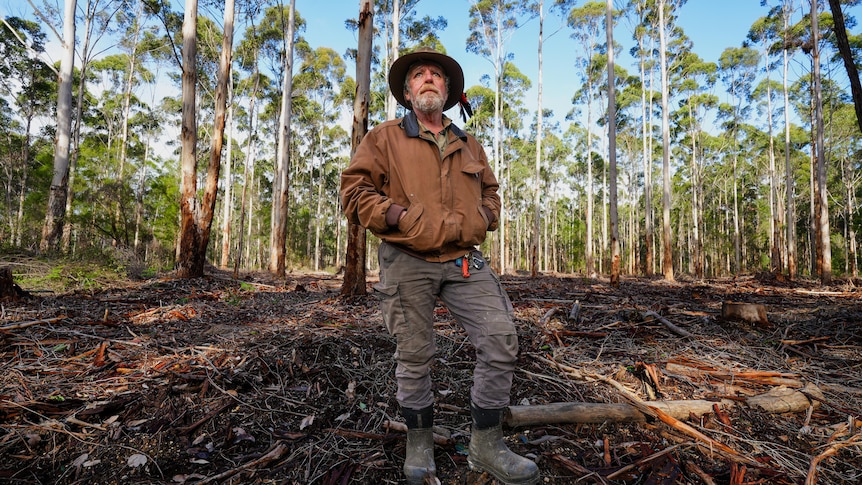
A South West landowner says contractors are ripping up trees without thought, and an independent scientist argues there is no scientific basis for the practice.
Almost 146,000 hectares of state forests and timber reserves have been earmarked as potentially suitable for ecological thinning.
Deep in Western Australia's South West, an ecological experiment is being carried out across swathes of state forests and timber reserves.
"Ecological thinning" involves removing smaller trees, with the goal of allowing those remaining to flourish.
The eventual goal is a return to the old-growth forests of the past.
But as logging trucks continue to stream up the region's highways, the practice is facing scrutiny from locals and independent scientists.
They are questioning whether eco-thinning is just native logging under another name.
DBCA scientists are monitoring an ongoing trial of ecological thinning across state forests. (ABC South West WA: Jon Daly)
The scientific rationale behind eco-thinning is that trees are increasingly competing for water in the South West region's drying climate, causing stress and, in some places, collapse of karri, jarrah, and marri regrowth forests.
These forests, globally recognised biodiversity hotspots, were clear-felled by loggers for almost 200 years, until native logging was banned entirely in 2024.
Unthinned (left) and thinned (right) sites near Manjimup in South West WA. (ABC South West WA: Jon Daly)
"We are slowly moving into this warmer drying period, which has put a lot of stress on the forest ecosystems," Department of Biodiversity, Conservation and Attractions (DBCA) scientist Katinka Ruthrof told the ABC during a visit to a thinned site.
Katinka Ruthrof from the Department of Biodiversity Conservation and Attraction. (ABC South West WA: Jon Daly)