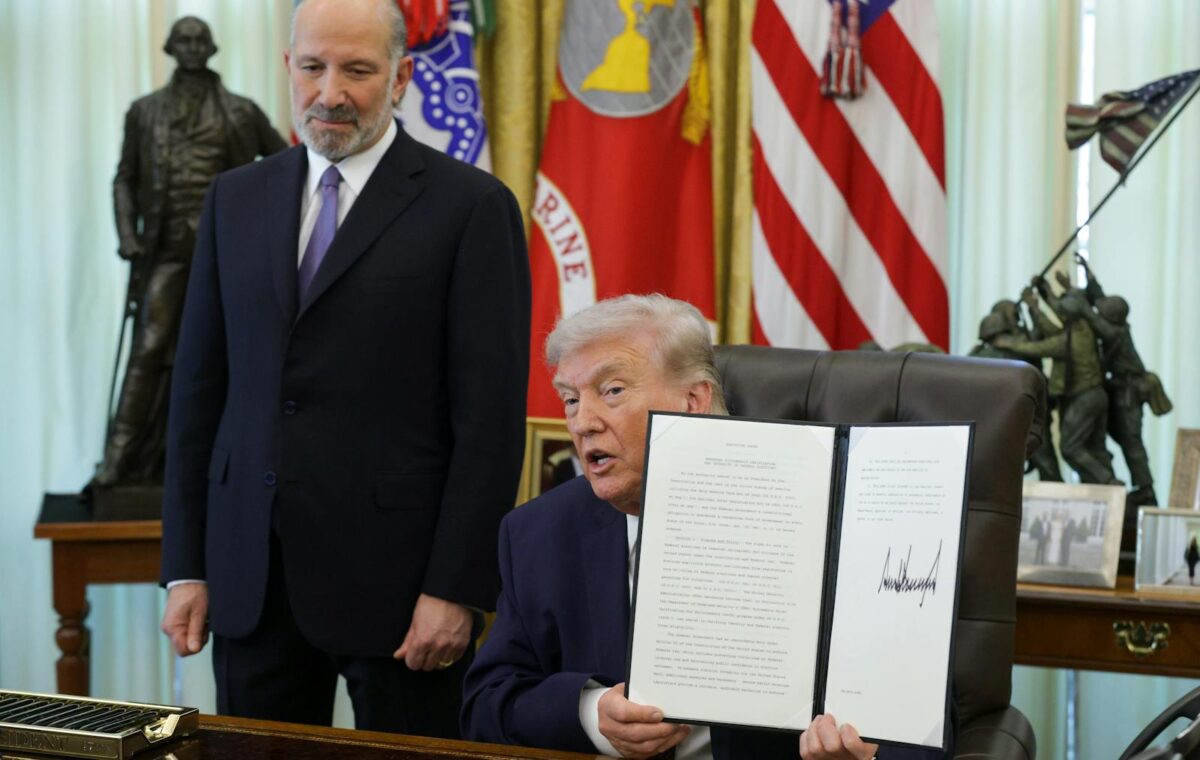
Supreme Court Justice Ketanji Brown Jackson slammed the Supreme Court’s Monday shadow-docket decision to greenlight Donald Trump’s executive order restricting mail-in voting ahead of this year’s midterm elections. While the decision does not necessarily mean mail-in voting will be overhauled, it nevertheless removes a block that the judiciary had placed in the administration’s way.
In an unsigned order Monday, the Supreme Court lifted a lower court stay on an executive order requiring the U.S. Postal Service to bar any person not included on a massive federal voter list from receiving a mail-in or absentee ballot.
All three of the high court’s liberal justices dissented from the unsigned order.
“This ruling violates well-established precedents concerning this Court’s equitable discretion and needlessly injects chaos and uncertainty into the upcoming midterm elections,” wrote Jackson. “It also lets another shoe drop in the Kafkaesque nightmare that our precedents have been steadily creating for certain plaintiffs who seek to bring election-related challenges.”
After the executive order was signed in March, Democratic officials in 23 states and the District of Columbia sued to block the order. U.S. District Court Judge Indira Talwani blocked the plan in Massachusetts, and later issued a nationwide injunction. Last month, Trump’s DOJ asked the Supreme Court to weigh in on the issue, calling the challenge “premature” and “hypothetical” because the order had not been implemented by the Department of Homeland Security or the U.S. Postal Service.
It’s unclear how this order might be implemented in the time that remains between now and the fast-approaching midterm elections. The high court’s decision is also far from the final judicial challenge the administration faces in its efforts to juke the upcoming elections. Today’s ruling left open the possibility for future legal challenges.
Trump’s order has been described by Democratic leaders as a “desperate, illegal power grab” and “laughably unconstitutional.”
Despite the obvious chaos Trump’s order would cause, the U.S. Postal Service has moved ahead with issuing new requirements for mail-in ballots. If implemented, Trump’s executive order could potentially disenfranchise thousands of Americans who vote by mail ahead of the high-stakes midterm elections.
Darline Graham’s latest bid to solidify Donald Trump’s support involves a fraught empty gesture.
The 62-year-old younger sister and current holder of the late Lindsey Graham’s South Carolina Senate seat dodged questions on Monday as to whether she would have certified the results of the 2020 presidential election, as her brother had six years prior.
“Senator, you just mentioned that you agree with your brother on everything except for one matter, that being illegal immigration; you’d go farther than him on that,” said MS NOW’s Mychael Schnell during a press conference. “That being said, I’m curious, do you agree with him about the 2020 election, that Joe Biden was certified the winner of that election, was lawfully elected, and that you would’ve voted to certify the election, as your brother did?”
Graham responded that she believed that the “election system is broken,” attempting to redirect the question toward her support for the White House’s SAVE America Act, a voter suppression bill that has divided Congress for most of the year.
“You won’t commit to having certified the results of the 2020 election?” Schnell pressed in a follow-up question.
Trump has fervently championed Graham’s candidacy, despite the fact that she brings zero legislative experience to the job. She also seems to have little awareness of current events and pressing matters: Last week, Graham flopped on a softball debate question regarding Taiwan, shrugging that “national security is not my thing.” Nevertheless, her actual policy positions may not matter at all with the local electorate, depending on voters’ attitudes toward the president.
“If a voter’s decision is all about Trump, then they don’t care what she knows about foreign policy or anything else,” Scott Huffmon, a professor of political science at Winthrop University, told Newsweek Monday. “The question is will they ‘believe in’ this endorsement and be as, or more, motivated as the people who showed up at county meetings over the years to censure Lindsey Graham.”