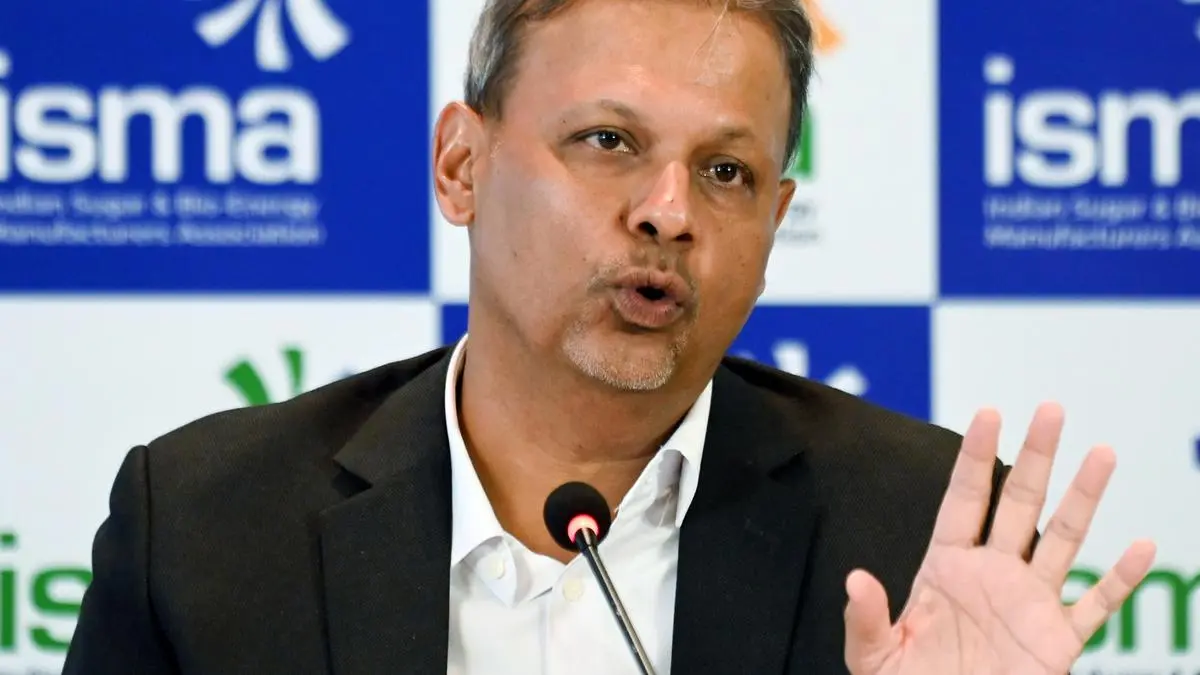
ISMA President Niraj Shirgaokar addressed a press conference in New Delhi on Monday
| Photo Credit:
ANI
Under pressure from the government, private sugar millers on Monday blamed speculation for the current rise in sugar prices ahead of Dussehra and Diwali. However, the statistics provided by the millers themselves indicate a shortage, and realising this, the government has also allowed the import of 1 million tonnes (mt) of raw sugar at zero duty to augment domestic availability.
The Indian Sugar & Bio-Energy Manufacturers Association (ISMA) addressed a press conference on Monday, asserting that there is no shortage of sugar in the country and that prices in the retail market are expected to come down. India’s production and stock position remain fundamentally comfortable.
ISMA President Niraj Shirgaokar stated that prices have risen due to various factors, including speculative buying by traders and bulk consumers, as well as lower production resulting from adverse weather conditions. He also denied the involvement of mills in creating artificial scarcity and inflating ex-mill prices.
The industry body has also demanded that the stockholding limit on traders, currently 400 tonnes, should be brought down to 200 tonnes.
The ISMA president rejected allegations of diversion of sugar to make ethanol as a main factor for the price hike. “The Ethanol Blending Programme is not competing with food-grade sugar, and it is not responsible for the current price movement…This year, around 2.9 mt have been diverted till July, with the full season expected to settle around 3 mt, well within our historical range of 2–4 mt,” he said.
He said that prices have started to ease following the government’s decision to allow duty-free imports of 1 mt of raw sugar.
Sharing the statistics, he stated that the closing stock of sugar at the end of September 2026 would be 3.5 million tonnes (mt). However, he portrayed a positive outcome for the first month (October 2026) of the new season, saying that mills would start operations around October 15 and could produce approximately 1 to 1.2 mt, even though millers admitted that historically, sugar production in October has not exceeded 0.5 mt. He noted that the demand for October would be between 2.4 and 2.5 mt.
The all-India average retail price of sugar was ₹63.05 per kg on Monday, which is 29 per cent higher than ₹48.73 per kg a month ago. The maximum retail price was at ₹75 per kg, according to consumer affairs ministry data. The ex-mill prices have eased in the last few days and are currently ruling at around ₹55-56 per kg in Maharashtra and Uttar Pradesh, ISMA said.
India’s net sugar production (after diversion to ethanol) is estimated at around 27.9 mt in the 2025-26 season (October-September), while the opening stock on October 1, 2025, was 4.9 mt. The annual domestic demand is estimated at 28-28.5 mt. But, out of 1.5 mt export was permitted, millers and traders have shipped 0.8 mt of sugar before the government imposed a ban.
The government’s duty-free import window, tightened stockholding limits, ongoing special crushing, and an early start to the new season would help in augmenting domestic supply and control prices, the ISMA President said.
“The rise reflects several factors coming together, not one single cause. Domestic output for the season came in below initial projections,” said Shirgaokar.
The gross sugar production (before diversion to ethanol) was revised to around 30.9 mt from the initial estimates of 34.5 mt, mainly due to weather-related effects, lower cane yield, and lower recovery, including a higher crush rate in Maharashtra and red-rot-related varietal issues in Uttar Pradesh, he said.
Copyright© 2026, THG PUBLISHING PVT LTD. or its affiliated companies. All rights reserved.
Comments have to be in English, and in full sentences. They cannot be abusive or personal. Please abide by our community guidelines for posting your comments.
Source: Read the original article on www.thehindubusinessline.com