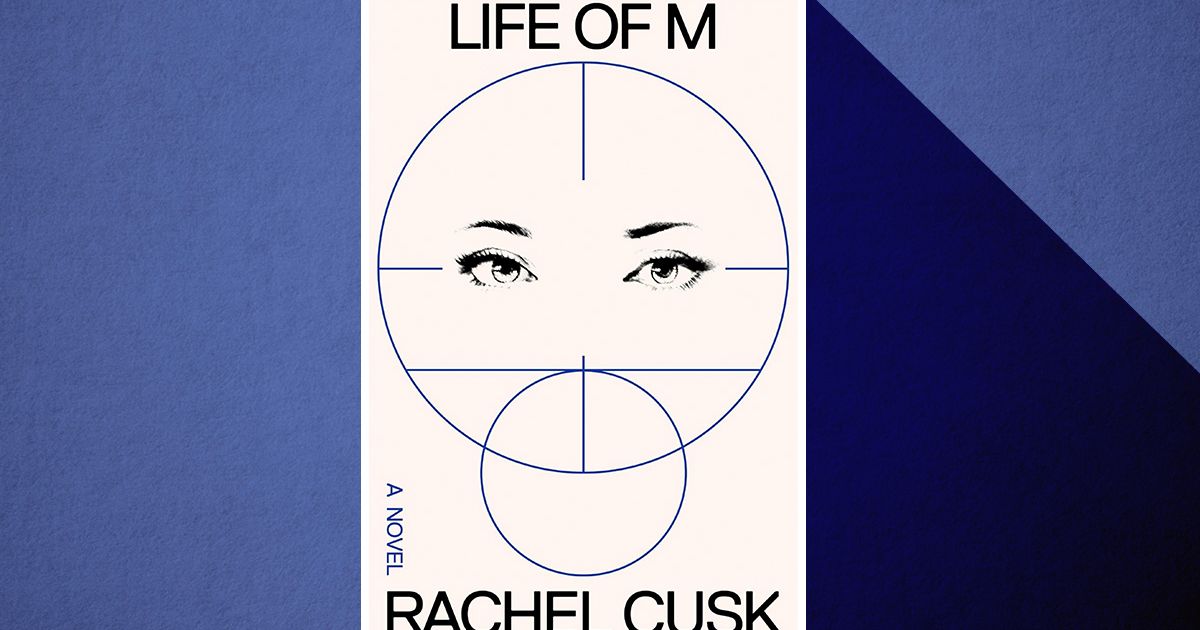
Life of M by Rachel Cusk (Farrar, Straus and Giroux) is out August 25.
Find this story in your account’s ‘Saved for Later’ section.
Life of M by Rachel Cusk (Farrar, Straus and Giroux) is out August 25.
In July, an unusually early review on the right-leaning British website UnHerd pointed out that Rachel Cusk’s next novel, Life of M, seemed to be all about Natalie Portman. The actress was said to be a friend of Cusk’s, or at least an acquaintance, and her double in the book, who’s just called M, is unmistakable. M starred as an uncomfortably precocious young girl in her first movie — same as the real Portman, who acted in Luc Besson’s Léon: The Professional as a tween. M made a Black Swan–esque film about ballet. She lives in an unnamed city that’s likely Paris. She’s literate and tasteful, in one scene co-presenting at a literary salon for a fashion brand.
As though anticipating the tabloid stories to follow, Cusk starts the novel with a caveat: “A little while ago, I told the actor M that I was thinking of writing her autobiography. She liked the idea. She’s a good sport. Would you just make it up? she said.” No answer is recorded, but we can guess the author takes the deal. Then we are shot inside M’s mind, which has been scrambled by fame-induced dissociation since she was a child. Decades later, her condition has only gotten worse. “Everyone else believed in reality,” the narrator says. “It was as if they, not she, were in a film, a film she was watching.” M has been neatly removed from the world.
Like most of Cusk’s recent work, Life of M is mainly plotless; unlike her Outline trilogy, though, which consists mainly of a series of long conversations, it’s light on dialogue, and there’s a mesmerizing, out-of-time quality to the whole scenario. M moves through a series of rooms, many of them white with taupe accents, sealed behind double-glazed windowpanes and with carafes of cold water on their tables. Everything is taken care of, and doors open to admit her. Alone with her thoughts, drifting among time zones, she reflects on the mutations of fame and the mingled envy and revulsion she feels when she observes normal people’s normal lives. Usually, she’s not close enough to see them.
This is the zone of Cusk’s acid celebrity story, whose central character experiences her fame more as restraint than excess. (“She wishes sometimes for more exhilaration,” the narrator says as M sits on “a large wooden schooner of great beauty.”) She is polite and generous but may be faking her kindness, and she sometimes seems intensely lonely: She has friends and family, but for the most part, she’s not the kind of person others understand or even dare talk to. The writing is about ten times more embellished than a People magazine article’s, full of dramatic statements about public life. “From where she stands she sees only the summit, directly above her,” the narrator says at one point, “brutal peaks of concentrated power, of evil and influence, of ambiguous victory.”
Between M’s scenes are sections told from the point of view of a “we,” who appears to be someone like the author from the first chapter but sometimes seems to be a stand-in for any upper-middle-class urbanite. This person lives in the city; they do things like go to the countryside and get EMDR therapy (or at least what seems like EMDR therapy; Cusk’s ongoing war on proper nouns doesn’t allow her to call it that). Like M, they don’t really notice the seasons passing, and they too feel removed from some experience of reality — a favorite Cusk word, gesturing toward an arbitrary consensus about the world. They seem designed as one of Cusk’s experiments in stripping character from her fiction, but her insistence on vagueness can be tedious. Meeting up with their friends, this person says, “we talk about what we see there, what we feel, the events that have occurred and what they might mean. Each friend is different and we don’t always remember that until it is too late.” At other times, the studied estrangement from common sense turns into something unintentionally comic. About a flock of pigeons, Cusk writes, “They are the reminder of how far removed we are from our animal nature.” These prim observations threaten to swallow the “we” sections, and they creep into the rest of the book, too: M muses that a pie she is served at a dinner party is “like an emblem of democracy itself.”
Both M and the narrator identify violence in their past, like the violence of the premature end of M’s childhood and the “violence of insignificance” the author feels. Occasionally, Cusk, as she often does in her work, wedges in some people experiencing acute physical violence: “mad people, angry people, people who shout and rail in the streets.” When it rains, she writes, “the misery of the people who have nothing is, we know, intensified.” Maybe the idea is that these less fortunate figures are able to experience their lives in a direct way without floating above things the way Cusk’s artist protagonists do. “Only the cleaners, always pushing their trolleys laden with equipment up and down one or another of the hotel’s carpeted corridors, seem to be real,” Cusk explains. If they’re there to signify that she is aware of how little her primary characters’ problems matter, the gesture ends up seeming bashful and, at moments, compulsively cruel. “Wouldn’t it be a relief to not see them?” M thinks at one point.
Intentional or not, Life of M works best as a spectacle of Cusk’s rudeness. The novel is not exactly tabloid material, but there’s gossip here — the Cusk version of it, at least. M has a meal with a cruel person who seems to be her former romantic partner, and she worries about her family’s resentment of her. She does not allow herself to eat pastries or pie. By the end, M and the author finally meet up again, this time in the actress’s elegant drawing room. Before she relates their conversation, a tense exchange that closes the book (and includes one of the oddest final sentences I’ve ever read), the author describes the room exactly: its herringbone parquet, moldings and cornice, painting of an egg, and long burgundy velvet curtains, undrawn. You can imagine her whipping out a notebook and scribbling down everything she can see when M steps out to get a carafe of water.
“This is what Rachel Cusk does — she torches people and moves on,” one anonymous critic who supposedly knows the novelist told the Times of London in July. “Her fiction is deeply unkind to people.” A judge for an “important literary award,” according to the same article, reported that some people on the committee once refused to read a book by her because “they felt Cusk was too cruel.” It’s not the first time her work has seemed almost made to rile a specific person or two: The first edition of her 2009 memoir, The Last Supper, was pulped in England when a group of tourists she had vacationed with saw themselves in the book and threatened to sue. This is also not the first time Portman has been the subject of a writer’s attention. She and Jonathan Safran Foer exchanged emails for over a decade, and there were rumors that he later left his wife in the hope that Portman would be with him. She didn’t reciprocate the gesture.
It’s hard not to think the wool is being pulled over our eyes in some way. Did Portman, like M, really take offense at what Cusk had written? (One source told the Telegraph she is “more concerned with the state of the world” — an impassive response that would be in keeping with M’s highly controlled persona.) Did Cusk, like the author, really inhabit a public figure as a way to “go and live in someone else”? (In an interview with the New York Times, she said whether M is based on a real person “is not really the point.”) Would the book be as compelling without all this external drama, and does that matter?
It’s ironic that the most interesting part of Life of M is a deviation from Cusk’s often labored project, beginning with the Outline trilogy, to move away from narrative and character. Her previous two books were too much in service of her artful ideas about what makes a modern novel. That final argument between the author and the Hollywood star, the pressure in the room once M gets a whiff of betrayal — for a minute, Cusk lets some heat come in.
Thank you for subscribing and supporting our journalism.
If you prefer to read in print, you can also find this article in the August 24, 2026, issue of
New York Magazine.