Pease Elementary in downtown Austin, Texas, has sat empty since 2020. Formerly the oldest continuously operating school in Texas, Pease was shuttered by the Austin Independent School District to save money. On a steamy day this summer, the hulking structure provided an appropriate backdrop for the political campaign of Gina Hinojosa, the Democratic state representative who is challenging incumbent GOP Governor Greg Abbott.
A district plan to close the school in 2012, while Hinojosa’s son was a student there, inspired her political career, sending her first to the school board and then, four years later, to the Statehouse just a few blocks away. But Pease is also symbolic of Texas’s surprisingly fierce attachment to public education. The school dates back to 1876, the same year that the current state constitution enshrined “a system of public free schools”—a factoid that Texas advocates drop with regularity. That Pease is no longer a school matters, too. Since late 2023, at least 135 Texas public schools either have closed or are slated to close due to budget crises brought on by state funding shortfalls.
Hinojosa believes her message that Texas public schools won’t survive another four years of Abbott can galvanize voters across the political spectrum. “For Texans, public schools are crucial to our identity,” Hinojosa told me. “They’re in our state constitution, they’re the largest employers in our rural communities, they represent ‘Friday night lights.’ That they are in crisis is a big deal.”
Her decision to make public schools so central to the campaign may seem like a risky gambit. Education, after all, rarely cracks the top five when it comes to issues Texans claim to care about, far overshadowed by the economy and immigration. And according to polling, just one in five Texas voters has school-age children. The “Pissed Off Texas Mom” T-shirts are a staple of rallies for the candidate whom supporters call simply “Gina,” but in reality, the demographic may be too small to make a difference.
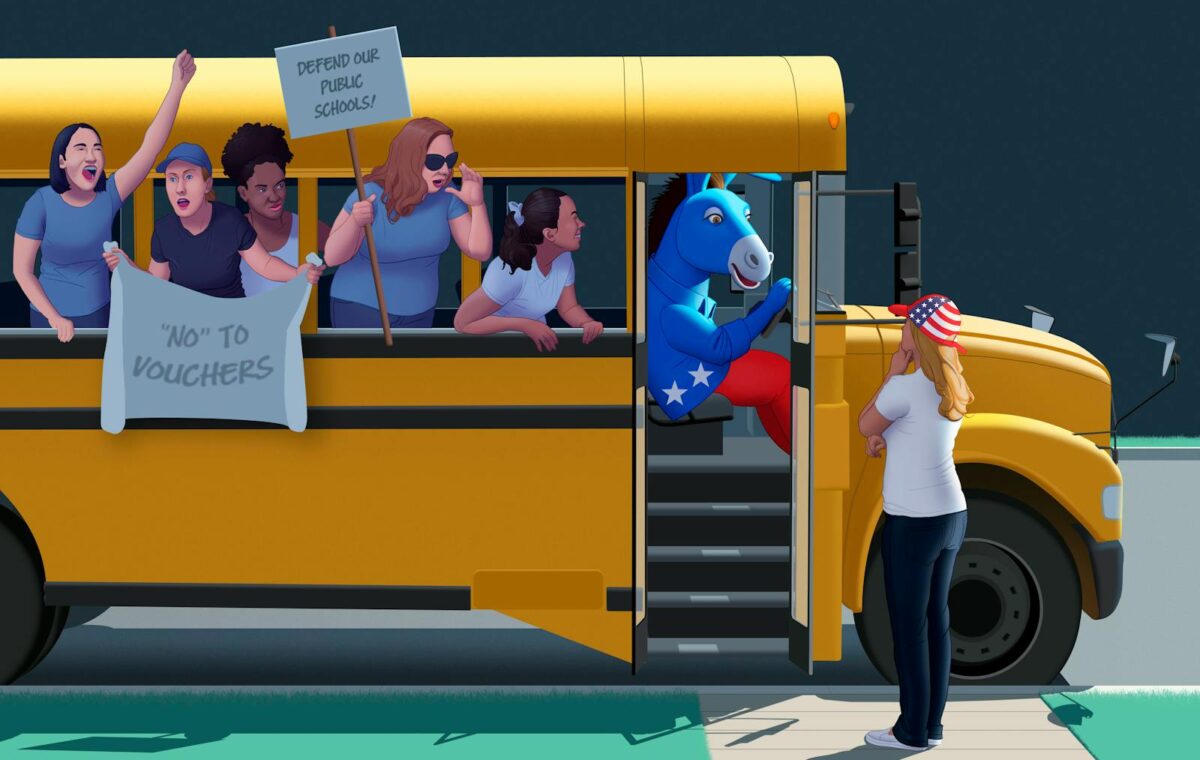
Hinojosa’s critique goes far beyond budget cuts and declining test scores. Schools are the centerpiece of what she argues has been an organized effort by Abbott and the GOP to rig the system against the state’s kids, especially those in working-class families like those she grew up with in Brownsville. Call it “mom populism”—an appeal that centers a full-throated rejection of school privatization and presents the GOP’s increasingly aggressive interventions into local school districts as “corruption schemes” intended to benefit big donors, especially the right-wing oilmen who hold such sway here. By systematically weakening public schools, Hinojosa argues, Abbott and his cronies are undermining the American Dream.
Beating a three-term GOP incumbent in a state like Texas remains a tall order, but there are signs that Hinojosa’s argument may just be breaking through. While Abbott, who is running for an unprecedented fourth term, comes to this fight with a massive war chest, Republicans in Texas are restive, and education is part of their discontent. The $1 billion school voucher program that Abbott muscled through the state legislature last year, after he orchestrated primary runs against rural Republicans who opposed it, remains deeply controversial among many conservatives, who view vouchers less as “education freedom” than as a state takeover of private and home schools.
Michael Ryan is one of Abbott’s defectors. A retired educator, Ryan served on the school board in Fort Worth until the state took over the district last year, installing handpicked leaders. “I’m as red a Republican as they come, but I have to do something different,” said Ryan, a three-time Trump voter. Hinojosa’s pledge to fire Abbott’s top education official on day one won him over, along with her sharp critique of school vouchers and the big money that flooded into the state on their behalf. Ryan was particularly rankled by the $10 million Abbott received from Pennsylvania billionaire investor Jeff Yass. “In the old days, a bribe meant $100 on the floor of the Capitol,” said Ryan.
Recent elections indicate that defectors like Ryan are part of a trend. This January, Democrat Taylor Rehmet, a veteran and union machinist, handily defeated a conservative activist in a special election for a state Senate seat in Tarrant County, a seat Democrats last held in 1991. Despite being far outspent by his opponent, Rehmet won by a decisive 14-point margin in a district Donald Trump carried by 17 points in 2024, alarming Republicans, not just in Texas, but across the country. “[A] swing of this magnitude is not something that can be dismissed,” chimed in Florida Governor Ron DeSantis on X. Rehmet used his background as a union leader at Lockheed Martin to win over working-class voters, but he also made public education central to his campaign, sounding many of the same themes that Hinojosa is running on now.
Affordability was the top issue for voters, but their economic concerns were often entwined with worries over the state of the local schools, said Rehmet, who grew up in a Republican household in Garland, the son of an aircraft mechanic and a beautician. “People are feeling the affordability crunch in the schools. Funding is down, the cost of living is up. You’ve got teachers paying for supplies out of their own salaries.” In a part of the state that has been ground zero for conservative school board takeovers and book bans, Rehmet also tapped into a deepening voter backlash against GOP culture-warring candidates, who have racked up a lengthening string of losses in Tarrant County.
A recent analysis of this spring’s GOP primary turnout in Texas warned that the party’s historically reliable voters were dangerously disengaged, “either sitting out this cycle or, in some cases, shifting their partisan affiliation entirely.” The phenomenon was most pronounced in suburban districts, the pollsters concluded.
That finding comes as no surprise to Hinojosa. “People know who has been in charge,” she told me, “and they want change.”
Texas isn’t the only state where education has emerged as a potent issue for Democrats. As of March 2026, in the 30 state legislative races where Democrats have flipped seats since Trump returned to office, public education was often a central issue. It’s not hard to see why. As the GOP has shifted sharply in favor of private school vouchers, Democrats are increasingly running against candidates who no longer believe in public education at all, even as constituents in both parties still have kids in the local schools. Ascendant populist Democrats are also tapping into anti-billionaire fury as they campaign against vouchers. And with affordability top of mind in nearly every election these days, Democrats are effectively linking issues like school budget cuts and teacher pay to voters’ broader economic concerns.
“Republicans have no answer to affordability except for eliminating the property tax, which would devastate public schools,” said Eric Gisler, who flipped a Statehouse seat in Georgia in 2025. “That makes education a real wedge issue.”
That Democrats are running—and winning—at least in part on education may seem surprising, given the dire reporting on the state of the nation’s schools. In recent years, the headlines have been relentlessly bleak—sliding test scores in math and reading, a “learning recession,” high rates of chronic absenteeism.
The cascade of bad news has prompted loud calls from influential centrist Democrats, including possible 2028 presidential contender Rahm Emanuel, to return to the more combative education policies of the past in an effort to reverse sagging student achievement. But these Democrats are also making a political argument about the direction of their party. Bring back the high-stakes testing and tough-on-teachers rhetoric of the Obama era, goes this line of thinking, and the party can win back fickle voters. “We’re adrift, it’s killing us politically, and it’s killing our kids,” former Obama Education Secretary Arne Duncan claimed recently.