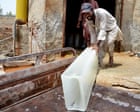
With limited electricity and poor ventilation, many families in Nasirabad have little to shield them from temperatures of up to 50C
As the first light reaches Nasirabad, a queue of men, women and children has already formed outside the town’s ice factory, with their buckets, sacks and plastic containers. Among those hoping to buy some ice to help their families endure another scorching day is 12-year-old Taimoor, in his school uniform. He says it is his most important task of the day.
“If I do not bring the ice, how will we endure the heat at home?” he says. “And how will we drink water that feels as though it is boiling?”
Once he collects his share, Taimoor hurries home to drop it off before setting out again for school, with a small portion of the ice in a plastic container to keep him cool on the journey.
By 8am, the sun is hot and he is wetting his face with the meltwater.
His mother is pregnant with her second child. Having experienced two miscarriages, she is afraid that walking to the factory herself and carrying ice through the heat could endanger her pregnancy.
As temperatures have been rising across this region of Pakistan, protection from the heat depends on what individuals can find, buy or improvise.
Surrounded by mountains and date-palm orchards, Nasirabad is a small town about 25 miles (40km) from Turbat in Kech district, in the province of Balochistan. Most people live in mud-built houses. Residents say electricity is available for about three hours a day, and that the voltage is often too weak to operate a fridge reliably.
Those who can afford solar panels use them to power fans and, in some cases, fridges during daylight hours. For everyone else, their only defence is the ice they collect each morning.
The intensity of heat in Nasirabad places the town near the frontline of a much wider warming trend.
In a heatwave warning in May 2026, the Pakistan Meteorological Department included Turbat in the regions expected to face temperatures reaching between 46C and 50C.
Extreme heat has become a defining feature in Asia, with the World Meteorological Organisation (WMO) suggesting the continent is warming nearly twice as fast as the global average.
Globally, the 11 years up to 2025 were the 11 hottest ever recorded, according to the WMO.
In Nasirabad, these planetary trends are experienced through the temperature of a glass of water, the length of a queue and whether a family can afford to keep a fan running.
Mohammad Haider owns Nasirabad’s ice factory, which he says was established by his late father in 1992. Every morning at about 7am, workers raise the metal shutter and within two hours, all 400 blocks produced overnight are usually sold.