Dibakar Ghosh is a tech journalist at How-To Geek, where he focuses on Linux, Windows, and productivity tools. His goal is simple—help readers at every skill level get more done with the tech they use every day.
He began his writing career in 2016 with WordPress tutorials, later moving into digital marketing, where he spent years reviewing complex tools for marketers. His work has also appeared on Authority Hacker, where he’s shared in-depth guides on digital workflows and online productivity. That experience now shapes his journalism, blending analytical depth with practical, real-world advice.
When he’s not writing or testing software, Dibakar is usually watching movies or playing video games. He’s a huge Christopher Nolan fan and a strong proponent of the theater experience. In gaming, he has sunk hundreds of hours into Insomniac’s Spider-Man series, Returnal, Prototype, Darksiders, and Final Fantasy titles.
The Linux world has no shortage of software. A new distribution drops every other week, and more and more developers are creating FOSS alternatives to popular proprietary apps. However, the same can’t be said about the Linux hardware space. Most of what we get are laptops that ship with Ubuntu preinstalled or iterative smartphones trying to replace Android—which, all things considered, is Linux.
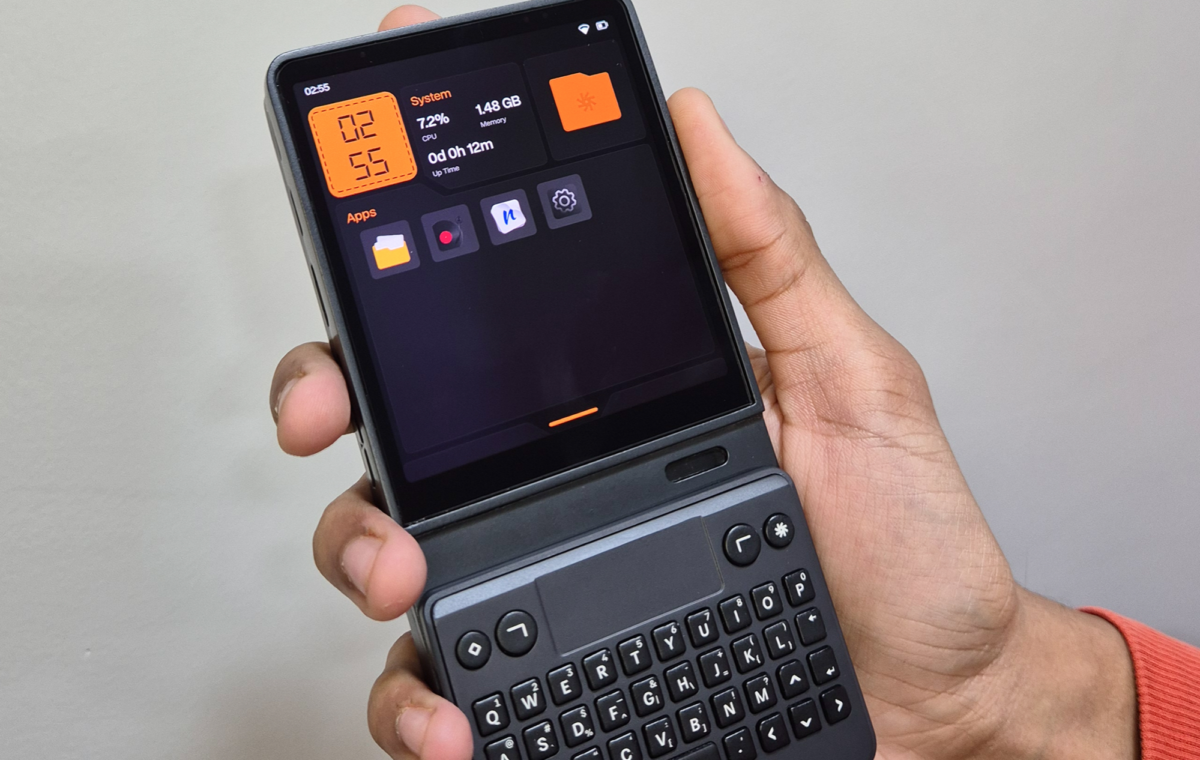
The Mecha Comet breaks the boring status quo. It’s a pocketable, modular handheld computer that ships with a custom, hardware-optimized Linux distro out of the box. Sign me up.
This is not a sponsored post. I first noticed the Mecha Comet during CES 2025 and found it so interesting that I pre-ordered one with my own money. I’m covering it simply because I think it’s a genuinely positive step for Linux hardware. If anything, this is the opposite of a sponsored post.
These are pre-release images of the device prototypes. The final version has improved modular extensions, which are discussed below along with their specs.
The Comet is a handheld Linux-phone hybrid from Mecha Systems. However, unlike a typical modern-day smartphone, only the top half of the device is a screen—a 3.9-inch 1080p AMOLED display, similar in size to the cover display on the Samsung Galaxy Z Flip. The bottom half houses a 40-pin pogo connector that allows you to snap on different extensions. At launch, Mecha is shipping three extension modules:
All three extensions are open hardware, and Mecha publishes the pin diagrams and design files so you can build your own, too.
As for the overall build, it weighs roughly 225 grams and measures 73 x 155 x 14mm. It should slide into most pockets unless you wear ultra-tight jeans. For comparison, the iPhone 17 Pro Max measures 78 x 163.4 x 8.8mm and weighs 233 grams.
I should also mention that it’s not thick because of bad design—in fact, the extra space is properly utilized. The left side houses a USB-C 3.0 host port and a USB-C 2.0 port that doubles as a display output, rated for 2K at 60Hz. You can also find a 3.5mm headphone jack. There’s also a USB-C 3.0 port on the bottom that supports PD charging and OTG.
Charging is just the tip of the USB iceberg.
The back panel is also removable. The top half conceals three kill switches for Wi-Fi, the mic, and the 8MP camera, while the bottom half hides a removable 4,100mAh LiPo battery, with the SIM tray sitting underneath it—like good ol’ phones from the 2000s. I should also mention that you don’t necessarily have to use the battery; it can power on over USB PD without one.
Overall, you’re getting the same I/O you’d expect from a computer in a smartphone-like form factor, complete with modular input devices—and it’s running Linux under the hood. For me, that’s the most innovative gadget I’ve seen in the Linux hardware space in a long time.
You can check out the full spec sheet here.
Before I get to the use cases, let me quickly highlight the silicon powering the device. The Mecha Comet comes in two variants:
Both models let you choose between 4GB or 8GB of RAM and 64GB or 128GB of eMMC storage. You can expand that later with a microSD card or an NVMe SSD.