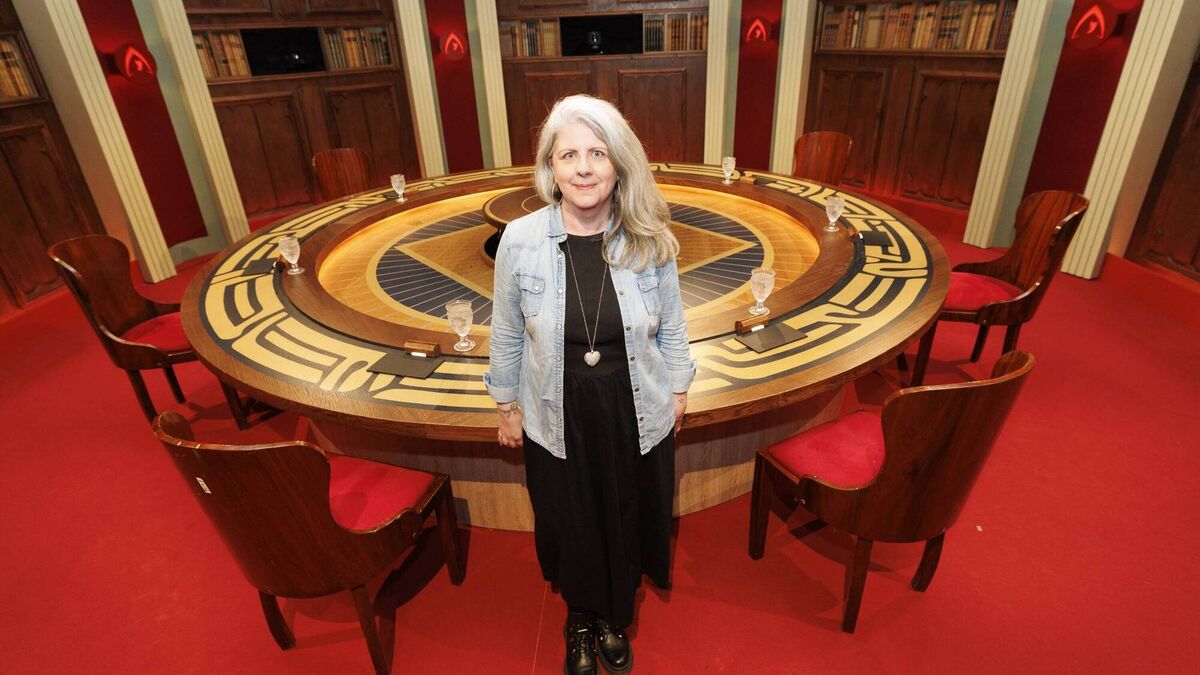
Deirdre McArdle at the round table on the set of The Traitors Ireland at Slane Castle, where some tense scenes will be played out when series two begins. Picture: Andres Poveda
An iron-clad NDA, cloak-and-dagger travel arrangements, dodging cameras, and skulking around a castle. It was all part and parcel of a media visit to the The Traitors Ireland set.
As the bus wound its way towards Co Meath, my excitement levels were rising. Like more than two million Irish people last year, I was glued to The Traitors Ireland. For almost a month we analysed, criticised, judged, shouted, laughed, and cheered. We swooned over Siobhán McSweeney’s glorious wardrobe. We fell in love with a former prison officer from Limerick.
The runaway hit, attracting an average of 557,000 viewers per episode, dominated conversations across the country last September. And I was about to step onto the set, to sit at the round table, to stand around in the conclave.
We’re visiting right in the middle of filming this year’s series, which debuts on RTÉ this weekend. There are seven contestants remaining, and we’re told they’re out on a mission. But as we exit the castle through its massive front door, they return; we catch a glimpse of the fleet of black SUVs pulling in. We’re quickly ushered back into the house. For a few seconds, it feels like we’re part of the show as we sneak our way to the back door of the castle.
The location of The Traitors Ireland, Slane Castle, has main character energy and is the perfect location for the fiendish reality competition. It’s undeniably Irish, and that’s something the production company Kite Entertainment and RTÉ leaned into last year, and will continue to embrace this year.
“We deliberately wanted to make the show as Irish as possible," said Darren Smith, MD at Kite. "Putting 24 Irish people in a castle tends to get that by default."
The choice language of the Irish contestants last year, compared to the UK and US versions, was a topic of debate.
However, Smith says: "This year’s contestants are not as sweary a bunch. Look, they are swearing — on missions, in interviews — they’re just a little bit less sweary.”
Another theme of last year’s show was the cúpla focail that snuck in. This wasn’t intentional, says Smith, but it did end up being a useful “mission device”, working as a type of code language for some of the contestants.
The Irish language features even more prominently in this year’s series, says returning host Siobhán McSweeney. “This year we've really embraced it, and we have contestants who spontaneously bring [Gaeilge] to the table every single night.”
Another distinctly Irish feature of the show is McSweeney herself. Indeed, Smith proclaims her “such a huge part of the Irish characterisation of the show”.
Last year the Cork actor enhanced her obvious Irishness with a wonderful wardrobe of Irish-designed and inspired outfits. She tells us she has ramped this up for the new series.
As we skulk around the castle, watching our steps on the hundreds of cables snaking the floors, avoiding the 44 cameras, while minding our heads on the very low ceiling that marks the entrance to the infamous conclave, I’m struck by how difficult it must be for contestants to act normally, to forget there are cameras everywhere, recording their every move and conversation.
When Smith shows us the production room, I’m taken aback. There’s a real Big Brother vibe – dozens of screens display different rooms and camera angles. There are very few “dead zones” explains Smith.