You have reached your maximum number of saved items.
The shocking collapse of US-Canada trade talks is the latest sign that President Donald Trump’s bulldozer approach to remaking the nation’s trade relationships may be reaching its limits.
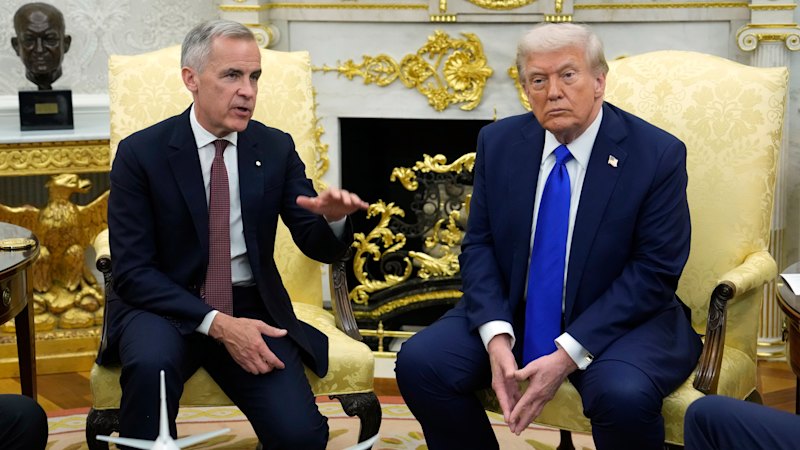
The president tried in recent days to use an untested legal power to force Canada to swallow trade concessions. Instead, Canadian Prime Minister Mark Carney quit the negotiations rather than accept a lengthening list of US demands.
As a result, 50 per cent US tariffs took effect on the weekend on an array of Canadian products, including hockey sticks and Crown Royal whisky.
As Carney prepared to walk away – a rare example of a foreign leader telling the president “enough” – Trump was retreating on another trade front. On Friday, after insisting for more than a year that tariffs do not affect consumer prices, he lifted tariffs on beef imports, saying the move would lead to lower grocery prices.
The two developments, coupled with legal challenges to Trump’s tariffs, leave the president’s signature economic policy in a state of flux.
“It’s a big setback for Trump’s trade policy. We’re at a juncture where other countries may be very closely watching how this plays out as they also are becoming increasingly frustrated with the demands the US is placing on them in these largely one-sided trade agreements,” said Wendy Cutler, a former US trade negotiator who is now senior vice president at the Asia Society Policy Institute.
Indeed, the United States has negotiated 10 “reciprocal trade agreements” over the past year with nations such as Malaysia, Cambodia and Argentina, along with other trade frameworks with the European Union, the United Kingdom and Japan.
Hearing of the concessions that the US offered Canada, including reductions in tariffs on industrial metals, some trading partners might demand revisions to their deals, Cutler said.
Administration officials have approached each bargaining round convinced of two things: decades of US trade policy hollowed out the nation’s manufacturing communities. And a muscular new approach, leveraging the appeal of the $US32 trillion ($44.7 trillion) US economy, can force other nations to give way and encourage the deindustrialisation of the US.
For the administration, trade negotiations are not a contest of equals. The talks start from the premise that US negotiating partners must make concessions, opening their markets and in some cases promising to invest in the United States, simply to win a reprieve from unilateral American trade barriers.
Both Jamieson Greer, Trump’s chief trade negotiator, and Treasury Secretary Scott Bessent have publicly complained that Canada and China are the only nations that retaliated for the tariffs that the president imposed last year.
The administration sees its actions as restoring fairness to an imbalanced global trade system, making such retaliation unjustified. But China’s tough stance last year, which included a temporary interruption of essential rare earth minerals, paid off. Trump lowered his triple-digit tax on imports from China and reached a trade truce in an October meeting with Chinese leader Xi Jinping, who is due in Washington on September 24 for more talks.
The Canada negotiations were aimed at averting the new 50 per cent tariffs, which Trump had threatened in July unless Carney dropped retaliatory measures imposed in response to earlier US tariffs.
On Tuesday, Trump delayed his initial deadline, posting on Truth Social that the two sides had reached “a DEAL” and needed three days to finalise the documents.